


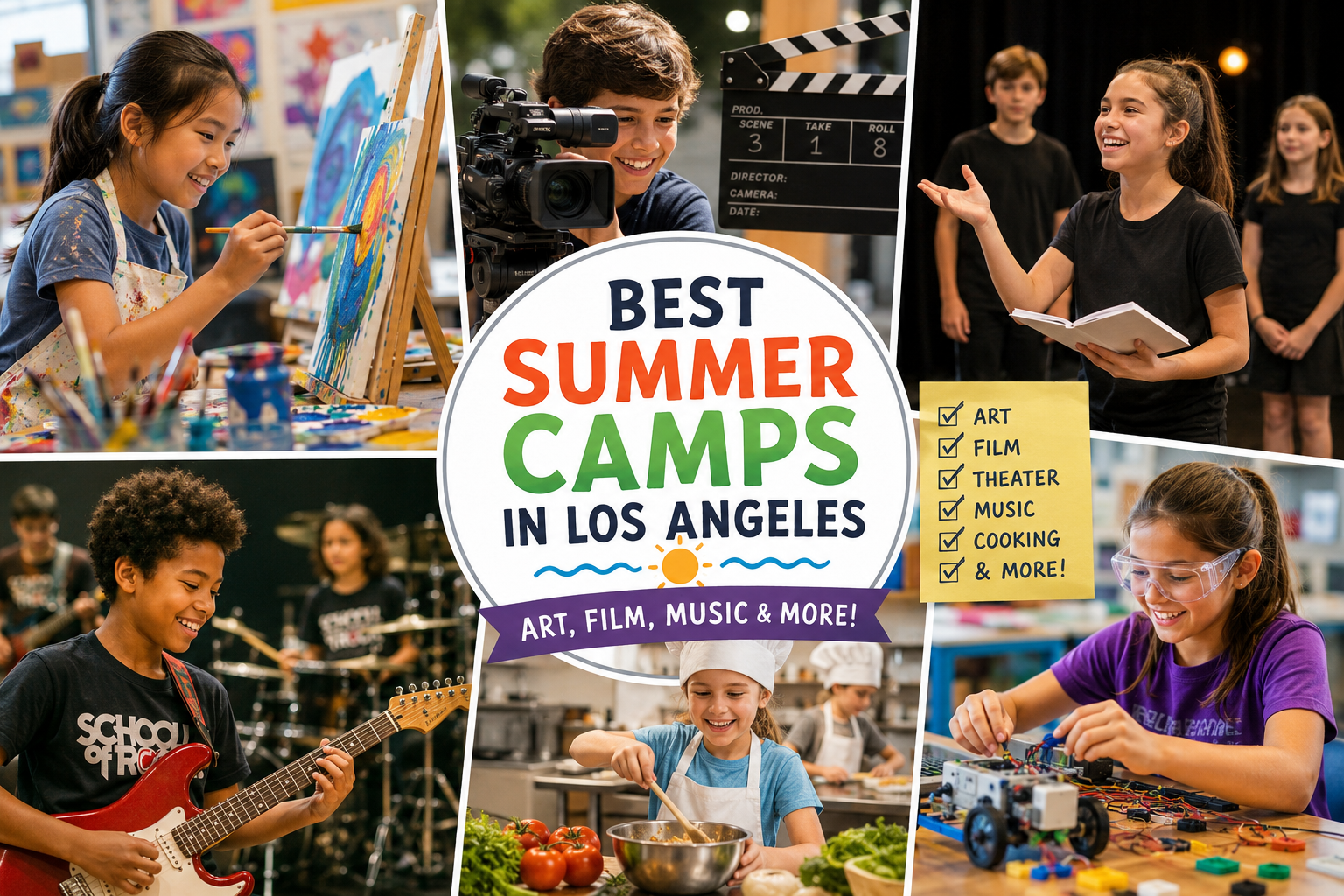
Los Angeles bursts with creative options, yet parents still juggle separate lists for art, dance, film, and more when school lets out. We built this guide to gather every standout program—visual-arts studios, kitchen labs, rock-band boot camps, and overnight adventures—in one place and show exactly what each costs.
Local Anchor’s painter-focused roundup is a solid starting point (see the full list on Local Anchor), but our lens is wider. According to camp data platform Campwing, a review of 100-plus providers found general day camps average about $543 per week, while film or other specialty sessions can top $1,200. We flag those ranges, note scholarship windows, and highlight early-bird deals so price tags never catch you off guard.
Ready to find the session that sparks your child’s creativity—without sticker shock? Read on.
How we picked the camps you’ll see below
Parents deserve more than a random roster from a search page. We began with a promise: every camp on this list must delight kids and reassure parents.
Quality came first. We chose programs led by credentialed artists, chefs, and educators; they inspire kids because they do the work every day. Camps that deliver student showcases, published portfolios, or notable alumni rose quickly on our list.
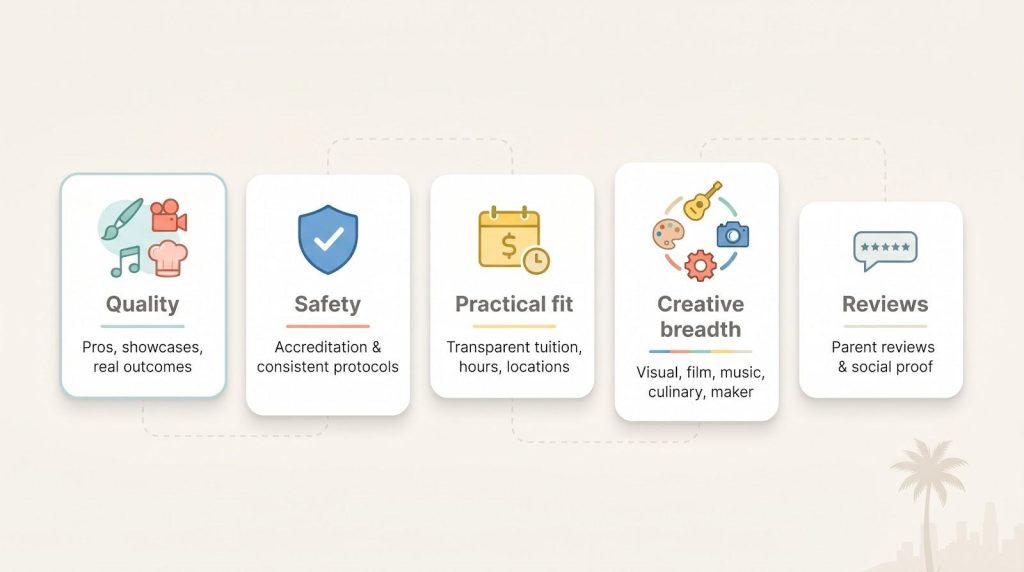
Safety and reputation followed. Accreditation from groups such as the American Camp Association signaled solid protocols, and we cross-checked parent reviews and social chatter for consistency. A glossy brochure is nice; steady five-star feedback is better.
We then weighed practicality. Tuition, multiple locations, extended-care hours, and scholarship access matter when you juggle carpooling and budgets. Camps that hide prices or bury key details did not make the cut.
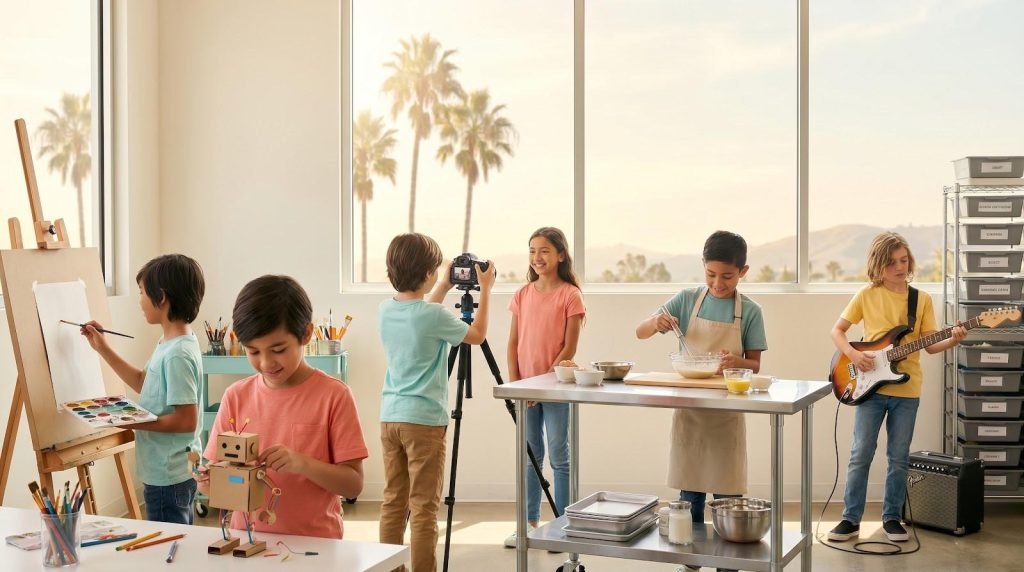
Last, we required creative breadth. Los Angeles is a mosaic of interests, so our lineup covers visual arts, filmmaking, music, culinary adventures, and maker labs. Whatever spark lights up your child’s eyes, you will find a camp below that turns it into lasting passion.
The camps that earned a spot on our short list
Los Angeles hosts hundreds of summer programs, yet only a few combine deep creative learning with parent-friendly logistics. We narrowed the field to camps that cover every major art lane, from canvas to camera to kitchen. Use the next subsections like speed dating with the city’s most inspiring programs; read them in order or jump to the discipline your child loves.
Pali Adventures: an overnight playground for multi-talented makers
Imagine your nine-year-old mastering movie-monster makeup in the morning, joining elective activities all afternoon, then cheering friends during an “Iron Chef” cook-off after dinner. That blend lives at Pali Adventures, a residential-only camp in the San Bernardino Mountains, about 90 minutes east of Los Angeles.
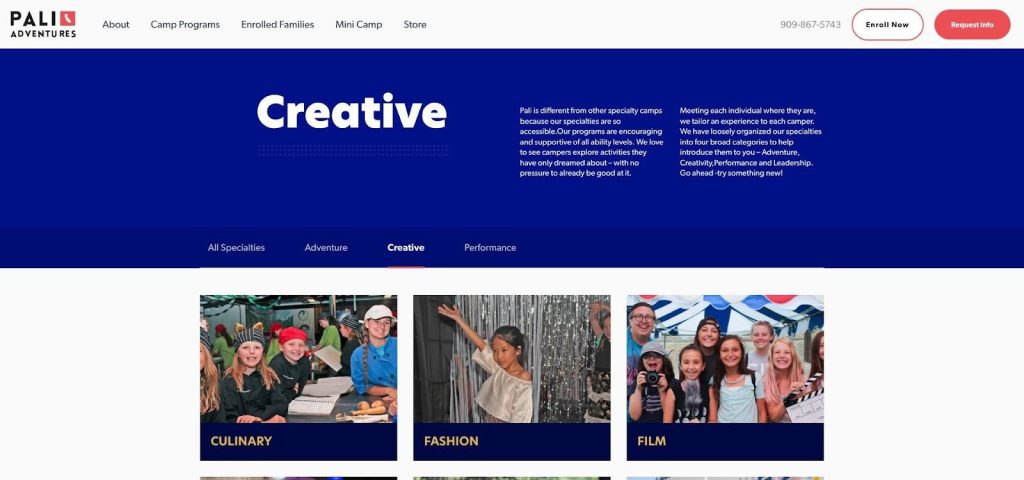
Pali Adventures overnight creative arts camp in the San Bernardino Mountains.
Campers choose one specialty—film, culinary, fashion, rock band, fine arts, and more—from 27 options across Adventure, Creative, and Performance tracks. Working professionals teach every class with professional gear, so kids create in real studios, not replicas.
Mornings focus on skill building. Afternoons open to dozens of electives. Evenings become a celebration: film students screen their shorts, fashion groups host runway walks, and culinary teams plate dishes for counselor judges who cannot hide their smiles.
The program serves ages 6–16, divided into Mini Camp (6–8), Juniors (8–12), and Seniors (13–16). Modern cabins house each group, complete with in-room bathrooms. Safety comes first: staff clear LiveScan and U.S. Department of Justice screenings and hold first-aid, CPR, and AED certifications. Accreditation from both the American Camp Association and the Western Association of Independent Camps backs every detail. Tuition is all-inclusive—meals, lodging, activities, and supplies—and multi-week discounts plus a modest scholarship fund help soften costs for qualifying families.
Enroll early: specialties such as movie makeup and film often reach wait-list status by March. Pack layers, too; mountain nights can feel chilly even in July.
Most camps on our list keep you closer to home, but none match Pali Adventures for creative variety. If your child wants to sample every art form in one stay and you are ready for the sleep-away leap, this is the camp to consider.
Inner-City Arts: downtown talent, community pricing
Housed on a bright campus in the Arts District, Inner-City Arts feels more like a mini conservatory than a kids’ camp. Studios, a black-box theater, and digital labs sit steps apart, so campers might paint in the morning and record a stop-motion short after lunch. Working artists teach every class and treat students as fellow creators.

Inner-City Arts downtown Los Angeles youth arts campus screenshot.
Programs run in two-week blocks. Elementary students join full-day Splash sessions, while middle and high schoolers enroll in focused Institutes covering animation, ceramics, photography, or theater tech. Each block ends with an open-house exhibit where families tour galleries and applaud performances.
Tuition follows a sliding scale, and documented low-income families receive full waivers, keeping access at the center. Spots disappear quickly because class sizes stay small—about twelve kids around a pottery wheel, not thirty. Mark February if this program speaks to you.
Parents rave about two things: the professional-level work kids bring home and the confidence that grows from creating on a real arts campus. For many families, Inner-City Arts is where a hobby turns into a calling.
Summer Art Academy: a two-week passport to every medium
If your child bounces from paintbrush to baking pan to dance routine before breakfast, Summer Art Academy is the place to explore it all. Locals call it Camp SOS, and the setting lives up to the nickname: a safe space where kids sample each creative lane without pressure to specialize.
Mornings rotate through studio blocks—watercolor one day, clay the next, digital illustration on Friday. After lunch the focus shifts to performing arts, with counselors guiding campers through scene work, choreography, and vocal warm-ups that lead to an end-of-session performance. To close the day, everyone gathers in the courtyard kitchen to whisk, chop, or decorate treats that usually vanish before pickup.
Sessions run two weeks in Valley Village or Agoura Hills, Monday through Friday, nine to three. Extended care frames the schedule, easing life for working parents. Tuition averages about five hundred dollars per week, and multi-session or sibling sign-ups drop that cost.
Counselor-to-camper ratios stay low because many staff members are alumni who return each summer. That tight culture helps even timid first-timers feel like insiders by day two. Parents enjoy the closing-day festival where kids mount an art gallery, perform a short play, and serve the cookies they perfected that week.
Pro tip: register with a friend. Staff will place buddies together, and a familiar face makes jumping into creative experiments even easier.
SOCAPA Los Angeles: pre-college film, photo, and acting intensives
Teen creatives who dream in storyboards need more rigor than campfire karaoke. SOCAPA supplies that professional push. For one to three weeks, students live and breathe their craft on the Occidental College campus in Eagle Rock.
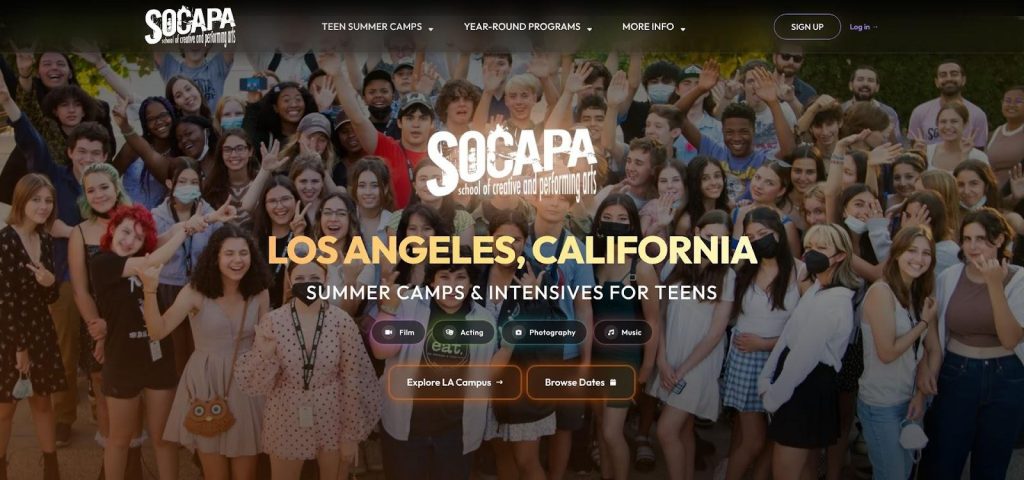
SOCAPA Los Angeles teen film and photography pre-college summer program screenshot.
Morning lectures resemble first-year film school classes: scripting, shot composition, editing labs, or on-camera scene study, depending on the track. Afternoons move to hands-on shoots and studio time. By nightfall, dorm lounges become informal writers’ rooms where new friendships and future collaborations take shape.
Students choose Filmmaking, Acting for Camera, Photography, or Contemporary Dance. Each track mixes beginners with experienced teens, yet instructors adjust projects so everyone stays challenged. Results speak loudly: a short film ready for festival entry, a curated photo portfolio, or a dance reel that bolsters college applications.
Day-only enrollment lowers costs, but many locals still pick the residential plan to enjoy college-style independence. Tuition is premium, around fifteen hundred dollars per week with gear, meals, and a dorm room included. In return, students use RED cameras, professional studios, and learn from guest speakers who work in Hollywood.
Spots open every December. If your teen wants a seat, set a reminder; first sessions often fill by February. Encourage at least the two-week option—alumni say week one teaches the rules, and week two is when artistry clicks.
Act One Theatre Camp: from cold read to curtain call in two weeks
Some kids belt show tunes in the back seat, while others keep scripts under the pillow. Act One channels that passion and turns it into a full youth production in just fourteen days.
On day one campers audition in a relaxed setting and receive their roles before lunch. Professional directors treat participants like working actors. Mornings cover vocals and choreography; afternoons focus on blocking and scene work. Laughter is steady, but precision matters. Lines must be memorized by the end of week one so technical rehearsals can start.
The schedule suits family life: nine to three in North Hollywood or Sherman Oaks, with optional extended care. Tuition lands between six and eight hundred dollars for the two-week block and includes scripts, simple costumes, and a keepsake show shirt. Register before March for an early-bird discount.
Parents love the closing performance in a real theater. Spotlights shine, microphones are live, and every camper gets a moment on stage. Shy kids leave braver; confident kids exit polished. Plan to arrive early because the lobby fills quickly with proud families.
Key tip: if your child counts down to the school play, Act One should top the summer list. Just confirm vacation dates; missing even one day means missing critical scenes.
School of Rock and Join the Band: one week, one stage, one epic encore
Nothing builds confidence like turning up an amp and hearing a crowd cheer back. At both School of Rock and Join the Band, campers form a real group on Monday and play a live concert by Friday.
Morning rehearsals break songs into riffs, drum fills, and vocal lines. Instructors—working musicians with solid teaching chops—rotate kids through parts until each band clicks. Afternoons feature workshops on songwriting, stage presence, and gear basics so students learn the why behind every chord.
Programs run as five-day sessions across multiple Los Angeles neighborhoods. Ages eight through seventeen join Beginner, Intermediate, or Performance groups, keeping egos in check and progress steady. Tuition averages four to six hundred dollars per week, and instruments are on-site, so you only bring your own guitar or bass if you have one.
Parents rave about the Friday show. Lights rise, a smoke machine puffs, and your once-shy drummer nails a Foo Fighters cover like it is second nature. Expect applause, plenty of phone videos, and a child who asks for more lessons on Monday.
Space is limited to maintain tight band sizes, so early registration helps. Toss earplugs in the camp bag; those power chords continue long after camp ends.
Chef Eric’s Culinary Classroom: where junior foodies earn their first toque
Los Angeles is full of celebrity restaurants, yet only one camp lets kids run the line themselves. Chef Eric’s Culinary Classroom turns a professional Westwood kitchen into a true culinary institute for ages eight through seventeen.
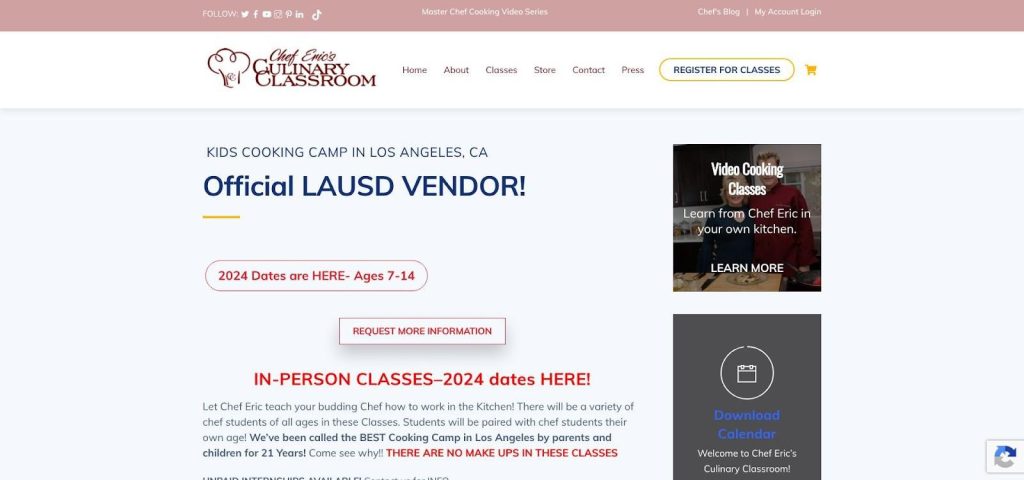
Chef Eric’s Culinary Classroom kids cooking camp Westwood screenshot.
Camp meets for five consecutive afternoons. Each day explores a new cuisine: Italian on Monday, Asian street food Tuesday, classic French pastry Wednesday, and so on. Students practice knife skills, sauté at real stovetops, and plate dishes they proudly photograph before tasting. Instruction stays hands-on; no one just watches a demo and heads home hungry.
Class size tops out at about twelve, so every student stirs, seasons, and garnishes under Chef Eric’s close eye. Safety leads the agenda; aprons, close-toed shoes, and child-safe blades help newcomers slice with confidence. By week’s end, campers leave with a recipe packet, a certificate, and the skills to cook family dinner on their own.
Tuition sits near five hundred dollars for roughly fifteen hours of instruction, and ingredients are included. Parents who know the drill pack reusable containers, because leftovers are both plentiful and delicious.
Seats open in January and sell quickly, especially the teen-only gourmet sessions. If your budding chef binges cooking shows, reserve early and clear space in the fridge for their upcoming experiments.
Otis College Youth Camps: design-school depth without the tuition shock
Step into Otis College’s bright studios near LAX and you sense professional creativity everywhere. Easels line one hallway, industrial sewing machines hum in another, and animation software glows in computer labs. For one summer week, your child can try it all.
Otis separates campers by age and ambition. Younger groups dive into mixed-media projects that encourage fearless experimentation: oversized charcoal, printmaking, even toy prototypes built from recycled plastics. Pre-teens select focused tracks such as Architectural Model Building or Digital Illustration, while high-school students tackle credit-earning intensives in Fashion Design or 3-D Animation, complete with critiques that match first-year art school standards.
Faculty and alumni simplify complex techniques without watering them down, and classes stay under fifteen students so everyone receives hands-on coaching. Kids return home with work ready for the fridge gallery or a future portfolio.
Tuition falls in the mid to upper range: about four hundred dollars for a half-day youth camp and twelve hundred for the three-week teen studios. Fees cover all materials, from canvases, to sewing supplies, to Adobe licenses. Scholarships are available, but applications must arrive by early April. Commuting families value the 8:30 to 3:30 schedule, which still leaves time to beat west-side traffic before dinner.
Seats open in February. Popular majors such as Toy Design fill within days, proving that Los Angeles kids take play very seriously.
Galileo Innovation Camps: art meets engineering for the curious maker
Some kids paint, some kids tinker, and Galileo simply asks, “why not both?” The program blends art, science, and playful engineering into weekly themes that keep hands busy and ideas flowing.
Each morning begins with a design challenge. Campers might prototype a toy with moving parts or draft a superhero headquarters. They test, tweak, then add artistic flair: neon paint, comic-book panels, or handmade fabric capes. Afternoons switch to classic camp games and outdoor experiments so everyone burns energy while fueling curiosity.
Programs serve pre-K through eighth grade at sites from Santa Monica to Pasadena. Parents appreciate the 9:00 to 3:00 schedule with optional care until 6:00—ideal for full-time workdays. Tuition sits around three to four hundred dollars per week, and Galileo’s scholarship fund is generous; thousands of Los Angeles families received aid last summer.
Counselors greet kids with choreographed high-fives and theme songs that stay fun all week. Mistakes become “marvelous flops,” celebrated as fuel for the next prototype. By Friday, campers parade their projects at an open-air exhibition that feels part science fair, part art festival, and all pride.
Registration opens in January. Move quickly if your child wants Chefology week or first choice in the Maker Studio major within the older Summer Quest program.
Steve & Kate’s Camp: freedom, creativity, and a side of fresh-baked bread
If your child resists rigid schedules, Steve & Kate’s delivers the perfect alternative. The philosophy is simple: trust kids. Campers enter a buffet of studios where sewing machines hum on one side, stop-motion stations blink on the other, and a bread kitchen perfumes the room with sourdough. They choose how to spend each moment.
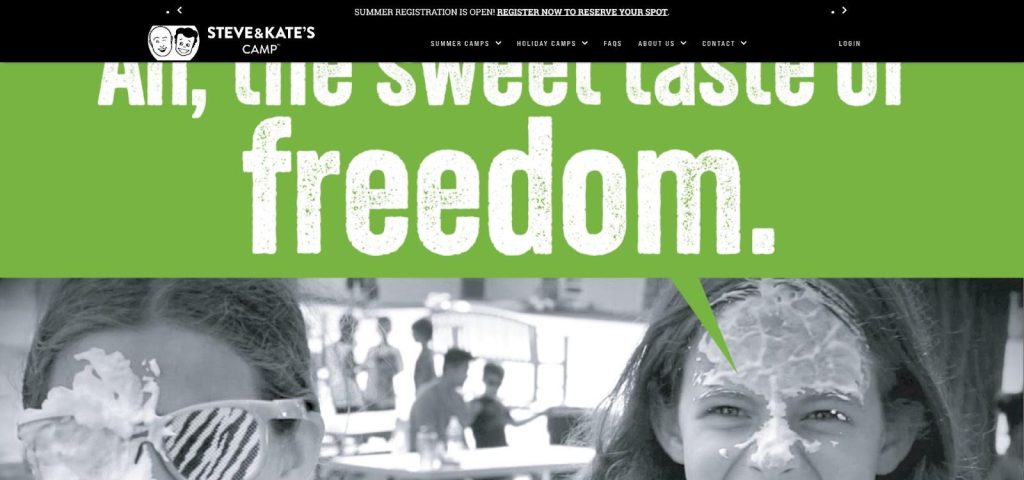
Steve & Kate’s Camp flexible creative studios and bread kitchen screenshot.
There is no rotating bell and no counselor herding anyone along. Instead, staff called Guardians hover just enough to keep things safe while letting curiosity lead. One camper may stitch a hoodie all morning, another may code a video game, and a third may split time between animation and soccer.
Flexibility extends to parents. You purchase day passes, drop off anytime after 8:00, and pick up anytime before 6:00. Unused passes refund automatically in August.
Value comes from long hours, all-inclusive meals, and quality supplies. Tuition averages about one hundred twenty dollars per day, but bulk packs lower the cost, and lunches range from pesto pasta, to roasted chicken, to veggie sushi.
Ages four to twelve share the same creative playground, which builds empathy and leadership among campers. Guardians gently guide indecisive kids toward new stations so no one stays in a comfort zone for long.
Early-bird discounts post in winter and disappear fast. Grab them, tuck a spare T-shirt into the camp bag for messy projects, and be ready to hear, “Can I stay five more minutes?” at pick-up.
More niche gems worth a peek
Rock n’ Roll Camp for Girls builds confidence by pairing young musicians with volunteer mentors who help them form a band, write original songs, and perform on a club stage in just one week.
The Miracle Project blends theater, music, and movement in an inclusive setting for autistic and neurodivergent youth. Mixed-ability casts work side by side, proving creativity welcomes everyone.
reDiscover Center’s Tinkering Camp hands kids power drills and recycled wood, then challenges them to build anything they imagine, from cardboard cities to pedal-powered zoetropes.
Debbie Allen Dance Academy intensives welcome beginners through advanced dancers to train in styles ranging from ballet to West African, often led by instructors who tour with Beyoncé or choreograph for television.
Fashion fans can stitch runway-ready looks at FIDM’s three-day program or at neighborhood studios such as Sew FYI, where campers finish with a self-designed outfit and an introduction to sustainable style.
Tech-minded artists gravitate to Digital Media Academy at UCLA for 3-D animation or to iD Tech’s AI-for-Teens boot camp. Both pair coding with creative storytelling and prepare students for tomorrow’s digital careers.
Conclusion
Spots are limited, so join mailing lists early and move quickly when registration opens. Your child’s niche passion deserves its moment to shine.