


Commuters throughout California navigate some of the country’s heaviest commercial freight corridors every day, from the constant crawl along Interstate 5 to the congested interchanges of Los Angeles and the Central Valley. Cutting close to an 18-wheeler to catch an exit or pass slow traffic easily leads to a sideswipe. Proving what happened afterward gets messy fast, which is why finding the right truck accident lawyer is critical for your claim. Respecting how much space these rigs actually need is the simplest way to stay safe.
Mapping the Four Massive “No-Zones”
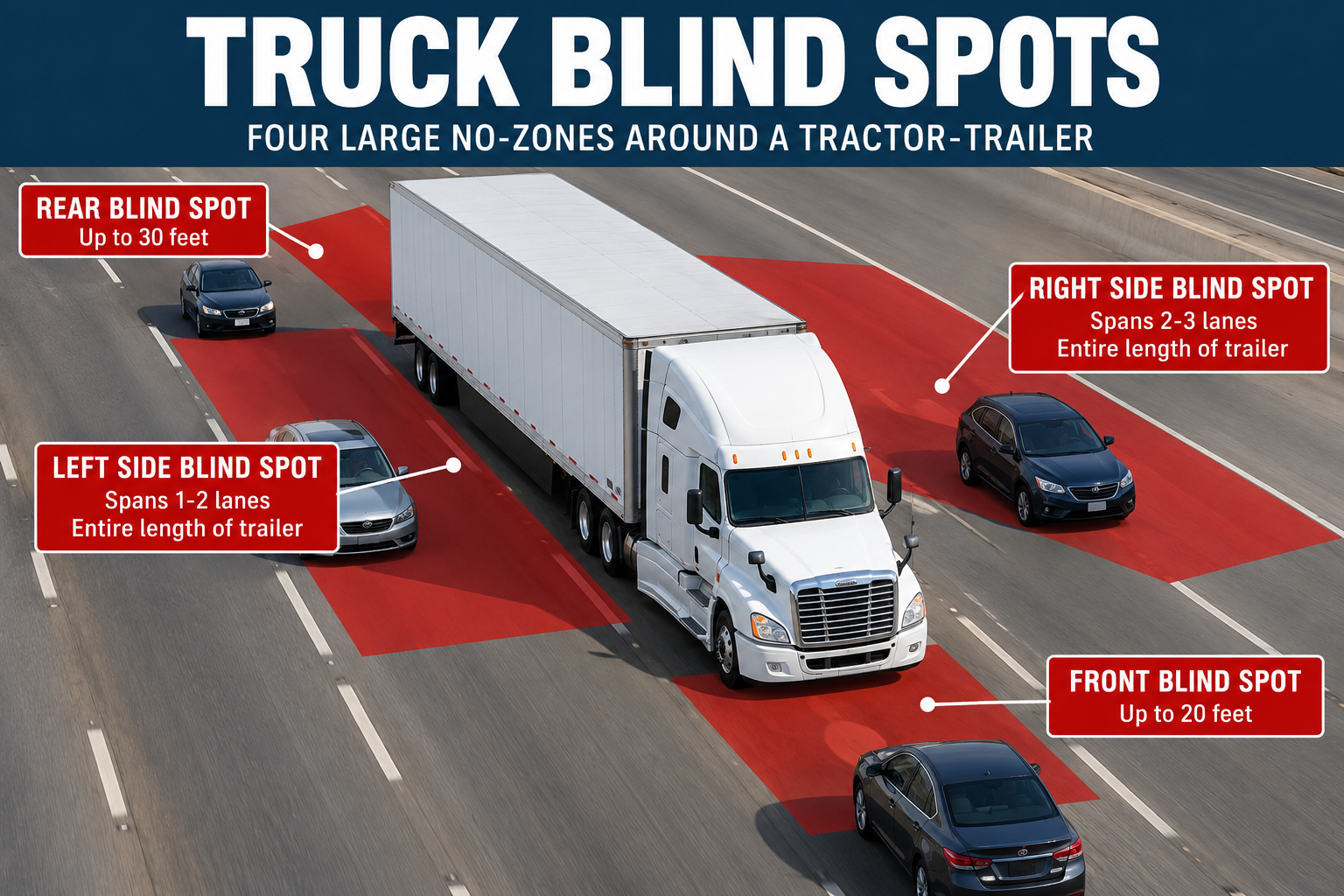
Commercial tractor-trailers do not possess the perimeter visibility that regular commuter vehicles enjoy, creating extensive blind areas colloquially termed “No-Zones.” A trucker sits high off the asphalt, yet the physical structure of the cab, mirrors, and 53-foot trailer creates significant visual blackouts on all four sides of the rig. The right side represents the most hazardous area, spanning across two or three lanes of traffic and reaching the entire length of the trailer, while the rear blind zone can extend up to thirty feet directly behind the bumper. As outlined in federal guidelines on commercial vehicle blind spots, if you cannot see the driver’s face reflected in their side-view mirror, the driver simply cannot see your vehicle at all.
Why Quick Lane Weaving Creates an Optical Illusion
Drivers of smaller passenger cars frequently misjudge how high-speed maneuvers look from the vantage point of a commercial truck cab. If a small vehicle suddenly cuts in between the lanes of a large truck, it will often vanish from view altogether as it passes beneath the truck’s hood line or slips behind one of the door mirrors of the truck’s passenger side. Commercial drivers must perform mirror sweeps of driver vehicles every few seconds. These sweeps allow smaller vehicles such as sedans to slip into the spot of the truck between sweeps. Passenger cars. Decelerate much faster than freight haulers that weigh many tons. What seems like a pass to a commuter can become a sudden unseen danger for the trucker.
Physics, Momentum, and Stopping Distance Disparities
The reality of trucks makes it really hard to make a mistake when a small car moves into the path of a big truck. A truck that is full can weigh much more, such as 80,000 pounds. It takes about the length of two football fields to stop from high speeds when the truck is moving normally. When a compact car darts ahead of a truck and suddenly hits the brakes for slowing traffic, the commercial driver has neither the visual warning nor the physical braking capacity to prevent an impact. According to traffic safety research on heavy vehicle crashes, unexpected lane incursions and sudden deceleration remain prominent contributors to devastating underride and override collisions on busy interstates.
Unraveling Liability After a Blind-Spot Crash
Determining fault in a collision involving a semi‑truck and a smaller passenger vehicle requires an investigation. The investigation is especially important when blind spots are said to be the root cause. Trucking defense insurers often argue that the passenger vehicle acted negligently by lingering in a zone or by making an unsafe pass on the right. Overcoming these aggressive defense tactics requires prompt access to critical evidence, including electronic control module telemetry, cab camera footage, and driver rest logs. In complex disputes where fault is contested under state comparative fault rules, finding the right truck accident lawyer ensures that physical skid marks, dashcam recordings, and driver logs are preserved before crucial evidence is lost or destroyed.
Conclusion: Staying Safe and Protected on the Open Road
It takes patience, awareness of the surroundings, and knowledge of the blind spots surrounding these large vehicles to drive alongside massive tractor-trailers on congested freeways. In order to maintain visibility for other drivers on the road, drivers of passenger cars must practice defensive driving techniques. Nonetheless, drivers of commercial vehicles are required by law to keep an eye on traffic and drive carefully. Knowing your rights and obtaining objective evidence can safeguard both your long-term financial stability and physical recovery in the event of an unplanned highway collision caused by poor visibility or negligent driving.