


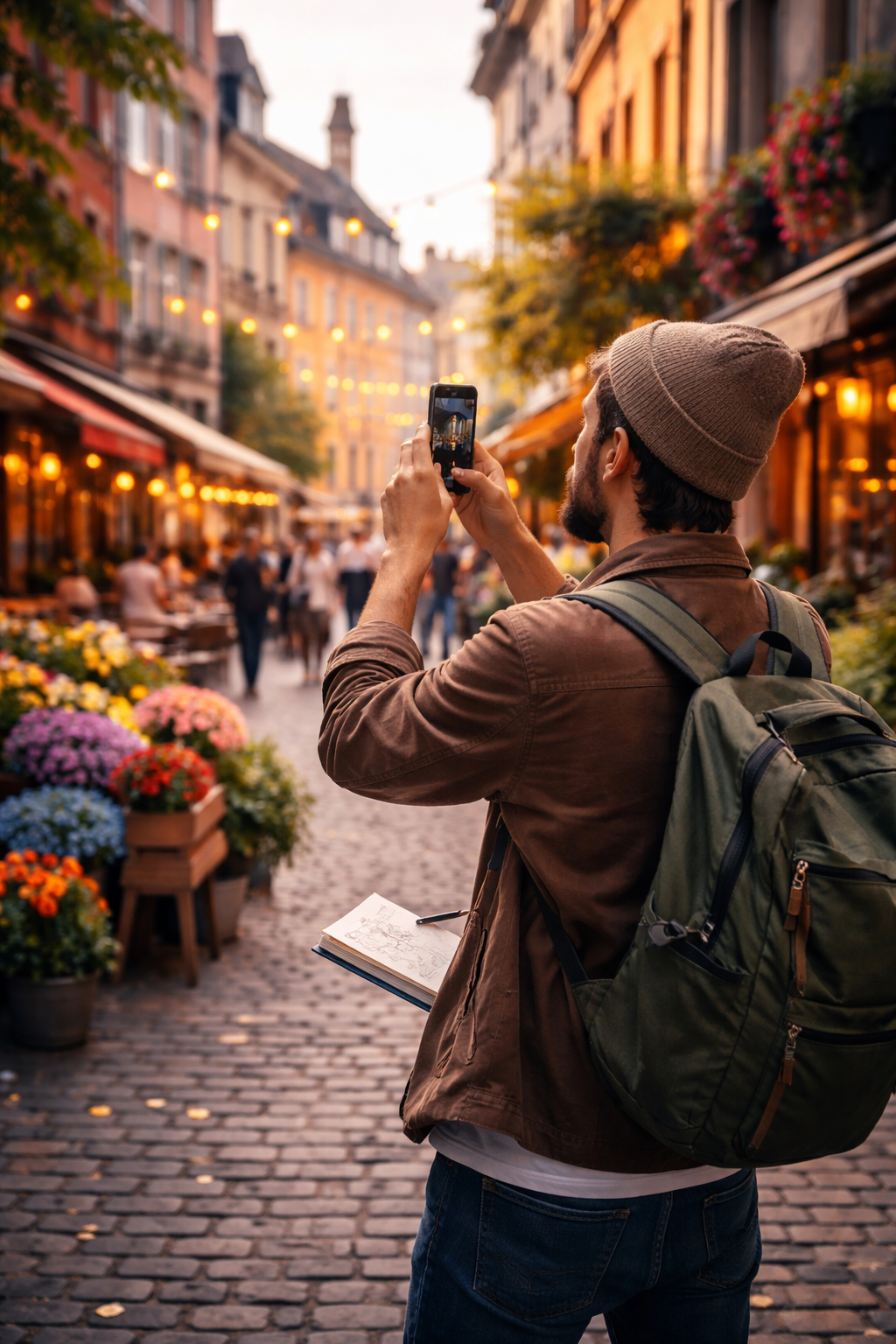
There’s a reason artists have always been drawn to travel.
Writers, painters, filmmakers, musicians—across disciplines and generations—have left familiar environments in search of something they couldn’t quite define. Not just new landscapes, but new ways of seeing.
Travel, in this sense, isn’t just movement. It’s disruption. And for anyone engaged in creative work, disruption is often where everything begins.
Why Travel as a Creative Practice Fuels Creativity
Historically, travel has been a catalyst for artistic evolution.
From the Grand Tours of Europe to modern-day residencies, creators have long understood that stepping outside of routine opens the door to new ideas. When you remove yourself from what is familiar, you begin to notice things differently.
Colors feel sharper. Sounds become more distinct. Small details—often ignored in everyday life—start to carry meaning.
It’s not just about what you see, but how you experience it.
And that shift in perception is where creativity lives.
The Power of Travel as a Creative Practice in Unfamiliar Environments
There’s something uniquely powerful about being in a place where you don’t fully understand everything.
You can’t rely on autopilot.
Simple actions—ordering food, navigating streets, reading signs—require attention. And in that heightened awareness, your mind becomes more receptive.
You observe more closely.
You listen more carefully.
You feel more deeply.
This is the opposite of routine, where familiarity often dulls perception.
In unfamiliar environments, even ordinary moments can feel cinematic. A street corner, a conversation, a passing glance—these become fragments of inspiration waiting to be captured.
Breaking Routine to Find New Ideas
Creativity doesn’t always come from effort. Sometimes, it comes from interruption.
When you travel, your usual patterns are broken. Your schedule changes. Your surroundings shift. Your expectations reset.
This creates space.
Space to think differently.
Space to notice connections.
Space to let ideas emerge naturally.
For many creators, this is where the most meaningful work begins—not in structured sessions, but in unplanned moments.
A phrase heard in passing.
A texture on a wall.
A fleeting interaction.
Travel fills your mind with raw material.
Capturing Inspiration in Real Time
In the past, capturing inspiration meant carrying notebooks, sketchpads, or cameras. Today, much of that process lives in a single device.
Your phone becomes your archive.
You take photos of details that catch your eye. You record voice notes when an idea appears unexpectedly. You write fragments of text that may later become something more.
Creativity rarely arrives fully formed. It comes in pieces.
And the ability to capture those pieces—instantly, wherever you are—has transformed how creative work evolves.
Creativity in a Connected World
There’s a common narrative that creativity requires complete disconnection. That to truly create, you need to step away from everything.
But the reality is more nuanced.
Connection, when used intentionally, can enhance creativity rather than limit it.
You can:
- Research ideas as they emerge
- Share work in progress
- Collaborate across distances
- Access references and inspiration instantly
The key is balance.
Not constant consumption, but purposeful use.
In a world where creativity often happens on the move, tools like Holafly’s esim help artists and travelers stay connected, capture ideas, and share their work from anywhere.
It’s not about being online all the time—it’s about having the option when you need it.
The Relationship Between Movement and Expression
There’s a direct link between how we move through the world and how we express ourselves.
When you change your environment, you change your inputs. And when your inputs change, your output follows.
New places challenge assumptions. They introduce unfamiliar perspectives. They invite you to question what you thought you understood.
This process is essential for growth—not just as an artist, but as a person.
Travel doesn’t just give you new material. It reshapes how you interpret it.
Bringing Ideas Back Home
One of the most interesting aspects of travel as a creative practice is what happens after you return.
You carry something back with you.
Not just photos or memories, but a shift in perception. A different way of seeing the familiar.
The places you left behind haven’t changed—but you have.
And that change often becomes the foundation for new work.
Ideas that began as fragments during travel start to take shape. Connections become clearer. Themes begin to emerge.
What felt abstract on the road becomes intentional at home.
The Quiet Influence of Experience
Not all inspiration is immediate.
Sometimes, the most meaningful creative impact of travel reveals itself slowly. Weeks or even months later, something resurfaces—a moment, a feeling, an image.
And suddenly, it makes sense.
Travel has a way of embedding itself into your creative process in ways you don’t always notice right away.
It becomes part of your perspective.
Final Thoughts
Travel, at its core, is an act of openness.
An openness to new environments, new ideas, and new ways of seeing.
For creatives, this openness is invaluable.
It disrupts routine, sharpens perception, and fills your mind with possibilities. It reminds you that creativity isn’t something you force—it’s something you allow.
And sometimes, all it takes is stepping into a new place to see everything differently.
Because in the end, creativity isn’t just about what you create.
It’s about how you experience the world around you.