


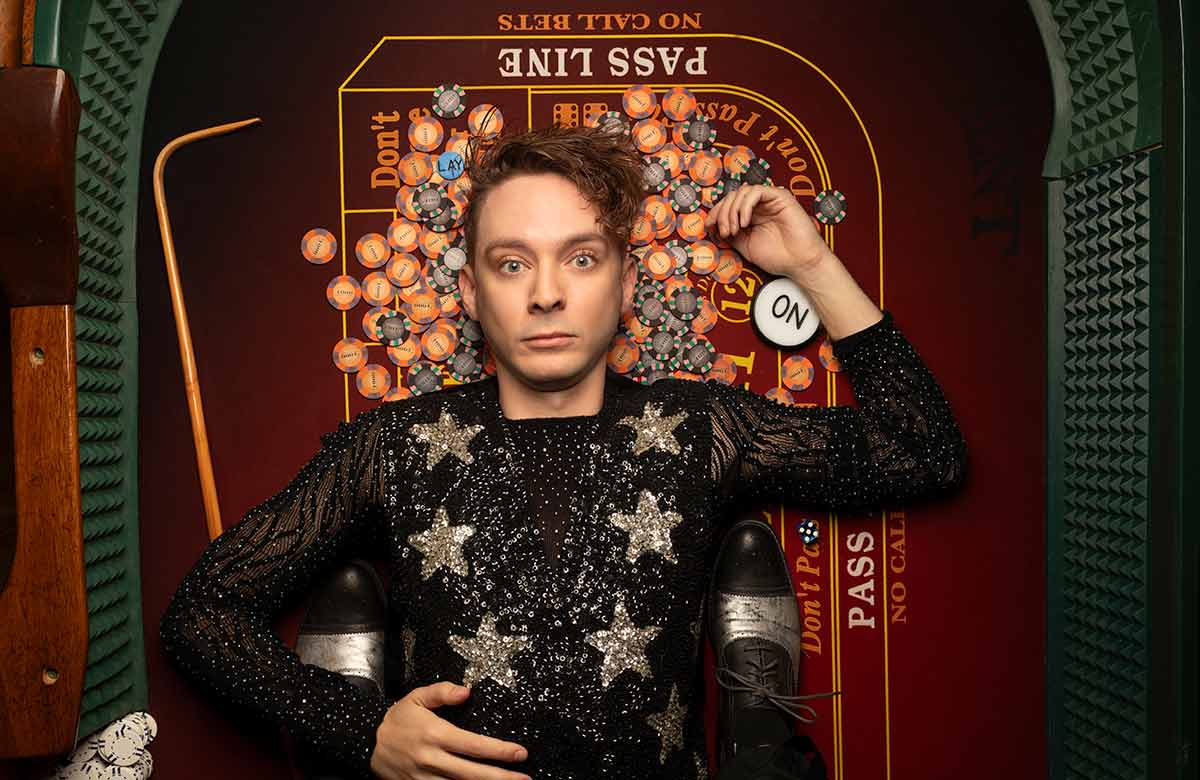
The lights go down, and the audience finds itself inside an internet livestream styled as an aggressive infomercial. The man on stage pitches his voice to a fever pitch of advertising hysteria, demanding calls, messages, and nothing but five-star reviews. The energy of the opening minutes pins you to your seat, conjuring the illusion of a “selling” broadcast in which the product is nothing less than the secrets of good fortune. The illusion, however, begins to crack almost immediately.
Behind the festive façade, stray noises creep in, then voices, and it gradually becomes clear that the host’s bright world is far more complicated and unsettling than his radiant smile would suggest.
Tom, the Luck Salesman, and the First Cracks in the Picture
The show’s protagonist is Tom, a gambler and charismatic showman who promises, for a “low, very low price,” to reveal the formula for fortune. The character is built on instantly recognisable infomercial tropes, yet the script methodically plants small charges of doubt beneath all that glitter. Every “noise off” hints that behind the upbeat selling monologue lies a story that cannot be squeezed into any advertising slot.
49% Against 51%, and Why Two Percentage Points Change Everything
The mathematics of blackjack becomes the production’s thematic backbone. When a player acts skilfully, they win 49% of hands. The casino takes 51%. The difference seems microscopic, yet it is precisely what guarantees that over the long run money always flows in one direction. The show transforms this arithmetic into a metaphor for relationships, power, and vulnerability, returning again and again to the idea of the “edge” and the “house edge.”
The gap between 49 and 51 turns out to apply far beyond the card table, and the garrulous luck salesman, without meaning to, broadcasts a truth more valuable than anything in his catalogue.
This metaphor captivates for good reason. The theme of online casinos has long spread beyond Scotland and Europe as a whole: online gambling has become part of everyday life in countries across the world, and everywhere it rests on that same modest house edge, merely packaged in attractive offers. Players study no deposit casino bonuses in Australia with the same enthusiasm as free spins on Latin American platforms, and increasingly scrutinise the wagering requirement, because it is precisely within its terms that those two percentage points hide. Anyone who has ever tried gambling will find Tom’s story painfully familiar. Yet an audience member who has never sat at a gaming table will feel it no less keenly, because the conversation is ultimately about trust and the price of illusion. Not every performer has the skill to make that tone convincing.
Tom Stilwell and Television Charm on the Edge of a Nervous Breakdown
Actor Tom Stilwell displays a rare ability to stay “on air” in a bright advertising register even as everything inside him tightens. Wide-open eyes, expressive features, an instant shift of register — all of it reveals a performer with the instincts of a TV host accustomed to smiling at the camera under any circumstances. Comic precision holds the audience’s attention throughout the show, but Stilwell’s greatest asset is his ability to switch from farce to raw honesty in a fraction of a second.
When the Volume Drops and the Mask Gives Way to Vulnerability
Gradually, both the advertising beat of the background music and the emotional intensity ease off. The selling persona retreats, revealing a living person beneath. Tom recounts how the adults’ passion for gambling simultaneously gave him warm, almost magical childhood memories and laid the foundation for a long, lingering pain. The genre drifts almost imperceptibly from parody into confessional monologue.
Handmade Puppets Populating an Empty Stage
Stilwell sits alone at a card table, yet gradually “populates” the space with characters, fashioning improvised figures from everyday objects. The details of this device are best left unrevealed: it is one of the show’s most inventive elements. Suffice it to say that a minimum of materials and a pair of stuck-on googly eyes produce an entire gallery of characters arranged on the table like a bohemian guard of honour.
What Works Flawlessly
The production rests on several pillars:
- The explosive energy of the opening scene, which draws the audience in instantly.
- A precise, almost surgical shift in tone from comedy to drama.
- The through-line metaphor of the “two-percent edge,” which holds the narrative together.
- Moments when a funny line suddenly turns into a painfully recognisable admission.
An Ending That Stops Mid-Sentence
The one notable reservation concerns the resolution. It lands with dramatic weight, but feels more like a pause in the narrative than its conclusion. The show is based on real events and the next chapter is still being written; yet theatre traditionally demands from a story a sense of closure, and here that sense is missing.
The Feeling of Winning Without a Recipe for Riches
The audience will leave without a ready-made formula for wealth, but will carry away a precise, emotionally calibrated conversation about risk, dependency, and the danger of allowing anyone to hold even the smallest “percentage edge” over them. The show fits naturally into the niche of contemporary theatre at the intersection of stand-up, performance art, and personal narrative. It will resonate with those drawn to themes of gambling, manipulation, and the psychological price paid for the illusion of luck.