


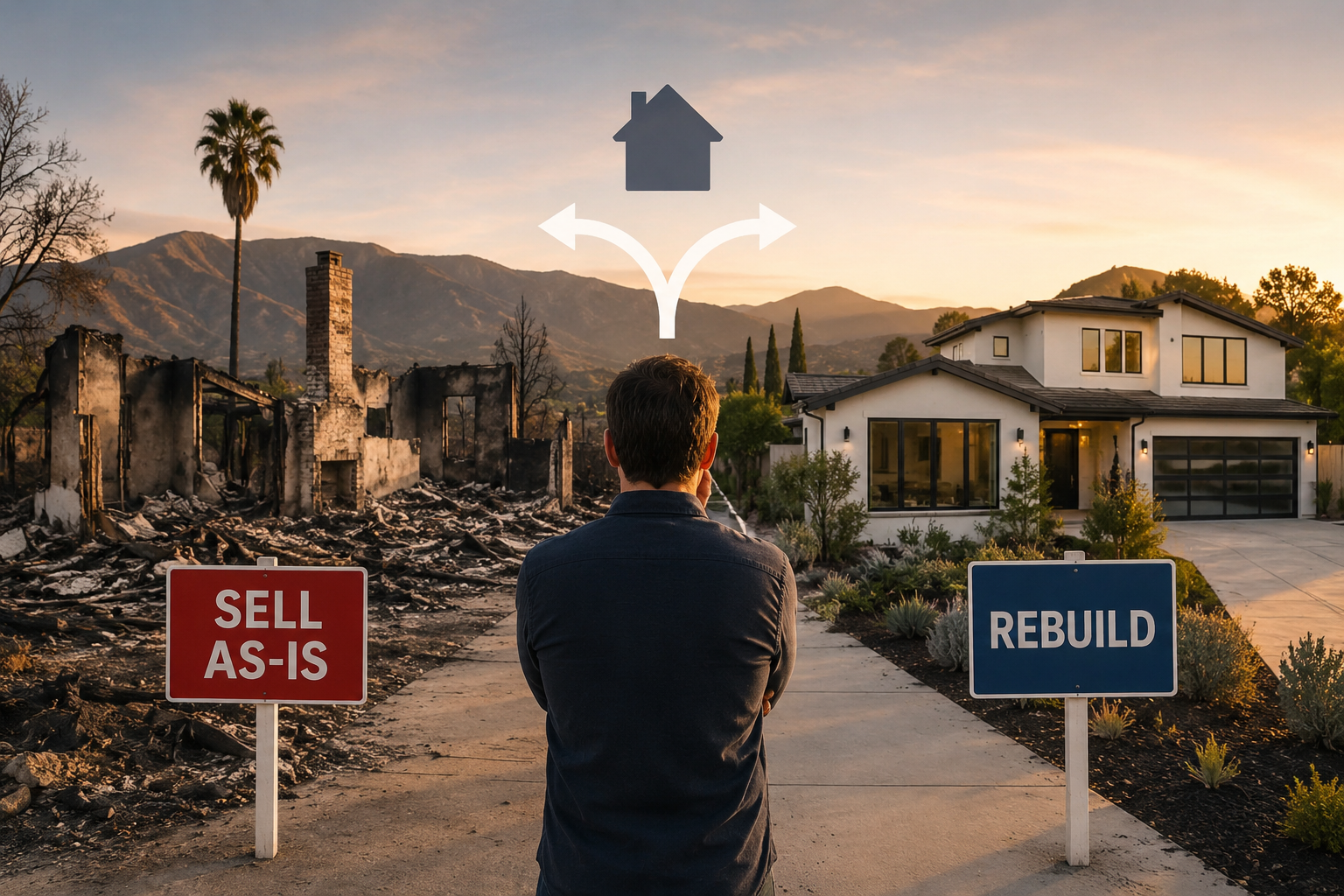
The decision comes down to three numbers: what your insurance will actually pay out, what a rebuild costs at current Los Angeles construction prices, and how many months or years you can afford to carry the property while you wait. Rebuilding makes sense when your settlement plus available cash covers the build with margin left over. Selling as-is makes sense when there is a gap you cannot close, or when the timeline itself is the thing you cannot survive.
The gap is more common than most people expect. Surveys of fire survivors in Los Angeles County have repeatedly found that adjuster estimates and contractor bids come in well above policy dwelling limits, sometimes by 40 percent or more, and that a large share of total-loss claims take many months to be fully approved. That means the choice in front of you is rarely “rebuild the same house for the money the insurer sends.” It is usually “rebuild a smaller or simpler house, bring cash to the table, fight the carrier, or sell.”
What It Actually Costs to Rebuild a House in Los Angeles
Current LA rebuild pricing sits in a wide band, roughly $400 to $750 per square foot for a custom single-family home once you include architecture, engineering, permits, and construction. Homeowners using pre-approved plan sets tend to land at the lower end, somewhere around $400 to $600, because those designs skip most custom architectural work and move through plan check faster. On a 2,000 square foot house, that is a construction budget of roughly $900,000 to $1.2 million before you have bought a single appliance.
The costs people forget are the soft ones. Soil testing on a post-fire lot typically runs a few thousand dollars, engineering and plan check fees another several thousand, and most hillside properties need drainage plans and sometimes grading plans on top of that. Add California’s residential fire sprinkler requirement and the Chapter 7A wildfire hardening standards that apply in Very High Fire Hazard Severity Zones (Class A roofing, ember-resistant vents, non-combustible siding, tempered dual-pane glazing) and you are looking at another five to fifteen percent on the build. Those upgrades are not optional in most burn areas, and they matter for whether you can get insured afterward.
Partial damage changes the math but not always in your favor. A kitchen fire that scorched one wing of the house sounds cheaper to fix than a total loss, and often it is. But smoke and water intrusion travel through the whole structure, and once a contractor opens the walls you can end up in gut-renovation territory with a settlement written for something smaller. Repair projects also trigger code upgrade requirements once work crosses a certain percentage of the structure’s value, which is where owners get surprised.
How Long the Permit and Construction Timeline Really Runs
Plan for two to three years from fire to move-in, and treat anything faster as a bonus. Design and engineering typically eat three to six months. Plan check and permitting in Los Angeles has been running around 45 to 60 days on average for streamlined rebuild pathways, though a meaningful share of applications sit longer. Construction itself is usually twelve to twenty months depending on complexity, and hillside lots with retaining walls run longest.
The bottleneck most people underestimate is contractor availability. With simultaneous rebuilding across Altadena, Pacific Palisades, and Malibu, licensed crews are competing for the same subcontractors, and homeowners who locked in a general contractor early are months ahead of those still collecting bids. County permitting dashboards have shown thousands of permits issued but only a small fraction of homes actually completed, which tells you how much of the delay lives in construction and financing rather than paperwork.
While all of that runs, you are paying. Property taxes, vacant property insurance at premiums that can be several times a standard policy, securing and maintaining the lot, and housing yourself. Additional living expense coverage helps, but it has limits and an expiration date, and in California that clock is one of the most stressful parts of the whole process.
When Selling a Fire-Damaged House As-Is Makes More Sense
Selling is the right call more often than the rebuild-at-all-costs narrative suggests. If your settlement leaves you $200,000 short, if you are over 65 and do not want to spend three years in a rental, if the property was a rental or inherited and you have no emotional tie to the lot, or if a contested claim is heading toward litigation, holding the property is a bet with real carrying costs and no guaranteed payoff.
The as-is market has two lanes. Listing a burned lot on the open market works when your neighborhood has real buyer demand, though burn-zone values have taken a serious hit, with reported declines of 30 to 60 percent in the worst-affected areas and hundreds of vacant lots competing for the same buyers. The other lane is selling directly to a buyer who specializes in fire-damaged property, which trades some price for speed and certainty. Companies such as We Buy Fire Damaged Houses purchase in that condition without asking the owner to clean up, repair, or wait through a financing contingency, which is the point for people whose main problem is time rather than price.
Get an honest number on both paths before deciding. A land broker who knows your specific block can tell you what lots are actually closing at, not what they are listed at, and a contractor walkthrough will tell you what a rebuild really costs on your lot rather than the neighborhood average.
How the Decision Differs by Neighborhood and Property Type
Location changes everything. In Altadena, lots have been trading in the mid-hundreds of thousands while rebuild costs run close to a million, which means many owners face a rebuild that exceeds what the finished house may be worth for years. In Pacific Palisades, land values are high enough that rebuilding usually still pencils out, though the Coastal Zone rules and hillside engineering add both cost and months. Malibu sits somewhere in between with its own permitting layer.
Property type matters just as much. Owner-occupants with strong equity and full replacement cost coverage are the clearest rebuild candidates. Landlords rarely are, since the return on a $900,000 rebuild for a rental that grossed $4,000 a month is difficult to justify. Heirs selling a family home from out of state face a different problem entirely, because managing a multi-year construction project remotely almost never works. And owners whose lots sold to investors in the first wave largely did so because they ran the numbers early and did not like what they saw.
Before you commit either direction, get your policy limits, your adjuster’s estimate, and at least two contractor bids on the same page in front of you, and then add a contingency of fifteen to twenty percent to whatever the build number says. If the total still works with room to breathe, rebuild. If it only works when everything goes right, that is not a plan, that is a hope.
The one thing worth watching closely is your permit deadline. Streamlined rebuild pathways and fee waivers in the City of LA come with an end date, and the flexibility available to you now on footprint, ADUs, and plan review will not be there indefinitely. Whether you rebuild or sell, decide before those advantages expire, because a lot with an active permit and a clean soil report is worth measurably more to the next owner than a lot with nothing but ash and a file number.