


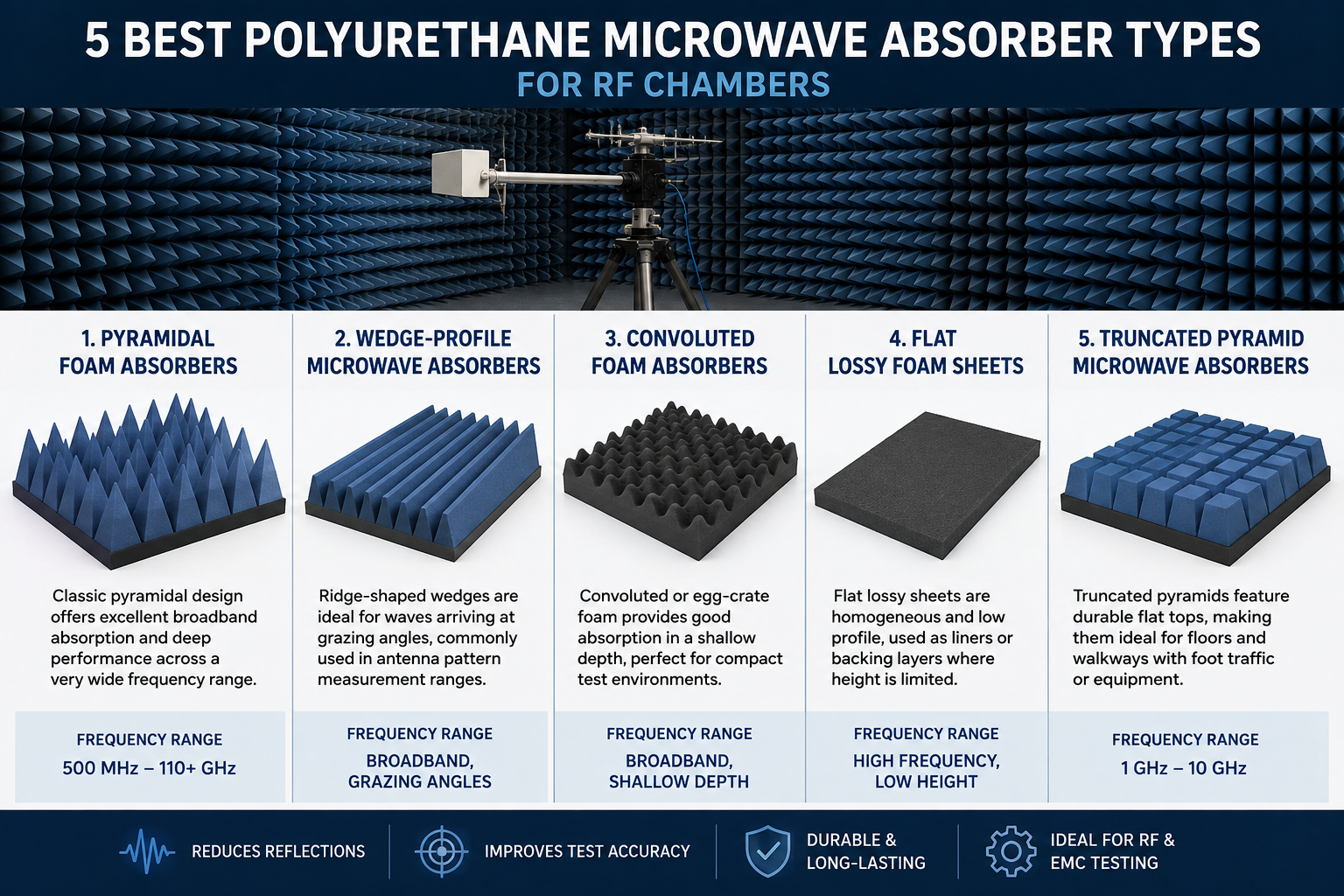
Pyramidal, wedge, convoluted, flat, and truncated pyramid microwave absorbers make up the five polyurethane configurations used in modern RF chambers, each suited to a different frequency range and installation space. Choosing between them comes down to physics as much as budget, and the difference shows up directly in test accuracy.
Interest in this material category isn’t shrinking. According to 2025 MarketsandMarkets data, the global anechoic chamber market is projected to reach roughly $1.5 billion in 2025, driven largely by 5G rollout and tighter EMC compliance rules across automotive and consumer electronics. That growth trickles down to every chamber builder deciding which microwave absorbing materials belong on their walls, floors, and ceilings.
What Makes Polyurethane Absorb Microwaves in the First Place?
Open-cell polyurethane foam becomes electrically active once it’s impregnated with conductive carbon particles. Instead of reflecting an incoming wave, the carbon network converts part of that energy into a small amount of heat, which is the entire point of microwave absorbing foam inside a test chamber.
The Role of Geometry
Shape decides how gradual that energy transition is. A recent peer-reviewed study on carbon-loaded polyurethane composites recorded a minimum reflection loss of −29 dB at a 3 mm thickness, with an effective bandwidth of 5.7 GHz where reflectivity stayed below −10 dB. That kind of performance shift, driven purely by thickness and structure, explains why five different shapes exist instead of one universal design.
1. Pyramidal Foam Absorbers
Pyramidal microwave absorber panels are the shape most people associate with anechoic chambers, and they earn that reputation through raw broadband performance. Rows of tapered cones create a smooth impedance match from free space into the deeply loaded base of the foam.
How Pyramidal Absorbers Perform
Reflectivity can reach as low as −50 dB, covering an unusually wide range from 500 MHz up to 110+ GHz. Pro tip: taller pyramids absorb lower frequencies more effectively, so chamber height needs to be planned around the lowest frequency in the test spectrum, not the average one.
2. Wedge-Profile Microwave Absorbers
Wedge absorbers replace the sharp point with a ridged, elongated form, built specifically for waves that strike at grazing or oblique angles rather than head-on.
Antenna pattern measurement facilities rely on this shape because signals rarely arrive perpendicular to the wall in that kind of testing. The ridged surface spreads absorption more evenly across a broad band, making wedge-style microwave absorbing materials a dependable middle ground between raw performance and installation flexibility.
3. Convoluted Foam Absorbers
Convoluted foam trades absorption depth for a much shorter physical footprint. Its rippled, egg-crate surface still produces a workable impedance gradient, just compressed into far less space than a full pyramid needs.
Smaller shielded enclosures, mobile test booths, and rooms with limited ceiling clearance benefit the most from this configuration. It won’t match a tall pyramid’s low-frequency reach, but as one of the lighter materials that absorb microwaves, it solves a very specific space problem.
4. Flat Lossy Foam Sheets
Flat sheets skip dramatic geometry entirely. They’re homogeneous, evenly carbon-loaded panels, usually installed as baseline liners or as a backing layer behind other microwave absorber types.
As a standalone microwave absorber material, flat foam isn’t chosen for the toughest broadband jobs. Its real value shows up in tight waveguide linings and compact test cells, where height restrictions rule out anything more elaborate.
5. Truncated Pyramid Microwave Absorbers
Truncated pyramids look like ordinary pyramidal panels with the tips removed, and that flat-topped base is a deliberate durability choice rather than a manufacturing shortcut.
Because the top surface is broad and stable, truncated pyramids are frequently installed on chamber floors and walkway areas where foot traffic or equipment carts would otherwise damage a delicate spike. Performance is generally optimized for 1 GHz to 10 GHz, which covers a large share of routine RF and EMC test programs.
Comparing the Five Types at a Glance
| Absorber Type | Typical Frequency Range | Best Reflectivity | Common Placement |
| Pyramidal | 500 MHz – 110+ GHz | Up to −50 dB | Full walls, ceilings |
| Wedge-profile | Broadband, grazing angles | Varies by design | Antenna ranges |
| Convoluted | Broadband, shallow depth | Moderate | Compact enclosures |
| Flat lossy sheet | High frequency, low height | Moderate | Liners, backing layers |
| Truncated pyramid | 1 GHz – 10 GHz | Solid mid-range | Floors, walkways |
How to Choose the Right Configuration
Selecting a microwave absorber isn’t about picking the most visually striking option in a catalog. Three practical factors tend to drive the decision in almost every project:
- Frequency range required for the specific test program
- Available depth between the chamber wall and the usable test volume
- Physical wear the surface will face, especially on floors or high-traffic zones
A facility built for full-spectrum EMC compliance testing typically leans on pyramidal panels for wall coverage, reserves wedge-profile pieces for antenna ranges, and puts truncated shapes underfoot. Smaller shielded rooms lean harder on convoluted foam and flat sheets simply because nothing taller will fit.
Installation and Maintenance Notes
Fire-retardant coatings are standard on polyurethane microwave absorbers before installation, since chambers are enclosed spaces with limited airflow. Mounting varies between adhesive backing, mechanical fasteners, or modular panel systems, depending on whether the chamber layout needs to change between test programs.
Upkeep stays fairly light. A few points worth flagging for facility teams:
- Pyramidal tips can grow brittle after years of light exposure and handling
- Modular wedge or convoluted panels are easier to remove and inspect without disturbing the rest of the lining
- Carbon dust from cut edges should be vacuumed rather than swept, since sweeping tends to spread it across the chamber
Frequently Asked Questions
What’s the main difference between pyramidal and wedge absorbers?
Pyramidal absorbers handle waves arriving head-on with very deep broadband performance, while wedge absorbers are built for grazing or oblique angles common in antenna pattern testing. Both use the same carbon-loaded polyurethane base, just shaped differently. The choice usually comes down to how the test signal is expected to strike the wall.
Why do some chambers use flat foam sheets instead of pyramids?
Flat sheets are chosen when ceiling or wall clearance is too limited for a tall pyramidal panel. They perform adequately at high frequencies and work well as a backing layer rather than a primary absorber. Space constraints, not performance goals, are usually the deciding factor.
Are truncated pyramid absorbers as effective as full pyramids?
Not across the same frequency range – truncated pyramids are optimized mainly for 1 GHz to 10 GHz, while full pyramids can reach much higher frequencies. What truncated shapes offer instead is durability, since their flat tops hold up better under foot traffic. They’re a practical trade of peak performance for physical resilience.
How long do polyurethane microwave absorbers typically last?
With stable indoor conditions and minimal physical contact, these absorbers can perform reliably for many years. Degradation usually shows up first at pyramidal tips, which can become brittle with age. Facilities that expect frequent reconfiguration often choose more durable, modular shapes for that reason.
Can different microwave absorber types be mixed in the same chamber?
Yes, and in practice most chambers do exactly that. Pyramidal and wedge microwave absorbers typically cover walls and ceilings, while flat sheets and truncated pyramids handle tight corners and floors. Mixing shapes according to space and traffic needs is standard practice rather than an exception.