


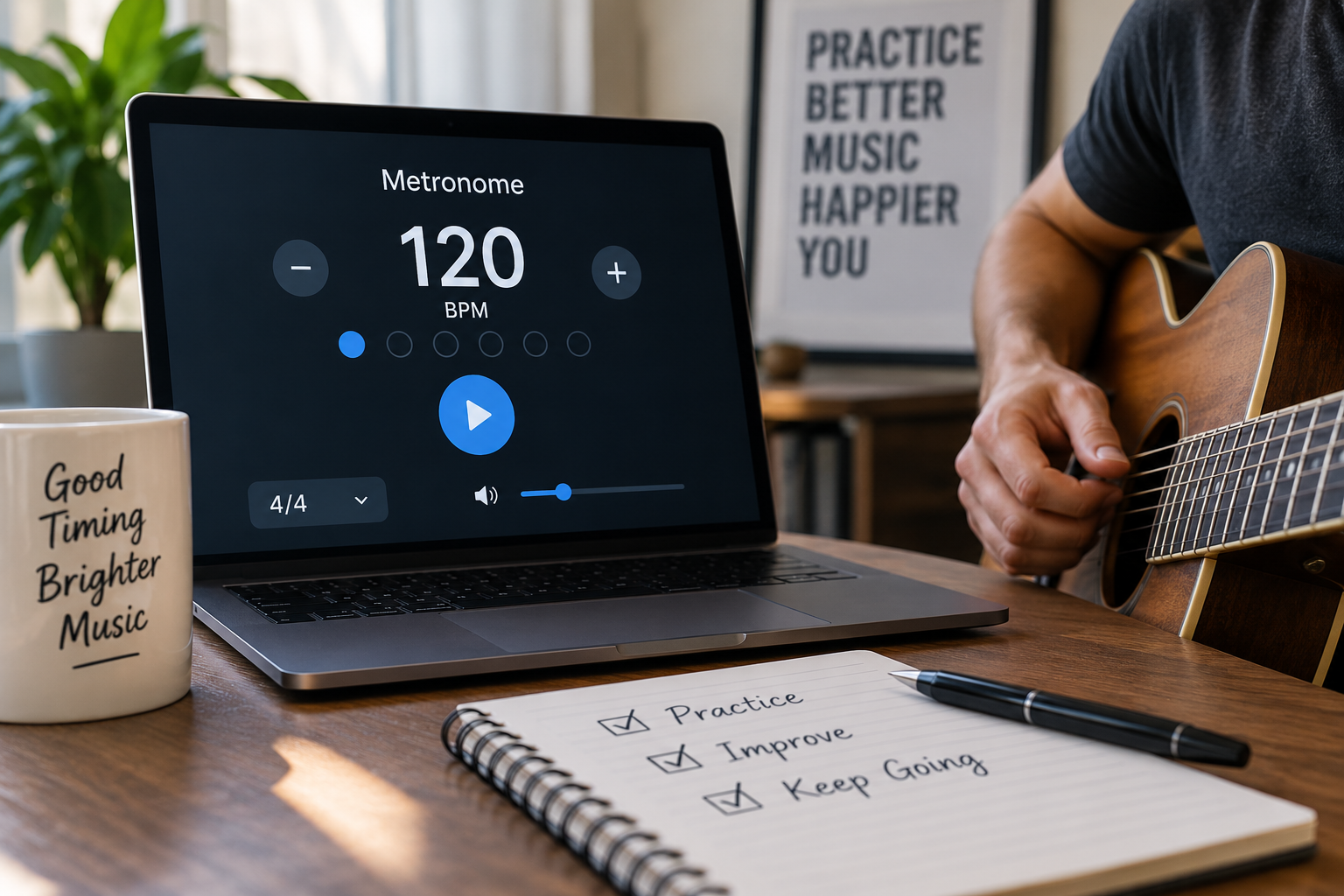
Playing the right notes is only part of creating the right melody. But playing them at the right time is what makes a musician skillful.
Keeping a steady rhythm is much more difficult than it seems, especially when a song becomes faster or more complicated. You may speed up during an easy section and slow down when you reach something difficult without even noticing.
A metronome is what helps you hear these small timing problems. And it is quite simple because you can open an online metronome in your browser and start practicing in seconds.
The important part is knowing how to use it properly, and we will tell you how to do this.
Start at a Comfortable Tempo
One of the most common mistakes is starting too fast.
If you are learning a new song, riff, scale, or rhythm, choose a tempo where you can play it correctly without struggling.
For example, if the original song is 120 BPM, you might begin at 70 or 80 BPM.
Try playing the section several times at that speed. Your goal is to stay with the click and play every note clearly.
Once it feels comfortable, increase the tempo by around 5 BPM. Then repeat the exercise.
It is usually much easier to build speed after your hands understand the movement correctly.
Listen to the Click Instead of Fighting It
When musicians first practice with a metronome, they try chasing the click. The trick is to do the opposite.
Listen carefully and let your playing sit naturally with the beat.
When your timing is good, your note and the metronome click may almost sound like one sound. If you hear your note clearly before or after the click, you know you are slightly out of time.
This is one of the easiest ways to notice whether you are rushing or dragging.
Do not stop every time you make a small mistake. Keep playing for a few bars and try to return to the beat.
Practice Different Subdivisions
A metronome does not have to represent every note you play.
Imagine the metronome is set to 60 BPM. Each click can represent one quarter note.
You can then play:
- one note per click for quarter notes;
- two notes per click for eighth notes;
- three notes per click for triplets;
- four notes per click for sixteenth notes.
This is a simple exercise, but it can improve your sense of rhythm a lot.
Start with one subdivision and stay with it for a minute or two. Then change to another without changing the metronome speed.
For example, move from quarter notes to eighth notes, then to triplets, and finally to sixteenth notes.
The click stays exactly the same. Only your rhythm changes.
Use the Metronome for Difficult Sections
You do not always need to practice an entire song from beginning to end.
If four bars keep causing problems, focus only on those four bars. Set the metronome to a slow tempo and repeat the section.
If you can play it correctly five times in a row, increase the tempo slightly. This approach is often more useful than repeatedly playing the whole song and making the same mistake every time you reach the difficult part.
It also makes it easier to see your progress.
For example, yesterday you may have played the section comfortably at 85 BPM. Today you can manage 95 BPM. That gives you a clear way to measure improvement.
Try Giving the Metronome Less Work
Once you become comfortable playing with a click on every beat, make the exercise harder.
Instead of hearing four clicks in a bar, try using only two. For example, imagine the clicks are beats two and four. You now have to feel the other beats yourself.
More experienced musicians can go even further and use one click per bar. This forces you to keep the internal pulse without depending on the metronome for every beat.
If you reach the next click too early, you probably sped up. If you reach it late, you probably slowed down.
Do Not Increase the Tempo Too Quickly
You should start playing quicker after you gain more control.
If you can play something at 90 BPM but everything starts falling apart at 100 BPM, do not keep forcing yourself through 100.
Go back to 92 or 95. Small increases give your hands and ears time to adjust.
You can also move backward. Playing something slower than usual can sometimes be surprisingly difficult because there is more space between each beat.
That makes slow practice useful even for songs you already know.
Build a Simple Timing Routine
You do not need to spend your entire practice session with a metronome. Even 10 or 15 focused minutes can be useful.
A simple routine might look like this:
- Spend two minutes playing simple quarter notes with the click.
- Practice eighth notes, triplets, and sixteenth notes.
- Work on one difficult section of a song at a slow tempo.
- Increase the tempo gradually.
- Finish by playing the section with fewer metronome clicks.
The goal is not simply to follow a machine but to develop a stronger sense of time so you eventually need less help from it.
Final Thoughts
A metronome is one of the simplest practice tools available, but it can show you things about your playing that are difficult to notice on your own.
It should be used slowly at first. Pay attention to whether you are ahead of or behind the beat. Practice different subdivisions, focus on difficult sections, and increase the tempo only when you can play comfortably.
Over time, the click should feel less like something you are following and more like something your playing naturally fits around. That is when you know your timing is getting stronger.