


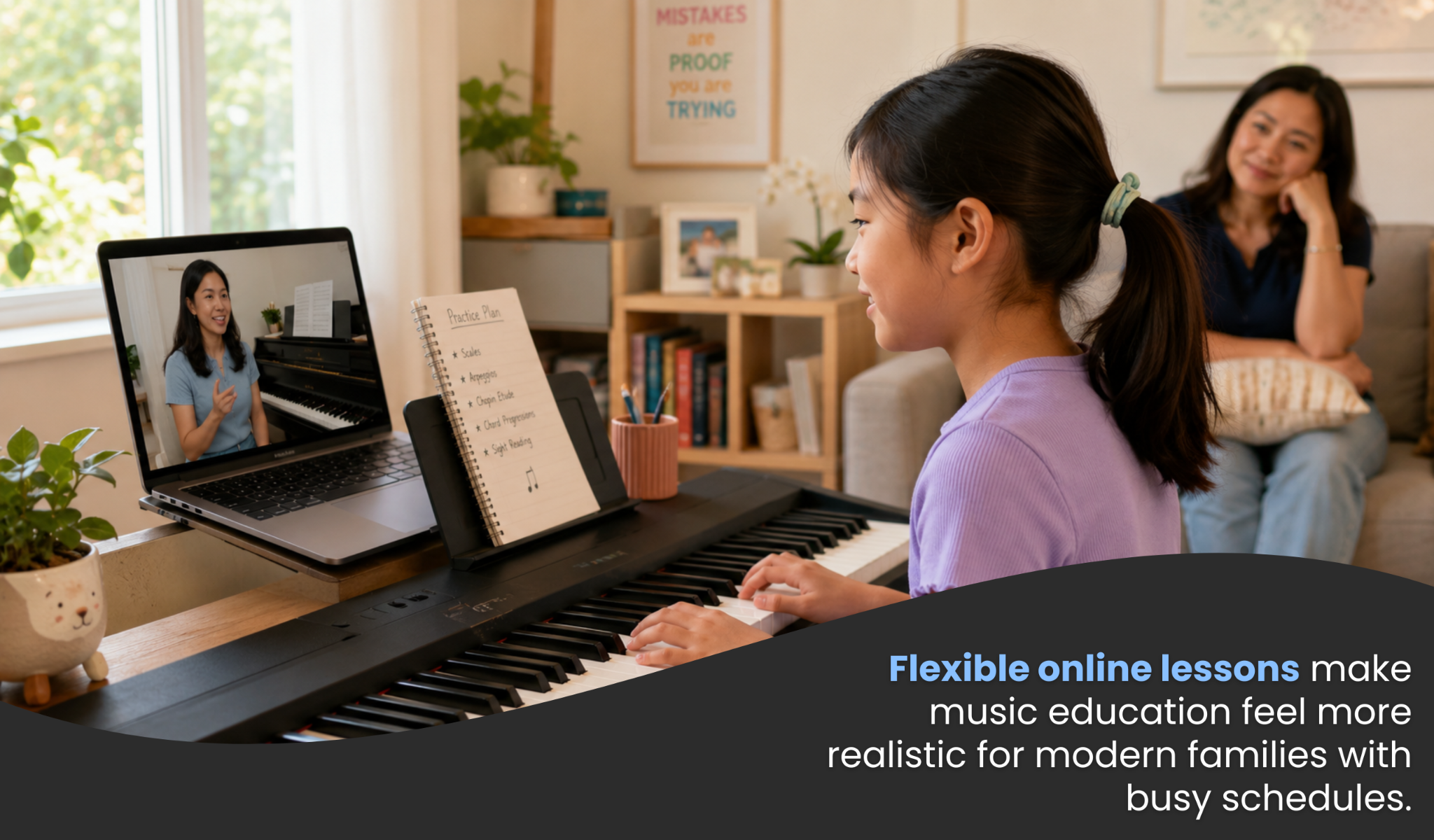
An Op-Ed on how the music lesson is finally catching up with modern life
There’s a version of music education most of us grew up with. It involved a fixed time slot on a Tuesday afternoon, a studio that smelled faintly of rosin and old sheet music, and a teacher who expected you to have practiced scales you had not, in fact, practiced.
You either fit into the system or you didn’t. And if life got in the way, well, you missed your lesson and lost your deposit.
That version of music education is not dead.
But it’s no longer the only option.
And for millions of learners, that changes everything.
The old model had a real problem
The traditional music lesson was designed for a world with predictable schedules, fixed geography, and a clear hierarchy: teacher knows best, student shows up, progress happens on the teacher’s terms. It worked well enough, for families who lived close to a good studio, had afternoons free, and could commit to a term-long schedule without exceptions.
For everyone else, it was a negotiation that rarely ended in their favor.
According to Gallup, 87% of people say music is a vital part of their lives, and 70% of respondents say they want to learn an instrument. Yet most of them never do, or they start and stop, citing scheduling conflicts, geography, cost, or the simple exhaustion of one more obligation to manage. The desire is there. The system was just built for someone with a more frictionless life.
What’s changed is not the desire to learn music. It’s the infrastructure around learning it.
The private teaching is having a moment
For all the noise about apps, platforms, and AI-generated lesson plans, the data keeps pointing in one direction: people want a real teacher.
Personal lessons captured 47.10% of online music education spending in 2025, underlining the willingness of learners to pay for bespoke instruction and rapid skill correction. That’s not a niche preference. That’s nearly half of an industry that spans everything from subscription apps to conservatory programs, all of it gravitating toward the one-on-one relationship.
Why? Because a private teacher does something no app or video library can replicate. They watch you play, hear what’s actually happening, and tell you precisely what’s wrong and how to fix it. They notice that your fretting hand is tense before you’ve even realized you’re tense. They remember that you responded well to learning through songs you already love, and they bring one to the next session. They adapt, lesson by lesson, to who you are as a learner.
That responsiveness is not something you can automate. And it’s not something that changes when the lesson moves online.
Vincent Reina has been inside music education long enough to have watched every iteration of this debate. He started teaching piano lessons as a high school student, went on to earn a Bachelor of Music in Piano Performance from Purchase Conservatory and a Master of Arts in Teaching Music from Manhattanville College, and in 2003 co-founded Music To Your Home with his wife Tracy, a classical voice-trained musician turned MTV producer.
Together they built what is now one of New York City’s most trusted online music lesson services, with teachers drawn from Juilliard, Manhattan School of Music, and NYU.
What Reina built with Music To Your Home’s online music lessons, from the start, wasn’t a music school in the traditional sense. It was a matching system: the right teacher, for the right student, at a time and place that actually worked. The online transition didn’t disrupt that model. It extended it.
“The teacher is everything,” Reina says.
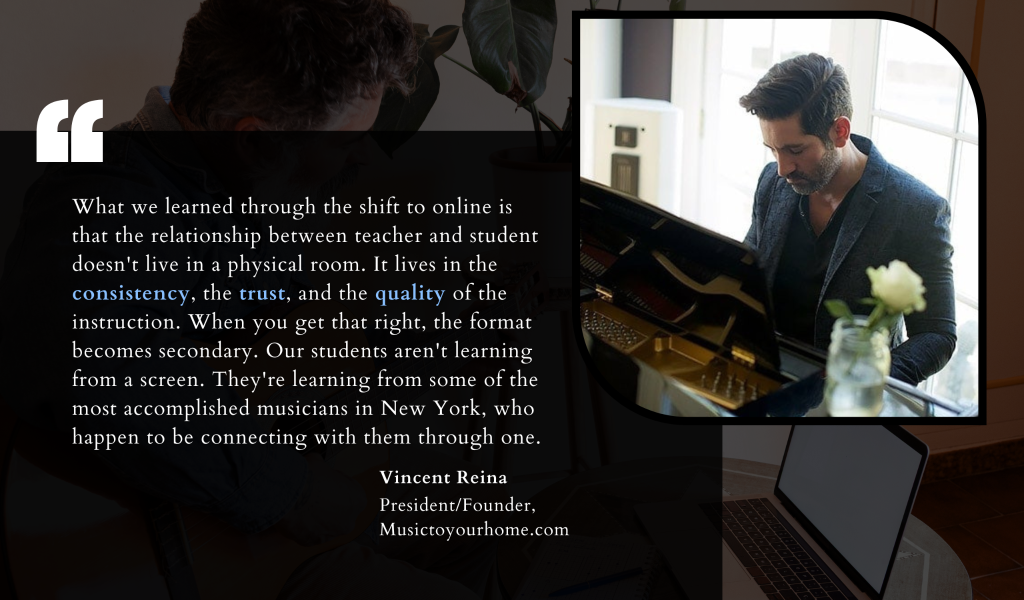
The question was never whether online music education could work. It was whether the instruction behind it was good enough to make the format irrelevant.
For schools that built their reputation on teacher quality first, the answer was yes, faster than most expected.
Flexibility is no longer a luxury feature
Here’s what the old model got wrong: it treated flexibility as a premium add-on, something you paid extra for, or negotiated awkwardly with a teacher who preferred their existing schedule.
For a long time, access to a truly great teacher meant bending your life around their availability.
That dynamic has shifted significantly. Live one-to-one instruction is advancing at a 16.1% compound annual growth rate between 2026 and 2031. The fastest-growing segment of music education is not passive, self-paced content. It’s live, private, flexible instruction. The market is telling us something straightforward: people want expert human teaching on terms that work for their actual lives.
Schools like Music To Your Home in New York City built their entire model around this idea. Same-day scheduling for most lessons. In-home instruction across all five NYC boroughs. Online sessions for learners anywhere in the world. The teacher comes to you; or connects with you from wherever you are. The lesson fits into your week, not the other way around.
That’s not a small operational shift. It’s a philosophical one.
This shift toward flexible, expert-led instruction also fits within a broader arts-education culture, from private online lessons to in-person music workshops for singers, songwriters, and musicians that give students access to industry-level guidance and performance-focused training.
What Geography used to cost
Before online lessons became genuinely viable, your teacher options were limited to whoever lived within a reasonable commute. In a city like New York, that might mean dozens of excellent teachers. In a smaller city or rural area, it might mean whoever happened to teach music locally, regardless of their expertise or fit with your goals.
The global reach of online music education platforms now enables learners from different regions to access quality instruction from expert musicians and educators regardless of geographical location. This isn’t a technicality. It’s a meaningful redistribution of access. A family in Queens can now work with the same caliber of teacher as a family in Greenwich, not because they found a workaround, but because the best teachers have made themselves available online without sacrificing quality.
The skepticism about online lessons, and there was plenty of it, has largely evaporated.
The concern was always that something essential would be lost without physical presence: the ability to correct hand position, to demonstrate technique up close, to read the room when a student was frustrated or losing focus. And in some contexts, for the very youngest beginners or highly tactile learners, in-person instruction still has meaningful advantages.
But for the vast majority of students, a skilled teacher on a well-set-up video call delivers an experience remarkably close to sitting in the same room.
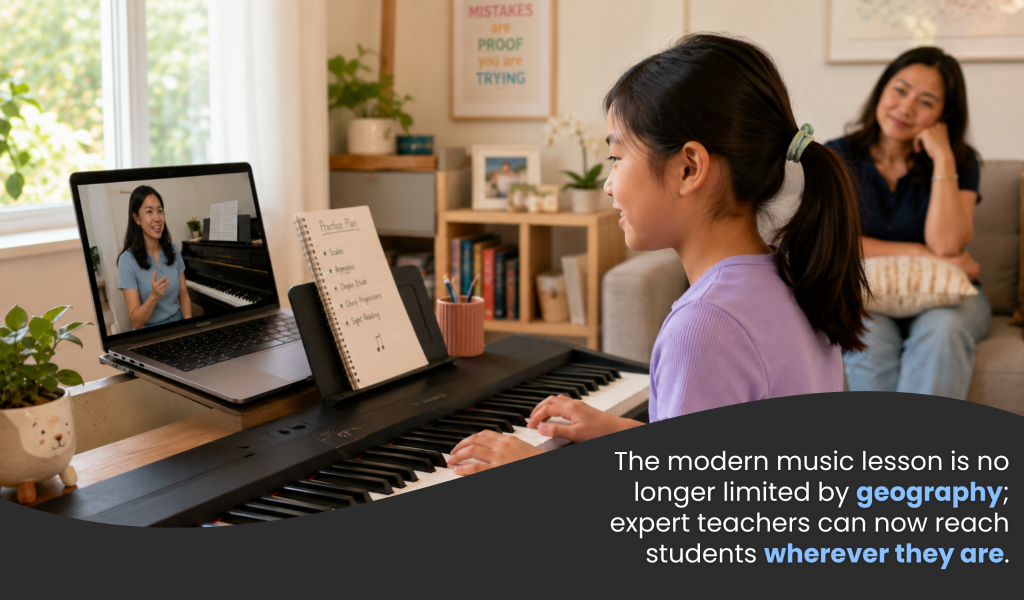
Real-time feedback, visible technique, live demonstration: it’s all there. What’s added is that the student is in their own home, with their own instrument, in the space where they practice. There’s an argument that’s actually better.
The case for music is stronger than ever
The cultural conversation around children’s education has shifted in recent years toward measurable outcomes, academic performance, and college readiness. Music sometimes gets squeezed out of that framework because its benefits are harder to quantify than a test score.
But the research keeps accumulating. Studies indicate that children who practice music show increased verbal memory, verbal intelligence, reading skills, visual-spatial processing, executive functions, attention, and logical reasoning. These are not peripheral benefits. They’re central to the kind of learning that schools and parents already care most about.
And that’s before you account for the effects that are harder to measure: the confidence of a child who performs in front of people and survives it, the patience of a student who learns that something difficult gets easier with time, the identity of someone who knows they’re a musician, not just a person who once took lessons.
Research has shown that music can stimulate the brain and improve memory, concentration, and quality of life at any age. That “at any age” matters. Music education is not only a children’s activity. Adults who return to an instrument they abandoned, or pick one up for the first time at fifty, are doing something genuinely valuable. They’re keeping their brains engaged, building a skill that rewards practice, and finding a source of pleasure and self-expression that most screen-based leisure simply doesn’t offer.
The real barrier was never talent
Ask most adults why they never learned an instrument, or why they quit, and you’ll hear some variation of the same story: they didn’t have time, it was too rigid, they felt behind, they didn’t think they were musical enough, the teacher wasn’t right for them, life got in the way.
Almost none of them say they didn’t want to learn.
That gap, between wanting to learn and actually learning, is where the new model of music education is doing its most important work.
The private music lessons market is projected to reach USD 5.57 billion by 2033, driven in part by heightened awareness of the cognitive and emotional benefits associated with music education. The demand was always there. What’s changed is that the supply has gotten smart enough to meet it.
A parent who can book a guitar lesson for Thursday evening, online, with a vetted teacher who specializes in working with beginners, confirmed by Friday morning: that parent is going to book the lesson.
A busy adult who can schedule a piano session at 7am before work, in their own living room, without commuting anywhere: that adult is going to keep showing up.
Remove enough friction, and people do the things they’ve always wanted to do.
For learners with unpredictable schedules, online instruction is not a compromise; it is often what makes creative education sustainable. As noted in our piece on online class support for artists, virtual learning can help creative people stay consistent, access guidance, and keep developing their craft without needing to be in a specific room or city.
What good instruction actually looks like now
The best private teachers working today, whether in-home or online, share a few qualities that the old model didn’t always prioritize: they listen before they prescribe, they build lessons around the student’s goals and musical taste rather than a fixed curriculum, and they treat each learner as an individual rather than a slot in a schedule.
That combination of expert instruction and genuine personalization is what separates the new era of music education from the old one. It’s not about technology. Technology is just the delivery mechanism. What matters is a great teacher, working with one student at a time, in a format that makes showing up easy enough to actually happen.
Music has always been worth learning. It’s just that now, finally, the path to learning it has caught up with the complexity of modern life.