


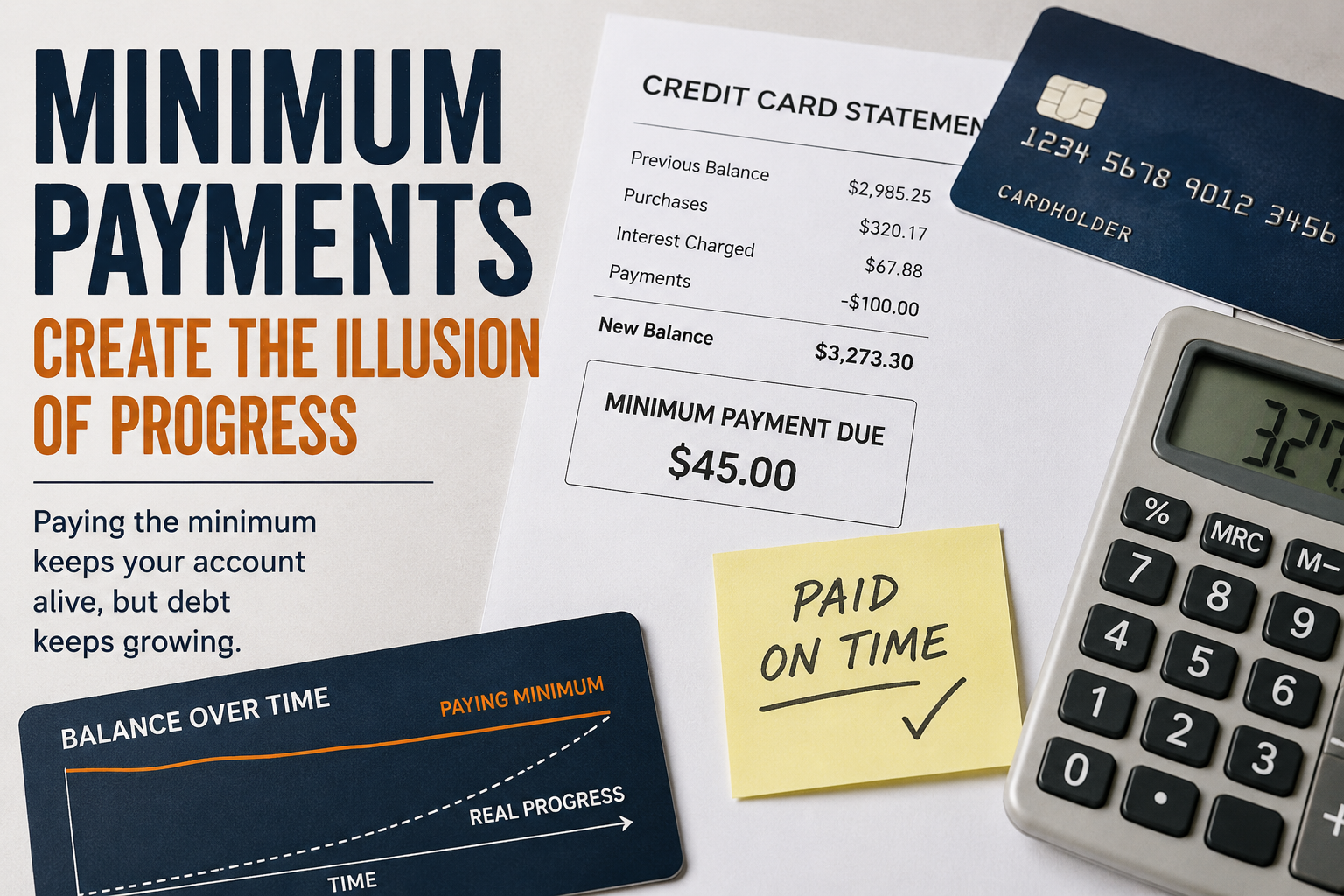
The Payment That Feels Like Progress
Minimum payments are designed to feel responsible. You open your credit card statement, see the amount due, pay it on time, and get the small relief of knowing you avoided a late fee. The account stays current. Your credit card company is satisfied. Nothing feels urgent enough to panic over.
That is exactly why minimum payments can be so misleading. They create the emotional feeling of movement while the actual debt barely changes. For someone looking into options like Nebraska debt relief, this illusion can be one of the hardest parts of debt to recognize because the problem does not look like failure. It looks like consistency.
Minimum Payments Keep The Account Alive
A minimum payment is not really a debt payoff strategy. It is more like the cost of keeping the account in good standing for another billing cycle. It helps you avoid late fees, missed payment marks, and collection pressure, but it does not necessarily mean you are making meaningful progress toward being debt free.
That distinction matters. When people pay the minimum, they often feel like they handled the debt for the month. Technically, they did handle the requirement. But the requirement was set low enough that the balance can survive for years. The payment keeps the system calm, not necessarily healthy.
This is why the Consumer Financial Protection Bureau’s credit card resources encourage consumers to understand how credit card terms, payments, and balances work. The more clearly you understand the mechanics, the harder it becomes to mistake account maintenance for real repayment.
The Balance Moves Too Slowly To Feel Dangerous
One reason minimum payments are so powerful is that they make debt feel boring. The balance does not explode overnight. The statement arrives. The minimum is paid. The account remains open. Life continues.
But underneath that calm surface, interest is doing quiet work. Credit card interest is often calculated daily, which means the balance can keep generating new charges even after you make a payment. If your payment mostly covers interest and only slightly reduces the principal, you may be spending money without actually escaping the debt.
That slow pace can trick the brain. People are good at noticing dramatic changes, but bad at noticing small repeated losses. A balance that barely decreases month after month may not trigger alarm because nothing feels sudden. Yet over time, those small stalled months can become years.
The Statement Gives You Permission To Underpay
Credit card statements are useful, but they can also shape behavior. When a statement shows a minimum payment due, it can make that number feel like the correct number. Not just the lowest allowed amount, but the normal amount.
That framing matters. If a bill says you owe at least $45, paying $45 feels compliant. Paying $75 may feel extra. Paying $200 may feel aggressive. But if the balance is large and the interest rate is high, the so called extra payment may be the first amount that actually makes a difference.
This is the hidden psychology of minimums. They anchor your expectations low. Once your brain accepts the minimum as the baseline, anything above it feels optional, even when it may be necessary.
Good Standing Can Hide Bad Momentum
Being current on payments is important. Nobody should dismiss that. Paying on time protects your credit history and helps you avoid penalties. But good standing and good momentum are not the same thing.
Good standing means you met the lender’s monthly requirement. Good momentum means your balance is shrinking at a pace that actually changes your future. Minimum payments often deliver the first without the second.
That gap creates a dangerous kind of comfort. A person may not feel “in trouble” because nothing has gone delinquent. The card still works. The payment history looks fine. The minimum is affordable enough. But the debt may still be controlling future income, limiting savings, and making every emergency harder to absorb.
Interest Turns Time Into A Cost
Minimum payments are expensive because they stretch debt over time. The longer a balance stays open, the more chances interest has to accumulate. Even if the monthly payment feels manageable, the total cost can become much larger than the original purchases.
The Federal Reserve has warned consumers that paying only the minimum can make repayment take longer and cost more in interest. Its credit card repayment information shows how a balance that seems manageable month to month can become far more costly when paid down slowly.
This is where the illusion becomes clearest. A person may think, “I am paying every month, so I am reducing the debt.” But a better question is, “How much of this payment is actually reducing what I borrowed?” If the answer is “not much,” the payment is buying time more than freedom.
Minimum Payments Can Make Spending Feel Safer Than It Is
Another problem is that minimum payments can make future spending seem less risky. If someone knows a purchase will only add a small amount to the next minimum payment, the real cost feels smaller than it is.
A $300 purchase may not feel like $300 when the immediate monthly impact looks like a few dollars. That gap between purchase price and payment size makes credit feel easier to use. It separates the decision to buy from the full consequence of paying it back.
This is one reason debt can grow even when a person believes they are being careful. They are not ignoring the bill. They are paying it. But the payment structure makes the debt feel lighter than it really is.
The Better Question Is Not “Can I Make The Payment?”
A safer way to think about credit card debt is to stop asking only whether the minimum payment is affordable. That question is too small. Many debts are affordable in the short term and damaging in the long term.
A better question is, “At this payment amount, when will this balance actually be gone?” That one question changes the whole picture. It turns the monthly payment from a comfort signal into a timeline. If the answer is measured in years, the minimum payment is not progress in the way it appears to be.
Another useful question is, “What would happen if I stopped using the card and paid this same amount every month?” If the balance still barely moves, the payment is too low. If the balance only shrinks when no new purchases are added, the card may be functioning less like a convenience tool and more like a financial trap.
Real Progress Feels Less Comfortable At First
Making real progress often requires paying more than the minimum, even when that feels annoying. It may mean cutting back somewhere else, pausing new charges, using a payoff calculator, or focusing extra money on the card with the highest interest rate.
At first, that can feel less comfortable than simply paying the minimum. But the discomfort has a purpose. It produces movement. The balance starts shrinking faster. Interest has less room to grow. The payoff date gets closer.
Minimum payments offer emotional comfort now in exchange for financial drag later. Larger, intentional payments do the opposite. They may feel harder today, but they create relief in the future.
Progress Should Be Measured By Distance, Not Activity
The main problem with minimum payments is not that they are useless. They can protect an account from becoming late, and that matters. The problem is that they can make activity look like advancement.
Real progress is not measured by whether you made a payment. It is measured by how much closer that payment brought you to being done. If the balance barely changes, the payment may have preserved the debt more than defeated it.
Seeing that clearly is not about shame. It is about accuracy. Once you understand the illusion, you can make stronger decisions. You can stop letting the minimum payment define what is enough. You can choose a number based on your goal, not just the lender’s requirement. That is when repayment becomes more than a monthly routine. It becomes a real exit plan.