


NoHo packs more than twenty professional theatres into a single square mile. That density is the whole point of the district, and it is what makes the neighborhood feel like a working ecosystem rather than a collection of venues.
Now consider a stretch of coastline where some of the theatres have been running for roughly 2,400 years.
That is the actual case for the Mediterranean as an arts destination rather than a beach one. Not museums full of things that used to be art, but venues, workshops, and traditions still in operation.
The Theatres Are Still Working Buildings
Start with the one that matters most to anyone who has ever stood on a stage and worried about the back row.
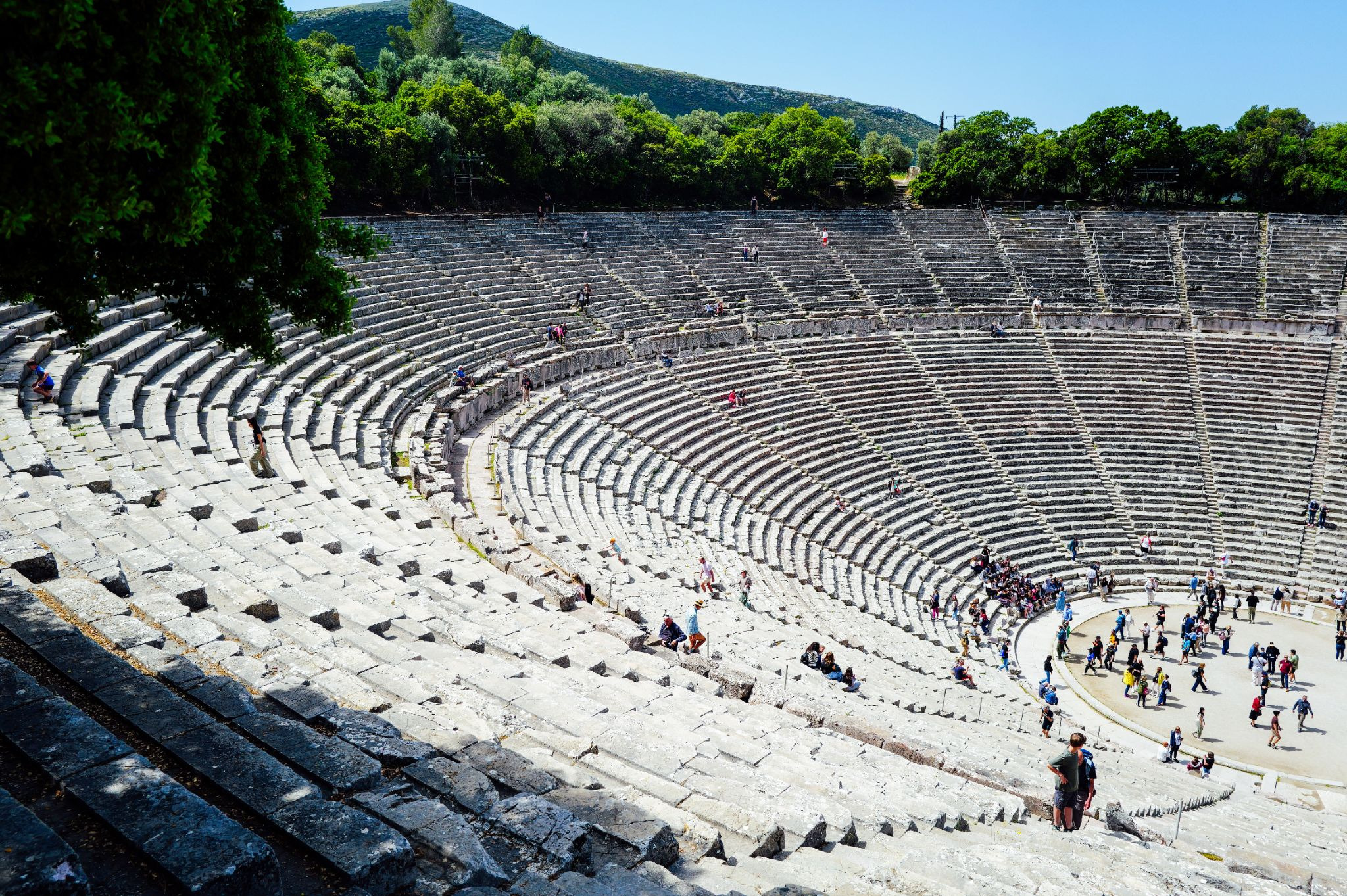
The theatre at Epidaurus was built at the end of the fourth century BC and is widely considered the most accomplished theatre structure of antiquity. UNESCO’s documentation describes a cavea of 55 tiers of seats divided by staircases into wedge-shaped sections, radiating from an orchestra that forms a near-perfect circle roughly 20 meters across.
The detail that should interest anyone who designs a space: those wedges are drawn from three separate centers rather than one, and that geometry is credited with the theatre’s acoustics. The overall plan follows mathematical principles influenced by Pythagorean thought.
Somebody solved a sound problem in the fourth century BC using geometry, and the solution still works.
The wider site, the Sanctuary of Asklepios, has held World Heritage status since 1988. But the theatre is not preserved as an artifact. It hosts the Athens Epidaurus Festival, which has run since 1955, making it among the oldest performing arts festivals in Europe.
Greek and international companies stage tragedies and new work there every summer. Actors from NoHo stages and actors at Epidaurus are doing the same job in rooms separated by 2,400 years.
Why Luxury Mediterranean Cruises Fit an Arts Itinerary Specifically
Here is the logistical problem with treating this as an arts trip rather than a holiday.
The sites are not clustered. Greek theatres, Sicilian ones, Turkish ones, and the museum cities of Spain, France, and Italy are spread across multiple countries and several thousand miles of coast. Assembling that independently consumes most of the trip in transit and border logistics.
Which is the practical argument for approaching this by sea. Luxury Mediterranean cruises are not usually pitched at working artists, but Silversea’s port itineraries through the region solve a real problem here: ports are where these cities were built, because the sea is why they existed at all, and moving between them by water is closer to how they were originally connected than any flight route could be.
There is also a working consideration. Arriving rested matters if you intend to spend your day looking hard at things rather than recovering from a transfer.
The Acoustics Question Nobody Has Fully Closed
For the sound designers and technical people, this is the genuinely interesting part.
Modern researchers have measured Epidaurus with contemporary equipment rather than relying on reputation. A study presented at an acoustics conference at the University of Patras documented detailed measurements of the theatre’s acoustic performance across listener positions.
The explanations have shifted over time. The valley setting was long credited, then the engineering, and later work has pointed toward the corrugated stone seating itself acting as an acoustic filter, attenuating low-frequency background noise while preserving speech.
The theatre’s documented history records that it fell out of use around 426 AD, sat unused for roughly 1,450 years, was excavated in 1881, and returned to performance in the twentieth century.
A building can be abandoned for fourteen centuries and still outperform rooms we build now. That is worth an afternoon of anyone’s attention.
What Else Is Actually There for Working Artists
Theatre is the obvious draw, but it is not the only one.
Visual art in original context. Frescoes, mosaics, and altarpieces still installed where they were made, in the light they were made for, rather than lit from above in a climate-controlled gallery. The difference is not sentimental. Scale and sightline were part of the composition.
Living craft. Murano glass, Moroccan zellige tilework, Spanish ceramics, Italian marble. These are working trades, not demonstrations, and in many towns you can watch people who trained for a decade doing something with their hands.
Architecture as sequence. Mediterranean port cities are legible on foot in a way Los Angeles is not. You can read how a city organized itself, which is a useful thing for anyone who designs environments, stages included.
The Case for Makers Specifically
If you work in the arts, the value of this trip is different from the value for a general traveler.
You are not going to admire. You are going to steal, in the way everyone in this district understands the word.
Sightlines. How a chorus moves through an orchestra that is a full circle rather than a proscenium. Why a set of stone steps carries a whisper. How a mosaic handles a curved surface. What a room does when it has no amplification and no option to add any.
Those are transferable problems. The solutions are two thousand years old and sitting in the open air.
One Practical Note
Check festival calendars before you set dates. Seeing Epidaurus empty is impressive. Seeing it with two thousand people in it during the summer festival is a different experience entirely, and the difference is enormous.
The same applies to Sicily, Turkey, and the Spanish coast, where ancient venues are programmed seasonally rather than year-round.
The Point
We built an arts district here on the premise that proximity produces work. Put enough theatres, galleries, studios, and rehearsal rooms in one square mile, and something happens that would not happen if they were scattered.
The Mediterranean is the long version of that idea. Cities that have been making, staging, and building continuously for millennia, connected by water, still open.
It is not a break from working in the arts. For most people who do, it is the most useful trip available.