


Dry skin is one of those conditions that feels straightforward enough to treat until you’ve been treating it consistently and still ending up with tight, flaky skin by mid-afternoon despite applying lotion twice before noon. The problem in that scenario is almost never that the product isn’t good or that the person isn’t applying enough of it. It’s that they’re applying the same product to a condition that has two distinct components, a hydration deficit and a retention problem, and the product is addressing one while leaving the other unmanaged. That mismatch is invisible until you understand what the ingredients in a moisturizer are actually doing, at which point it becomes the most obvious explanation for why the same lotion works well for some people and poorly for others with skin that looks identical on the surface.
The Two Problems Dry Skin Is Usually Presenting
Skin becomes and stays dry through a combination of insufficient water content in the upper skin layers and an impaired ability to hold onto whatever water is introduced. These two conditions often exist together, but they’re not the same problem, and they don’t respond to the same intervention. Skin that’s low on water content needs something that delivers or attracts moisture. Skin with a compromised barrier that can’t retain moisture needs something that slows the rate at which water leaves. Most people with chronically dry skin are dealing with both simultaneously, which is why a product that only addresses one of those components produces partial improvement that doesn’t last.
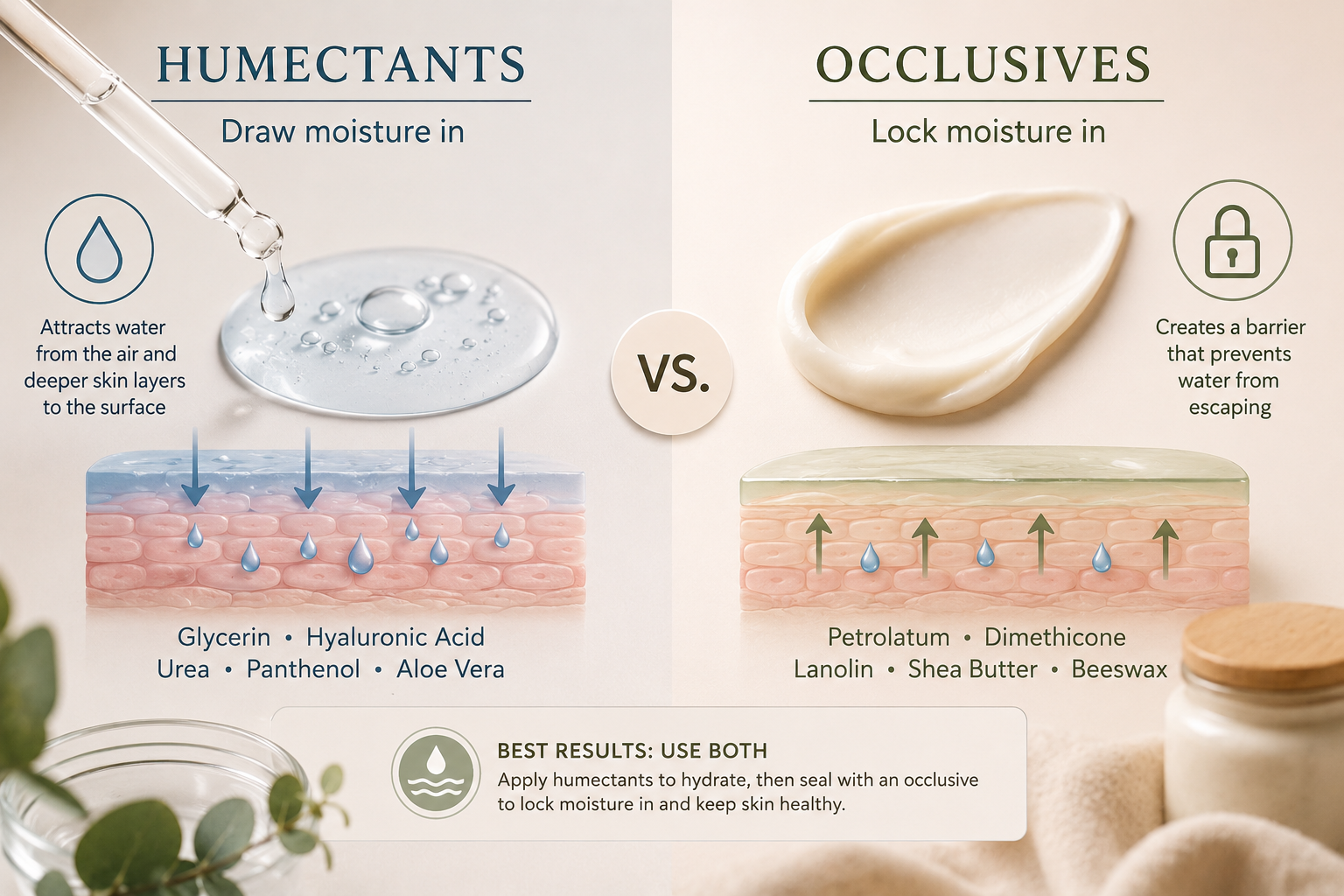
The ingredient categories built to address each problem are humectants and occlusives, and their mechanisms are different enough that understanding them changes how you read a product label and how you think about application sequencing in a way that produces better outcomes than any single product swap would.
What Humectants Are Doing
Humectants are hygroscopic molecules. They attract and bind water. Glycerin, hyaluronic acid, urea, panthenol, and aloe vera are all humectants. Their function in a moisturizer is to pull moisture toward the skin surface and hold it there.
Glycerin does this efficiently across a wide range of skin types because its molecular size allows it to work at the surface without the penetration depth issues that larger molecules like hyaluronic acid sometimes present. Urea is worth specific mention because it functions as both a humectant and a mild keratolytic at higher concentrations. It breaks down the protein bonds that hold dead skin cells together at the surface while simultaneously drawing moisture to the tissue underneath.
The limitation of humectant action becomes relevant in low-humidity environments. With very little moisture in the air, a humectant applied to the skin surface without an accompanying occlusive layer draws water from the deeper skin tissue upward. That water then sits at the surface in an accessible evaporation position where it contributes to skin suppleness. The net effect on moisture retention can be neutral or slightly negative. A lotion for dry skin that’s primarily humectant-forward will produce noticeably different results in a humid coastal climate versus a dry inland winter environment for this reason. The person who finds it works well in summer and stops working in January isn’t imagining the difference.
What Occlusives Are Doing
Occlusives work through an entirely different principle. Rather than attracting moisture, they create a physical barrier over the skin surface that slows the evaporation of water that’s already present in the tissue. Petrolatum is the most effective occlusive available in over-the-counter formulations, reducing transepidermal water loss by over 98 percent in clinical measurements. Dimethicone, lanolin, mineral oil, shea butter, and beeswax all function occlusively to varying degrees of effectiveness, with petrolatum at the top of the efficacy range and plant butters toward the middle.
The occlusive layer doesn’t add moisture. It preserves what’s there. Which means an occlusive applied to skin that’s already severely depleted of water content produces a sealed but still dry surface rather than the soft, hydrated result most people are looking for. The sequence that works is hydration first, through a humectant or through simple water contact, followed by an occlusive layer applied while the surface still has moisture present. That sequence addresses both components of the dry skin condition rather than optimizing for one while leaving the other unresolved.