


There’s a version of pink that plays it safe – blush walls, a few millennial pink accessories, a vase or two chosen because the color was everywhere and didn’t feel like a commitment. That pink has been done. It arrived around 2016, peaked somewhere around 2019, and left behind a lot of apartments that look like they’re still waiting for an aesthetic opinion.
Then there’s the other kind of pink. The kind that LA creatives have always understood better than most – saturated, intentional, unafraid. The kind that shows up in the studios and apartments of people who take color seriously, who think about what a room communicates, and who aren’t particularly interested in furniture that could have been chosen by anyone.
That pink is having a proper moment, and the living room is where it’s landing hardest.
Why Pink Works Differently Than You Expect
Most people approach pink cautiously because they’re thinking of it as a soft color – delicate, feminine, easily overwhelmed. But pink spans an enormous tonal range, and the way it behaves in a space depends almost entirely on which end of that range you’re working with.
Pale, dusty pinks genuinely are soft. They recede, they calm, they read almost like a warm neutral in certain lights. A blush sofa in a sun-drenched LA apartment can feel breezy and considered without demanding much from the rest of the room.
But move up the saturation dial – into coral, into hot pink, into the deeper rose and raspberry tones – and you’re working with a completely different energy. These are colors that advance. They hold the eye. They turn a sofa from a piece of furniture into a focal point, which is exactly the kind of design decision that separates a room with personality from one that simply contains objects.
For creative people living in spaces that need to double as inspiration environments – which describes a significant portion of NoHo – that focal point can do a lot of work.
Building a Room Around a Pink Sofa
The biggest mistake people make when they introduce a bold-colored sofa is treating everything else in the room as though it needs to apologize for the sofa’s existence. The result is a pink sofa surrounded by beige and gray, looking stranded and slightly confused.
Bold color works best when the room engages with it rather than retreating. That doesn’t mean everything else needs to be loud – it means the surrounding choices need to be deliberate.
Warm neutrals over cold ones. Pink has warm undertones, and it pairs far more naturally with warm whites, creams, and terracotta than with the cool grays and stark whites that dominated interiors for the previous decade. If your walls are a cool-toned white, a pink sofa will fight them. Repaint with something warmer – an off-white with a yellow or pink undertone, a warm sand, or even a rich terracotta if you want to lean fully into the warmth – and the sofa starts to look like it belongs.
Art as a bridge. This is where creative households in neighborhoods like NoHo have a natural advantage. Original artwork – particularly pieces that pull in the pink or repeat any of its undertones – turns a bold sofa color from a risk into a conversation. A painting that picks up the coral in a pink sofa, or contrasts it with deep blue-greens, makes the whole room feel curated rather than accidental. For anyone with art on the walls already, reorienting the room around a new sofa color can be as simple as rethinking which pieces get displayed where.
Texture does the heavy lifting. Pink sofa upholstery tends to perform best when the surrounding textures are varied enough to add visual interest without competing for attention. Linen curtains, a jute or wool rug, wooden furniture with visible grain, ceramic lamps – these all add dimension while keeping the palette calm enough that the sofa remains the star. A room full of flat, uniform surfaces can make even a beautiful pink sofa look strangely inert.
For a more thorough breakdown of palette combinations and layout approaches, this guide to decorating a room around a pink sofa covers the specifics in useful detail.
The LA Factor
Los Angeles has always had a particular relationship with pink. It shows up in the bougainvillea that cascades over every other fence in the Valley, in the sunsets that turn the whole sky into a gradient from coral to magenta, in the neon signs and painted storefronts that give neighborhoods like NoHo their visual identity.
Living here trains your eye to see pink as dynamic rather than precious. The light helps – Southern California sun gives pink a warmth and vibrancy that flat northern light can’t replicate. A sofa that might feel overwhelming in a smaller apartment elsewhere reads with genuine vitality in a North Hollywood space with afternoon light coming through west-facing windows.
That context matters. Decorating in LA means working with one of the world’s most generous light sources, and pink is one of the colors that benefits from it most.
Getting the Shade Right
The single most important decision in a pink sofa purchase is the specific shade, and it’s worth taking more time over than most people do.
The broad categories: pale blush sits quietly and integrates easily; mid-toned dusty rose is versatile and currently very on-trend; coral leans warm and vibrant and suits maximalist rooms well; hot pink is a genuine statement that requires a confident surrounding palette; deeper rose and raspberry tones carry a richness that works particularly well in velvet.
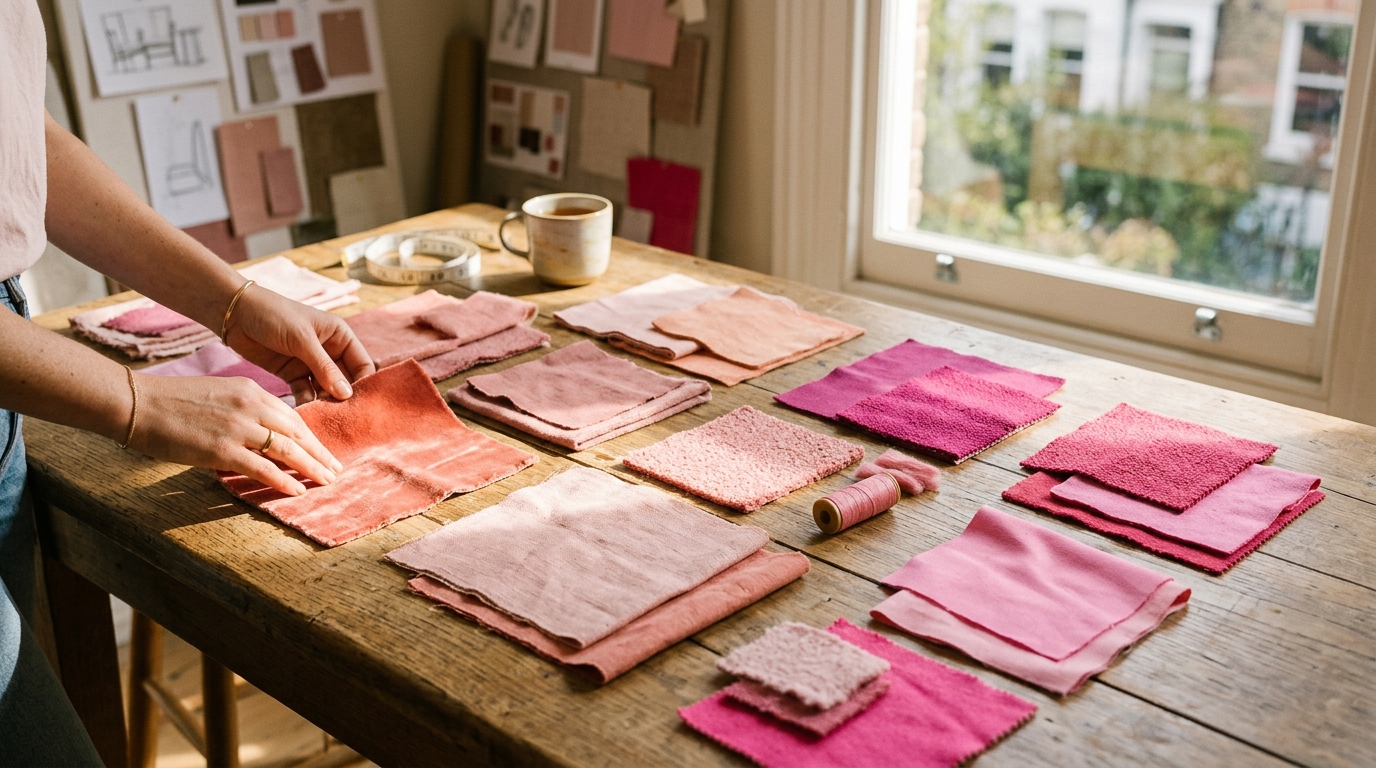
Order swatches before committing. Pink is more sensitive to lighting conditions than most colors – it can shift dramatically between daylight and artificial light, and what looks like a sophisticated dusty rose in the store can turn an unexpected direction under your specific apartment’s lighting. Seeing the actual fabric in your space before you sign off on anything is genuinely worth the extra step.
The payoff, when it works, is a room that has the kind of confident, expressive personality that tends to come naturally to people in creative neighborhoods – and less naturally to their furniture. Pink is one of the easiest ways to close that gap.