


When someone loses most or all of their teeth, the traditional path toward full-mouth restoration often involves months of procedures, bone grafts, and extended healing periods before any permanent teeth can be attached. According to the American Academy of Periodontology’s 2024 clinical guidelines, conventional full-arch implant protocols typically require 6-8 implants per arch and can take up to a year to complete. Yet a growing number of patients are walking out of dental offices the same day with a full set of fixed teeth, thanks to a technique that strategically uses just four implants per arch.
This shift toward immediate restoration reflects broader changes in implant dentistry, where patient demand for faster solutions has driven innovation in surgical techniques and prosthetic design. For the millions of Americans facing complete tooth loss—whether from periodontal disease, trauma, or genetic factors—understanding how All-on-4 works mechanically can clarify why this approach succeeds where previous methods required extensive preparation. The technique’s success hinges on principles of physics, biology, and surgical precision that most patients never see but directly impact their long-term outcomes.
How Do All-on-4 Implants Work Mechanically and Surgically?
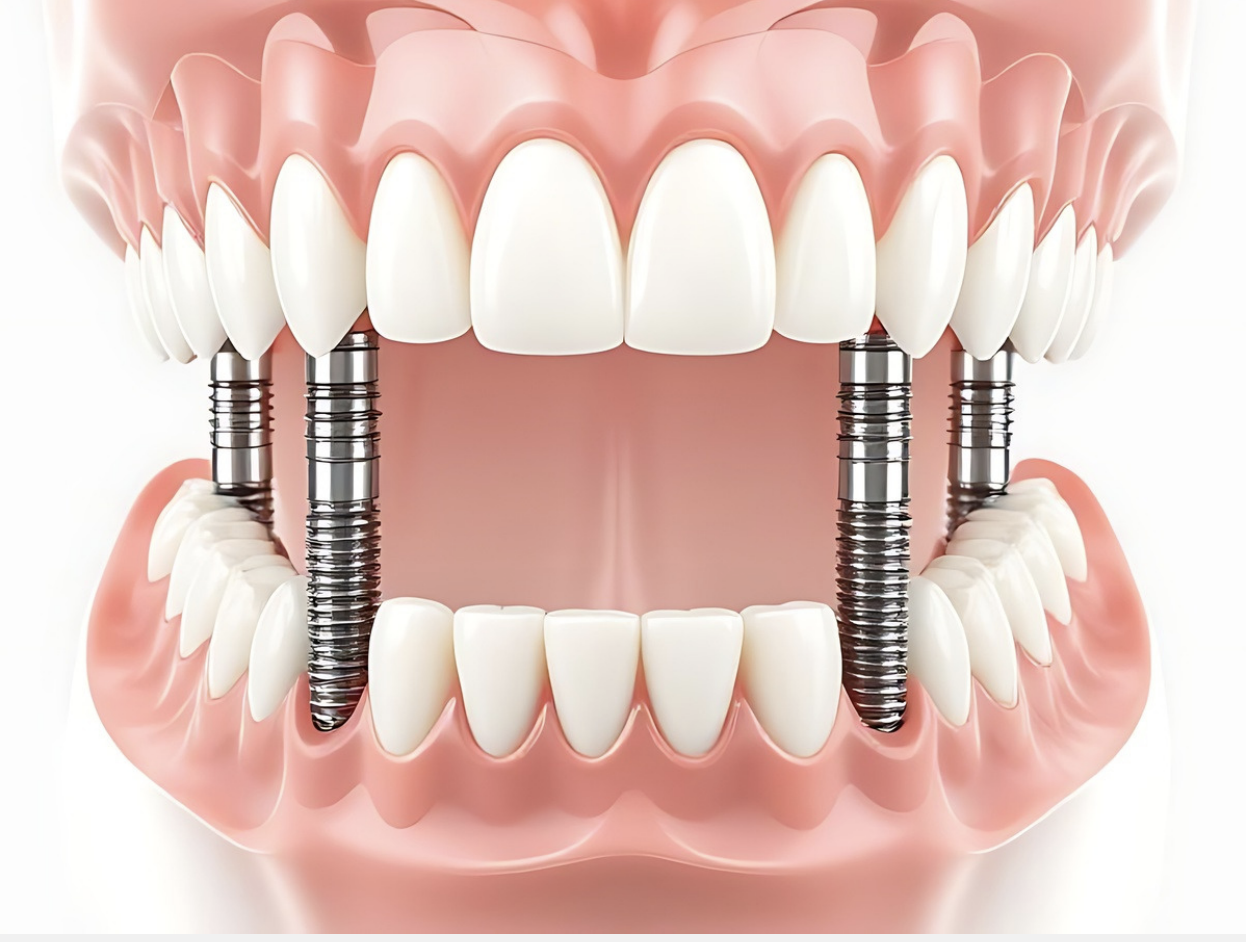
The fundamental innovation behind All-on-4 lies in its strategic use of implant angulation to maximize contact with available bone. While traditional implant placement positions each implant vertically, All-on-4 places the two posterior implants at angles up to 45 degrees. This angled positioning serves multiple mechanical purposes: it avoids anatomical structures like the maxillary sinus in the upper jaw and the inferior alveolar nerve in the lower jaw, while simultaneously increasing the surface area contact between implant and bone.
From a biomechanical perspective, the angled implants create what engineers call a “wider polygon of support.” Picture four legs on a table—if you angle the back two legs outward, you create a more stable base than four vertical legs positioned closer together. The same principle applies here, where the angled implants distribute chewing forces over a broader area of the jawbone, reducing stress concentration on any single implant.
Osseointegration—the biological process where bone cells grow directly onto the implant surface—occurs identically whether implants are placed vertically or at an angle. The titanium surface of each implant undergoes the same chemical bonding with bone tissue over the 3-6 month healing period. However, the angled placement often allows implants to engage denser bone in the anterior region of the jaw, where bone quality typically remains higher even after tooth loss.
This mechanical advantage explains why All-on-4 can support immediate loading with a temporary prosthesis on the day of surgery, while traditional methods often require months of healing before any restoration can be attached. The distributed force pattern and strategic bone engagement provide sufficient stability to handle the modest chewing forces patients can generate during the initial healing phase.
What Happens During the Step-by-Step Surgical and Prosthetic Procedure?
The All-on-4 process unfolds in carefully orchestrated stages that transform a patient’s oral situation in a single day. Understanding each phase helps clarify why this approach works and what patients actually experience during treatment.
How Is the Implant Surgery Performed?
Surgery begins with precise mapping of implant positions using 3D imaging and surgical guides created from the patient’s CT scan. After administering local anesthesia or sedation, the surgeon makes small incisions to access the jawbone at the four predetermined sites. The key surgical skill lies in achieving the exact angles and depths planned during treatment planning—especially for the posterior implants, which must navigate around anatomical structures while maximizing bone contact.
Each implant site is prepared using gradually increasing drill sizes, with constant irrigation to prevent overheating of the bone tissue. The surgeon monitors drill depth and angulation in real-time, as even small deviations from the planned position can affect the final prosthetic fit. Once all four implants are placed, healing abutments or temporary attachments are connected to each implant, creating the foundation for the prosthetic restoration. The entire surgical phase typically takes 2-3 hours, depending on bone quality and any necessary extractions.
How Is the Immediate Fixed Prosthesis Attached?
While the patient recovers from surgery, the dental laboratory fabricates a temporary acrylic prosthesis that was pre-designed based on the surgical plan. This temporary bridge attaches to the four implants using screws that access through small holes in the biting surface of the prosthetic teeth. The immediate prosthesis serves multiple functions: it provides patients with functional teeth right away, protects the implant sites during healing, and maintains facial support that prevents the sunken appearance common after tooth loss.
The temporary restoration is intentionally designed with limited contact on the back teeth, directing most chewing forces to the front implants where bone is typically denser. Patients receive specific dietary instructions limiting them to soft foods during the first 3-4 months while osseointegration occurs. After the healing period, the temporary prosthesis is replaced with a final restoration made from stronger materials like zirconia or porcelain-fused-to-metal, designed to handle normal chewing forces long-term.
Who Is a Good Candidate and What Bone Health Factors Matter?
Patient selection for All-on-4 depends primarily on bone volume and density in specific areas of the jaw, rather than overall bone health. The anterior region of both upper and lower jaws typically retains adequate bone even years after tooth loss, which is why All-on-4 can often succeed in patients who wouldn’t qualify for traditional implant approaches without extensive bone grafting.
Ideal candidates have at least 10mm of bone height in the anterior region and sufficient width to accommodate implant placement. However, the angled posterior implants can often find adequate bone even when the back areas of the jaw have experienced significant resorption. In the upper jaw, the angled placement frequently allows implants to avoid the maxillary sinuses entirely, eliminating the need for sinus lift procedures that traditional approaches require.
Certain medical conditions can impact implant success rates. Uncontrolled diabetes affects healing and osseointegration, while medications like bisphosphonates for osteoporosis can impair bone remodeling around implants. Heavy smoking significantly increases the risk of implant failure, particularly during the critical first months of healing. However, patients with well-controlled systemic conditions and realistic expectations about healing timelines often achieve excellent outcomes.
The most challenging cases involve patients with severe bone loss extending into the anterior jaw regions. When bone height falls below 8mm in the front areas, or when bone density is severely compromised throughout the arch, all-on-4 dental implant solutions may still be possible with supplemental procedures like guided bone regeneration, though this extends the treatment timeline and complexity. Advanced 3D planning helps determine candidacy by measuring bone volume and density at each proposed implant site before surgery begins.
What Are the Long-Term Outcomes and Maintenance Needs?
Research tracking All-on-4 implants over 10+ years shows survival rates consistently above 95% for lower jaw restorations and 90-95% for upper jaw restorations, with the slightly lower upper jaw success rates attributed to generally softer bone quality in the maxilla. These outcomes compare favorably to traditional implant approaches and far exceed the longevity of conventional dentures or bridges.
Functionally, patients typically regain 70-80% of their original chewing efficiency within six months of receiving their final prosthesis. This represents a dramatic improvement over removable dentures, which typically provide only 20-25% of normal chewing function. The fixed nature of All-on-4 restorations eliminates concerns about slipping or adhesives while speaking or eating, contributing to improved confidence and social comfort.
Maintenance requirements center around daily hygiene and regular professional care. Patients must clean around each implant using interdental brushes or water flossers to remove plaque and food debris from areas where the gums meet the prosthesis. Regular dental visits every 3-4 months allow professionals to remove the prosthesis periodically for thorough cleaning of both the appliance and implant sites. This maintenance routine prevents peri-implantitis—an inflammatory condition that can jeopardize implant stability if left untreated.
The prosthetic restoration itself typically requires replacement every 10-15 years, as normal wear gradually affects the artificial teeth and connecting components. However, if implants remain healthy and stable, this replacement involves only the prosthetic portion, not the implants themselves. This predictable maintenance cycle allows patients to budget for long-term care while enjoying the benefits of fixed teeth throughout each prosthetic lifecycle.
What Risks and Complications Should Patients Know About?
Like any surgical procedure, All-on-4 implant placement carries inherent risks that patients should understand before treatment. Immediate post-operative complications include bleeding, swelling, and temporary numbness from proximity to nerves during surgery. These acute issues typically resolve within days to weeks and can be managed with appropriate medications and post-operative care.
More serious complications can occur during the osseointegration period. Implant failure—where the implant doesn’t integrate properly with bone—affects roughly 2-5% of All-on-4 cases. This risk increases significantly in patients who smoke, have uncontrolled diabetes, or fail to follow post-operative instructions regarding diet and oral hygiene. When an implant fails, it usually becomes loose within the first 3-6 months and requires removal and possible replacement.
Infection around implant sites, known as peri-implantitis, represents a long-term risk that develops gradually over years. Poor oral hygiene, smoking, and certain genetic factors increase susceptibility to this condition. Early stages can often be treated with professional cleaning and improved home care, but advanced cases may require surgical intervention or even implant removal.
Mechanical complications with the prosthetic restoration include screw loosening, chipping of artificial teeth, or complete framework fracture under excessive force. Modern materials and improved designs have reduced these issues significantly, but they still occur occasionally, particularly in patients who grind their teeth at night or habitually chew hard objects. Most mechanical problems can be repaired without replacing the entire prosthesis, though they do require prompt professional attention to prevent more extensive damage.
Understanding these potential complications allows patients to make informed decisions and recognize warning signs that require immediate professional evaluation. The key to long-term success lies not in avoiding all risks, but in choosing qualified providers, following post-operative protocols carefully, and maintaining excellent ongoing oral hygiene habits that support both implant health and prosthetic longevity.