


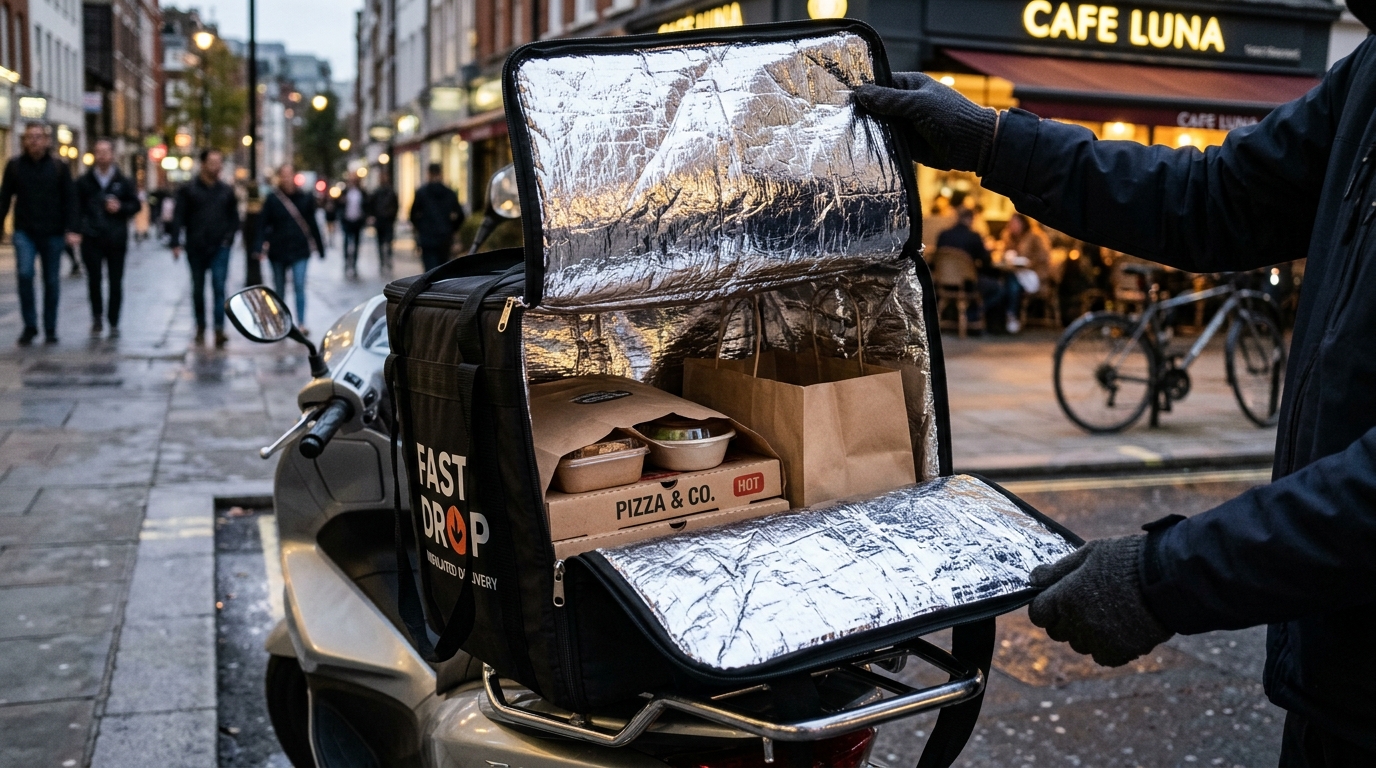
Commercial delivery operations depend heavily on temperature control for their success or failure. A pizza that is delivered lukewarm, a burger with a soggy bun, or sushi that has been warmed up during the delivery, these small failures lead to real financial losses for restaurants in terms of refunds, negative reviews, and loss of loyal customers.
Heat-reflective liners inside delivery bags are one of those unglamorous pieces of equipment that by themselves, silently fix a lot of these problems. If you ever questioned why some delivery bags feel very light and shiny on the inside, whereas others use just thick foam, it is the difference made by reflective liners that you are seeing. They are not just a sales trick. They work on the same principle that is used to make emergency blankets effective and to keep the hardware in space from getting too hot when exposed to direct sunlight.
This is what they actually do, and the main reason that commercial kitchens running high-volume delivery so much need them is explained in this article.
How Heat-Reflective Liners Actually Work
Heat travels through three different ways: conduction, convection, and radiation. Normal foam insulation can deal with conduction and convection quite well since it traps the air inside small pockets and slows down the heat transfer through materials. What foam doesn’t really do is radiant heat – the invisible energy that hot food constantly emits in all directions.
A heat-reflective liner, usually a thin aluminized film or metallized polyester, sends that radiant energy bouncing back at the food instead of letting it leak through the bag walls. The same liner also turns back external radiant heat, which explains why these bags do great jobs both for hot meals and cold items like ice cream or raw fish deliveries.
The calculation is straightforward. For a half-hour delivery, foam alone might keep roughly 60 to 70 percent of a meal’s heat. But together with a correctly sealed reflective layer, you’re getting 85 to 95 percent retention under similar conditions. That difference is exactly the time that sets apart a pizza that’s still steaming from a pizza which is just warm.
Keeping Food in the Safe Temperature Zone
Most food safety regulators in different territories set the temperature danger zone between 40F and 140F (4C to 60C). Hot food that is prepared should always be kept above the higher limit, and cold foods should be kept below the lower limit. However, if food stays for a long time in the middle, bacteria will grow quickly.
For a delivery driver who is handling three orders in a densely populated downtown area, that would be a real problem. A hot meal can go down to the danger zone in 20 to 30 minutes without good insulation and reflective lining. That is not a case of speculation – it is actually the reason why health inspectors ask more and more about transport equipment in their audits.
Reflective liners make the safe window is much longer. Restaurants that used to restrict their delivery time to 15 or 20 minutes are now able to extend that to 35 or 40 minutes without any worries when their delivery bags consist of insulation and a high-quality reflective layer. In terms of a business, that means a larger market base without having to hire more drivers.
Food Quality Beyond Just Temperature
Temperature is the main subject of discussion, but there is a lesser-known problem that reflective liners can tackle: moisture control. When hot food is left in a container that does not retain heat properly, the steam will cool down and condense on the walls of the container, which are colder, and then the water will drip back onto the food. This is the reason fries become limp, pizza crusts get rubbery, and breaded items lose their crispiness.
Since reflective liners help maintain a warmer and more constant interior environment, the amount of condensation is significantly reduced. The steam that the food produces will remain as vapor for a longer period of time and thus will not become water droplets as quickly. Reflective liners are not a complete solution – ventilated bags and proper packaging are still important – but it is a major improvement that customers notice even if they do not know exactly why.
For restaurants building their reputation on delivery as a core channel, this matters. A customer who gets a crisp, hot meal ordered from a mile away is more likely to reorder than one who got the same food in soggy, mediocre condition. Quality food delivery bags with proper reflective liners are one of the cheapest forms of quality control a kitchen can invest in.
Operational and Financial Benefits for Businesses
The price to switch to reflective-lined bags is typically 30% to 80% higher than regular foam-only ones. Sometimes the operators do a double take. However, the calculations show that a bad delivery really costs quite a lot and so it’s better to go for an upgrade.
According to the industry, one of the main causes why customers ask for a refund is product temperature or quality. A refund is not only the amount of the order but the original food cost, the time of the driver, the commission of the platform that still gets charged in most cases, and the negative impact of a one-star review. Preventing one or two refunds per week may fund the purchase of an entire set of upgraded bags in less than a month.
Last but not least comes durability. Compared to simple foams, aluminized liners are more resistant to stains and odors. Foam surfaces, which get easily greasy, don’t have that protective layer and so get a bad smell quite fast. Such reflective bags are also very good for the environment as they do not get discarded as often as the non-reflective ones.
Choosing and Maintaining Reflective-Lined Bags
Not all reflective liners are created equal. Less expensive bags sometimes contain a very thin metallic film that looks like metal and can be peeled off and torn within a few weeks of use, especially along parts that are frequently handled by drivers. Usually, the points of entry where food is pulled out. It is a good idea to get a bag where the liner is bonded to a fabric substrate rather than glued directly to foam. Also, find out if the seams are stitched and taped rather than just glued.
Cleaning is really simple but people often forget about it. After every shift, wipe the inside of the bag with a cleaner that is safe for food, and do not use rough scrubbing pads that might scratch the surface of the reflective liner. Although a reflective liner that has been scratched or is very scuffed will lose some of its effectiveness over time, it will not completely stop working like foam that has been compressed.
For large operations, it may be a good idea to try out different types of bags before deciding on purchasing them for the entire fleet. Place a thermometer inside a sample order and record the temperature after 30 and 45 minutes in real delivery conditions. Numbers on a specification sheet do not always correspond to what happens in real life, especially when you consider the fact that drivers not only load but also unload bags during their route.
The Bottom Line
Reflective liners for heat have been around for a long time – not a breakthrough invention – but they are still quite scarce in commercial deliveries. Businesses that don’t consider the delivery bags seriously usually have to pay the price with refunds, bad reviews, and losing customers. Those who spend on high-quality products are likely to experience fewer complaints, more content drivers who are willing to cover larger areas without additional cost.
If your present system is foam-insulated only, doing a trial with reflective-lined bags for a week is an almost risk-free method of judging the difference. By the time you have the weekend rush, you are likely to have enough evidence without even saying a word.