


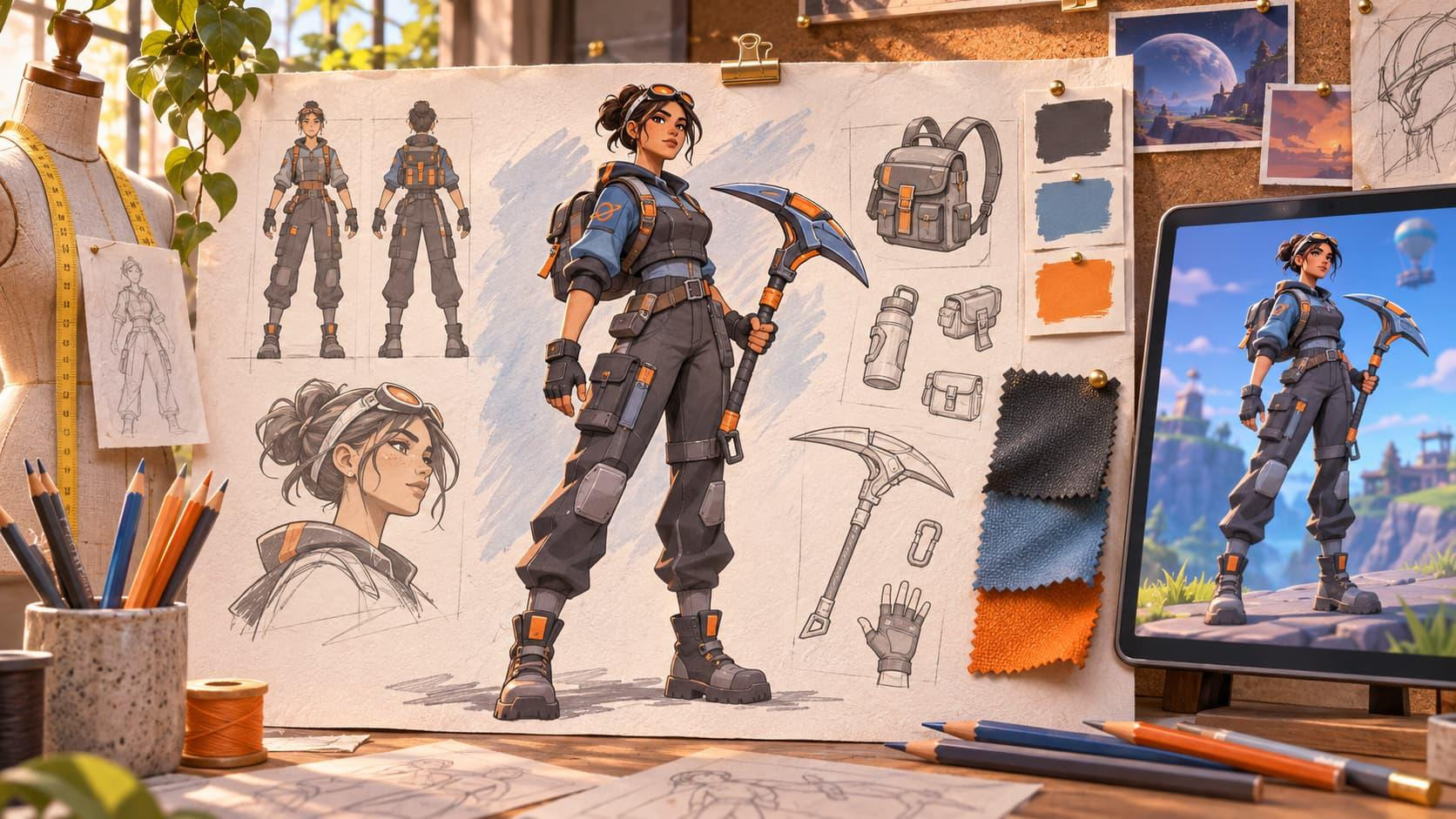
A costume can introduce a character before they speak. A sharp silhouette suggests confidence; weathered equipment hints at a difficult journey; an unexpected colour can turn a serious figure into something playful. The same visual thinking can make styling a Fortnite character more interesting.
For anyone drawn to theatre, dance, illustration, or fashion, the Locker offers a small exercise in character design. Instead of assembling the most expensive combination, approach it as a creative brief: who is this character, and what should their appearance communicate?
Start with a character, not a shopping list
Give your character a short description before choosing accessories. Think “an exhausted space courier,” “a glamorous comic-book villain,” or “a street dancer who explores abandoned cities.”
A specific idea gives you something to judge each choice against. A battered backpack might suit the courier, while an oversized decorative accessory could belong to the villain.
Keep the story simple enough to express visually. You do not need a detailed biography; three descriptive words can work. “Playful, futuristic, practical” gives clearer direction than “something cool.”
Before browsing GameBoost or considering new purchases, look through what you already have. An existing item may become more interesting when placed in a different context.
Build a colour palette with a clear lead
Choose a dominant colour, a supporting colour, and one accent. This gives the eye somewhere to settle without requiring every piece to match exactly.
For a futuristic courier, you might use charcoal as the base, muted blue for supporting details, and orange as the accent. A small orange detail on the outfit could connect visually with a tool or accessory.
Pay attention to colour intensity, too. Two blue items can feel unrelated if one is softly faded and the other glows brightly.
Try repeating a small colour rather than covering the character in it. A restrained connection often feels more deliberate than matching everything from head to toe.
Check the silhouette from every angle
Costume design involves shape as much as colour. A broad accessory can make a character feel imposing; a compact one can suggest speed or practicality.
Consider the outline of the entire combination. If the outfit already has dramatic shoulders, a large back accessory may compete with its strongest feature.
View the character from behind as well as the front. Think about whether the arrangement still makes sense when the face and chest details are less prominent.
You can also experiment with contrast. A simple outfit might benefit from one exaggerated shape, while a visually busy character may look more coherent with quieter accessories.
Treat accessories as props with a purpose
A stage prop can reveal occupation, personality, or history. Apply that idea to a pickaxe, back accessory, or glider.
Ask why your character would carry it. Does it look like equipment, a treasured possession, or a deliberately theatrical statement?
The answer does not need to be realistic. A comic character might carry something absurd precisely because it supports the joke. What matters is having a reason for the combination.
If one missing item would complete the idea and you decide to buy v bucks, check the full cost and delivery requirements first. Choose the item because it serves the design; avoid reshaping the whole concept around an impulse purchase.
Consider movement as part of the costume
A look that works in a still image may feel different in motion. Watch how its shapes and details read while the character moves.
An emote can also help establish personality. A relaxed gesture, an energetic dance, or a dramatic flourish can suggest different versions of the same character.
Think of this as a brief performance test. Does the movement reinforce the character you imagined, or introduce an interesting contradiction?
Make one final edit
Finish by removing one element and comparing the result. The strongest combination may need fewer competing details.
Save a screenshot, step away, then return with fresh eyes. If the character’s personality still reads clearly, your choices are working together. That is the reward of approaching a Fortnite look as costume design: creating a character whose appearance tells a story.