


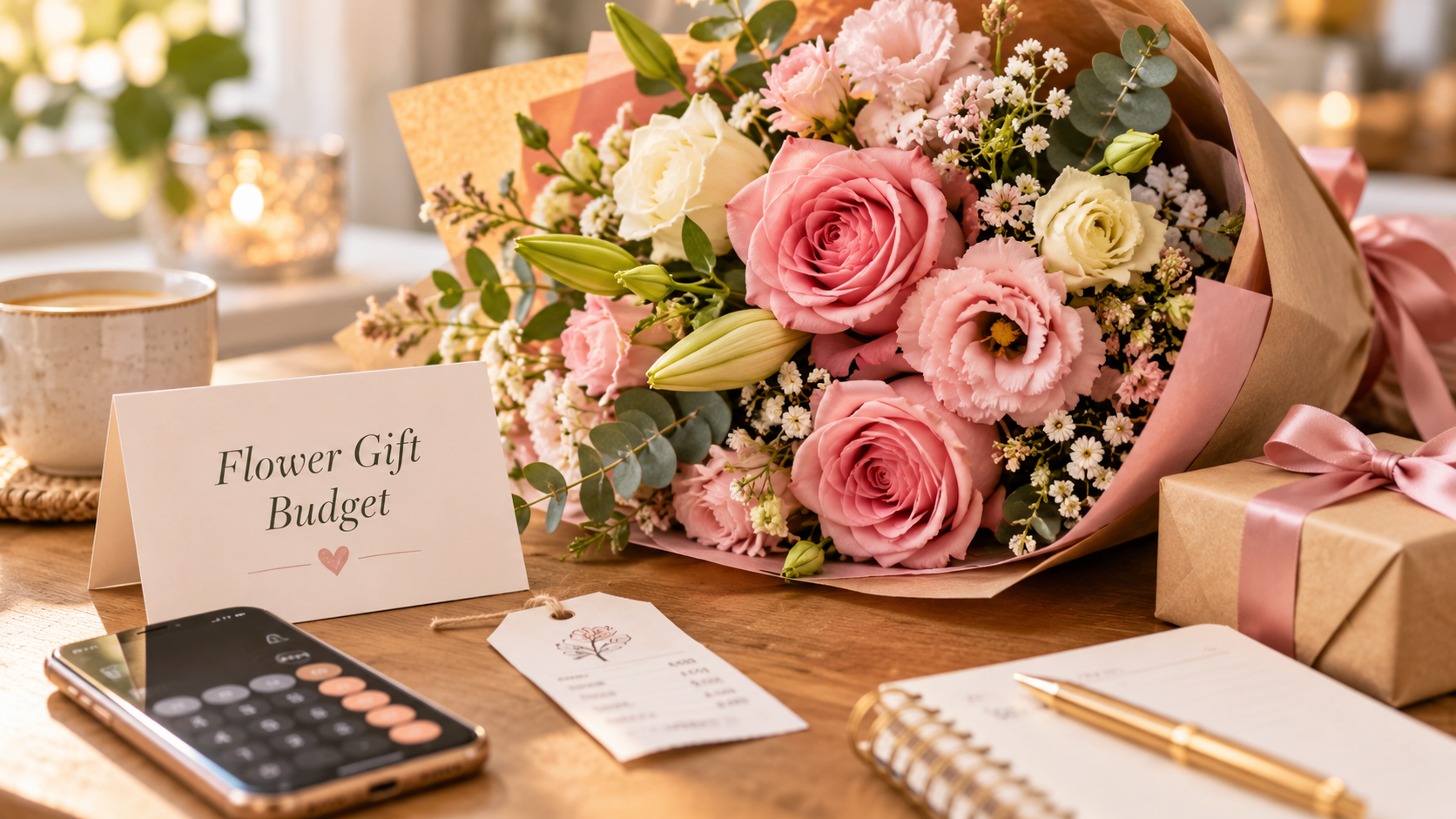
Twenty dollars is the number most people say out loud when you ask what they’d spend on flowers for someone they like. Then they see the delivery fee, the vase upgrade, the card, and they panic and buy the $89 arrangement instead. I’ve watched this exact spiral happen in flower shops for years, and the fix isn’t willpower. It’s a number you decide before you ever open a browser tab.
So here’s the promise: by the end of this piece you’ll have a repeatable way to pick a flower budget in about ninety seconds, adjusted for who the flowers are for and what the occasion actually demands. You’ll also get a short list of the fees that quietly blow budgets apart, and a simple rule for when it’s fine to go cheap and when cheap reads as careless. Whether you plan to order flowers online for a birthday or pick up a bunch on the way to dinner, the same approach applies.
Start With the Relationship, Not the Price Tag
Flowers are a signal, and signals have a going rate. Your budget should track the size of the message, not the size of the bouquet in the photo. I’d rather see someone spend $30 with real intention than $120 out of guilt.
Here’s the lens I use with clients. Tier one is casual: a coworker’s birthday, a thank-you, a neighbor who fed your cat. Tier two is meaningful: a close friend, a parent, a long-distance partner you miss. Tier three is the big four: anniversaries, apologies, funerals, and the days when someone you love needs to feel held.
Tier one lives in the $25 to $45 range. Tier two runs $50 to $90. Tier three is where $100 and up makes sense, and where the arrangement itself matters less than the timing and the note. Notice that none of these tiers cares about your income. That’s the point. The tier tells you the shape of the gesture, and then you fit the dollars to your month.
Give the Gift Its Own Line in Your Month
Most flower budget disasters are calendar problems, not florist problems. Three birthdays, a wedding, and Valentine’s Day land in the same six weeks, and suddenly every gift feels expensive.
Pull up your last three months of spending and count what you actually spent on gifts, not what you meant to spend. Roughly a third of U.S. households spend more than they expect on gifts during holiday months, and the pattern repeats for spring weddings. According to the Bureau of Labor Statistics, household spending tracks closely to income and life stage, which is a dry way of saying your gift line should look different in your twenties than it does at forty.
Set a monthly gift number, divide it by the number of gift occasions you expect, and let that be your ceiling. If the math gives you $38, your tier one gifts are $38 gifts this month. No shame in it.
One practical trick: keep a running note on your phone of everyone you buy flowers for and the date you last sent them. You’ll stop double gifting the same person in the same season, which is where a lot of the waste hides.
The Fees That Break the Number You Chose
You picked $60. You’re going to spend $78. Here’s why, and here’s how to defend the line.
Delivery is the big one. Same-day delivery usually costs more than a standard window, and rural zip codes cost more than city ones.
Then there’s the vase. Many listings show the blooms, then add the container at checkout, and a decent glass vase can run $15 to $25 on its own. Add a Mylar balloon, a box of chocolates, or a hand-written card upgrade and you’re thirty dollars past your number before you’ve blinked.
A few ways to hold the line:
- Send flowers, skip the add-ons. The arrangement is the gift. Chocolate at the grocery store costs a fifth of the add-on price.
- Pick a standard delivery window. Saving the rush fee often means the flowers arrive a day early, which nobody has ever complained about.
- Check whether a vase is included. If the recipient owns a single vase, skip the paid one. If they don’t, the vase is part of the gift and worth the money.
- Book ahead for peak dates. Prices and slots on Valentine’s Day and Mother’s Day are tightest in the final 48 hours.
My honest take: if you’re choosing between a bigger bouquet and a vase the person will keep, buy the vase. It sits on the counter for years and reminds them of you.
When Cheap Is the Right Call, and When It Isn’t
Cheap flowers can look thoughtful. Cheap flowers can also look like you grabbed something at a gas station at 11 p.m. The difference is almost always the choice of flowers, not the price.
Seasonal and local stems go further for less. In spring, tulips and daffodils are cheap and cheerful. In late summer, sunflowers and zinnias do the heavy lifting. In December, a simple bunch of amaryllis or a small poinsettia reads generous at a fraction of a fancy mixed arrangement.
The U.S. Department of Agriculture tracks where cut flowers come from and when domestic growing seasons peak, which is why a seasonal stem often costs a third of an out-of-season import.
Cheap is the wrong call for apologies, funerals, and hospital visits. In those moments, the recipient is reading how much care you took, and a $20 grocery bunch from someone who should know better lands badly. Spend the extra forty dollars. You won’t remember it in a year; they might remember it for a decade.
A Ninety-Second Decision Walkthrough
Let’s run one real scenario. It’s a Tuesday. Your sister’s birthday is Thursday, she lives two states away, and you have $70 total to spend.
Step one: tier. Sister, close relationship, birthday. Tier two.
Step two: budget. $70 including delivery, so the arrangement needs to land around $45 to $50. Step three: browse with a filter. If you want to order flowers for delivery, sort by price and pick the tier that leaves room for the delivery fee, then skip the vase if she has one.
Step four: write the note yourself. A five-line note about the time you both got lost in Seattle does more emotional work than an extra dozen roses and it costs nothing.
Step five: schedule the delivery window instead of paying the same-day rush.
Total spent: $68. Total regret: zero. Your sister cries a little. You feel like a hero, and you didn’t wreck your grocery budget to do it.
Two details worth naming because people skip them. First, check the delivery date promise on the listing itself, not the banner at the top of the site; the banner is optimistic and the listing is binding. Second, save the order confirmation. If the arrangement arrives looking tired, most shops will replace it, and they’ll ask for that email.
Make It Repeatable So You Stop Guessing
The real reason flower budgets feel stressful is that every purchase is a fresh decision with no system behind it. Here’s a small one you can build today, and the one I’d actually suggest you keep.
Call it the three-number rule. Write down your monthly gift ceiling, your tier two number, and your tier three number. That’s it. Three figures, somewhere in your phone, reviewed once a quarter. The census data on household composition is a reminder that your list of people changes over time, so revisit the numbers when someone enters or leaves your life. The
Census Bureau keeps the big picture; you keep the small one.
I’ve watched people use this for two years and the pattern holds: they spend less overall and feel better about every arrangement they send. The number does the worrying so you don’t have to.
So what’s your tier three number? Write it down before the next birthday sneaks up on you, and the whole thing stops being a scramble.