


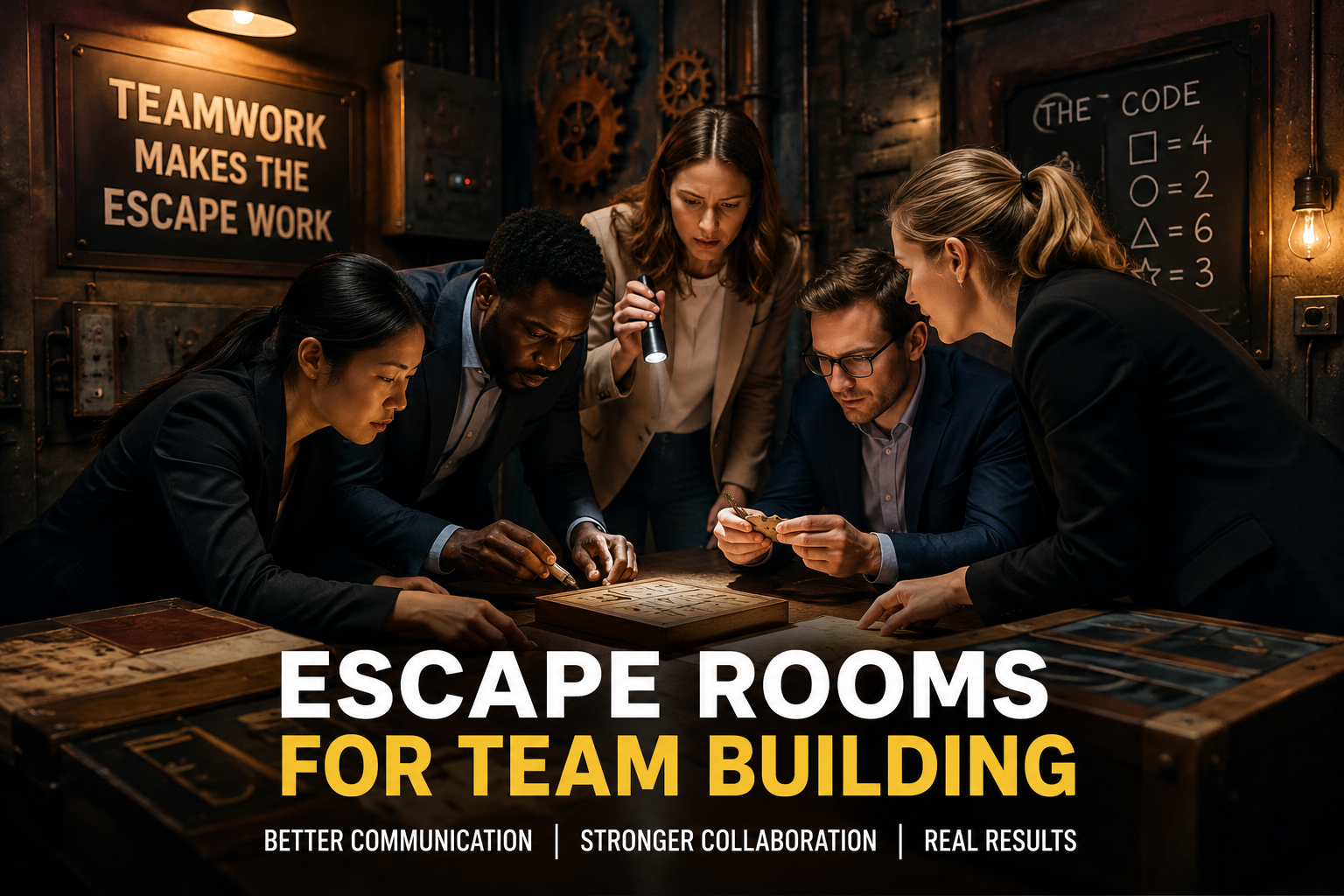
A few years ago, escape rooms were a Friday night thing. You’d book one with friends, panic over a padlock for sixty minutes, and grab dinner after. Now, HR managers, team leads, and event planners are booking them on Tuesday afternoons. In suits, with coworkers, on the company card.
The shift makes sense once you watch a team try to solve one. Strip away the desks and the project management software, and you see how a group really communicates under pressure.
From hobby to office tool
Escape rooms have moved well beyond the leisure category. Consultancies use them for new hire onboarding. Sales teams run them at offsites. Government agencies book them as part of leadership programs. The reason isn’t novelty. An hour inside a locked room shows you more about a team than a full day of slide decks ever will.
When the clock starts, hierarchy quietly disappears. The intern who notices the pattern in the wallpaper becomes the one giving instructions. The senior manager who usually runs meetings might be the one holding the flashlight. That kind of role swap tells a manager something a personality test never will.
What the room asks of you
Inside an escape room, you have a problem, a deadline and a team that may or may not have ever solved anything together. The puzzles aren’t really the point. The point is what you do when the easy answers run out.
Three things tend to happen. People talk more, and more clearly. There’s no time for long monologues, so you learn to share information in short, useful sentences. Roles take shape on their own: someone tracks clues, someone keeps the team calm, someone pushes back on the obvious answer. Nobody assigns these jobs. They fill themselves. And teams hit a wall, then push past it. The interesting moment isn’t the win. It’s the minute before, when everyone’s stuck and somebody has to suggest something risky.
Those habits don’t stay in the room. They show up the next morning, in standups and client calls.
Why classic team building has lost its grip
The trust fall has had a long run. So have the rope courses, the cooking classes and the breakout sessions where someone hands you a Sharpie and asks you to draw your “why.” A lot of people quietly dread these.
Escape rooms work because nobody has to perform sincerity. You’re solving a problem, not sharing your feelings about quarterly goals. The team building happens as a byproduct, which is part of why it sticks.
There’s also a competitive edge that adults rarely get to use at work. Splitting forty colleagues across multiple rooms and tracking who finishes first isn’t deep. But it’s fun, and fun is something most office events fail to produce.
On-site, online, or somewhere in between
One reason escape rooms scaled into the corporate world: the format bends. You can run a full physical room for a small leadership team, host an online version for a distributed crew working from five time zones, or build a hybrid setup where remote and on-site colleagues solve the same case from different ends.
For larger groups, say a 200-person company day, providers can split everyone into parallel teams playing the same game, then aggregate the scores. That kind of setup turns what would have been another buffet and icebreaker afternoon into something people actually talk about on Monday.
A Dutch outfit called The Box Company has built much of its work around this flexibility. They run a box escape room format that scales from five people to two thousand, on location or remote, which is the sort of range bigger employers tend to look for. They’re one of several providers working in this space, and a useful example of how the format keeps stretching to fit different group sizes and setups.
Picking a room that actually fits
Not every escape room fits every team. A few things worth checking before you book.
The difficulty curve matters. A room aimed at experienced players will frustrate a group of first timers, and a room built for tourists won’t push a senior team. Ask. Group size is the other one. Some rooms cap at six, so if you have forty people, you need a provider that can run parallel rooms or a format built for crowds. And then there’s the debrief. The good providers include a short conversation after the room: what worked, what didn’t, who picked up what role. That’s where the team-building part actually lands.
What you take back to the office
The puzzles fade quickly. People forget which key opened which box and what the third clue was. What sticks is the moment your colleague made a call you didn’t expect, or the time the quietest person on the team turned out to be the best at lateral thinking.
That’s the part teams keep using long after the timer ran out.