


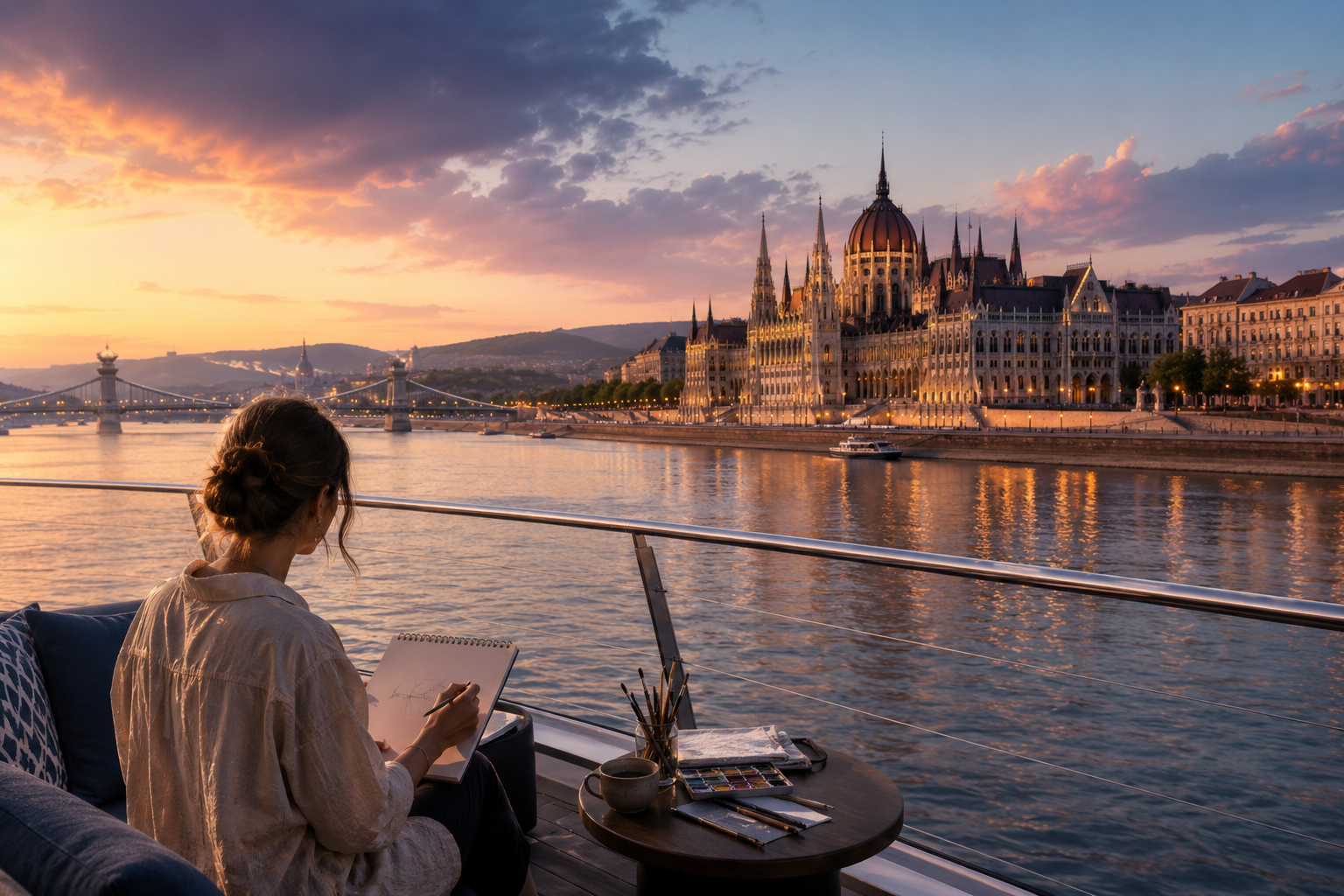
In the vibrant ecosystem of the NoHo Arts District, we understand that style is not merely an appearance; it is a form of communication. Whether it’s the movement of a dancer in a Lankershim studio or the composition of a mural on Magnolia Boulevard, our environments dictate our creative output. As we move through 2026, a new frontier for this visual dialogue has emerged far beyond the borders of North Hollywood. The Danube River, once seen through a purely historical lens, has been reimagined as a “Kinetic Gallery”—a 1,700-mile stretch of shifting aesthetics, textures, and light that is calling to the global creative community.
For the artist, the architect, or the designer, the river offers a specific kind of “Atmospheric Immersion” that a static studio cannot replicate. It is a world defined by the “Blue Hour” over the Hungarian Parliament, the brutalist silhouettes of Bratislava, and the baroque opulence of Vienna. To truly engage with these historic riverside cultural expeditions, the 2026 creator is looking toward the river as a source of “Information Gain” and aesthetic recalibration.
The Aesthetic of the “Moving Frame”
One of the core tenets of the 2026 arts movement is the concept of “Environmental Fluidity.” We are moving away from the “White Cube” gallery toward spaces that interact with the natural world. On the Danube, your vantage point is in constant motion. This “Moving Frame” creates a unique neurological response: it forces the eye to find new patterns and compositions in real-time.
As you glide toward the Wachau Valley or through the Iron Gates, the play of light on the water acts as a natural filter for the landscape. For a visual artist or a cinematographer, this is a masterclass in “Natural Diffusion.” The way the mist hangs over the gothic spires of Regensburg at dawn provides a texture that digital tools are still struggling to perfectly simulate. By inhabiting this space, the creator is not just observing art; they are moving through it.
Architecture as Narrative: From Baroque to Brutalism
The Danube serves as a physical timeline of European creative evolution. In NoHo, we value the intersection of different styles, and the river offers this on a grand scale.
- Vienna’s Operatic Opulence: The Ringstraße is a lesson in “Total Art”—where architecture, music, and social style converge. In 2026, events like Vienna Art Week are pushing the boundaries of “Learning Systems,” exploring how inherited traditions interact with emerging tech.
- Bratislava’s “Funny Signs” and Social Realism: The Slovakian capital offers a fascinating contrast between its medieval Old Town and the drab uniformity of its Communist past. For a designer, the imaginative statues like the Čumil (the manhole peeker) provide a lesson in “Public Whimsy”—the idea that art should live in the streets, not just on the walls.
- Budapest’s Art Nouveau Majesty: The city is a masterpiece of the “Secessionist” movement, where organic forms and intricate mosaics create a sense of “Living Architecture.” Arriving in Budapest by water allows you to see the city as its architects intended: as a dramatic, riverside performance.
The “Skillmaster” Series: Becoming Part of the Culture
In 2026, the creative traveler is no longer content to be a spectator. We want to be participants. Celebrity Cruises has recognized this by launching their “Skillmaster Series,” which allows guests to engage directly with the cultural DNA of the region.
Imagine a NoHo-based choreographer learning the precise geometry of a Viennese waltz from a master in a gilded hall, or a ceramicist mastering traditional Hungarian motifs in a centuries-old workshop. This is the “Relationality” of art—the understanding that our creativity is interconnected with the human and “more-than-human” actors of the places we visit. These historic riverside cultural expeditions are designed to foster this mutual support between the guest and the local artisan.
Technical Sovereignty for the Digital Artist
Even while traveling the “Blue Silk Road,” the 2026 creator remains a digital being. The transition to “Smart Ships” like the Celebrity Compass or the Celebrity Seeker ensures that the creative flow is never interrupted by technical friction.
With “Skylight Infinite Balconies” that dissolve the boundary between the stateroom and the river, the artist has a private, open-air studio. The availability of high-bandwidth Wi-Fi ensures that a high-resolution build or a 4K edit can be synced with a studio back in Los Angeles without latency. This is the “Closed-Loop” creative environment: the privacy to create, the beauty to inspire, and the tech to deliver.
The ROI of “Deep Rest” for the High-Output Creator
We often think of travel as a distraction from work, but for the creative professional, it is a vital part of the “Build.” In NoHo, where the pressure to produce is constant, “Sensory Neutrality” is a necessary palate cleanser.
The Danube provides this through its “Blue Spaces.” The rhythmic movement of the water and the vastness of the horizontal landscape lower the cognitive load, allowing the subconscious to synthesize complex ideas. Returning to the NoHo Arts District after such a journey, the creator brings back more than just photos; they bring back a renewed “Visual Language” and a fresh perspective on their own practice.
Conclusion: The Final Composition
The NoHo Arts District is defined by its ability to blend the traditional with the avant-garde. In 2026, the Danube offers the same opportunity on a continental scale. It is a river that respects the complexity of its past while embracing the innovation of its future.
By choosing to engage with historic riverside cultural expeditions, the artists and designers of 2026 are ensuring that their work remains grounded in the physical reality of our world. The Danube is not just a destination; it is a catalyst. It is a reminder that the best art is produced when we step out of our comfort zones and into the flow of the world. The river is moving—it’s time to find your place in the frame.