


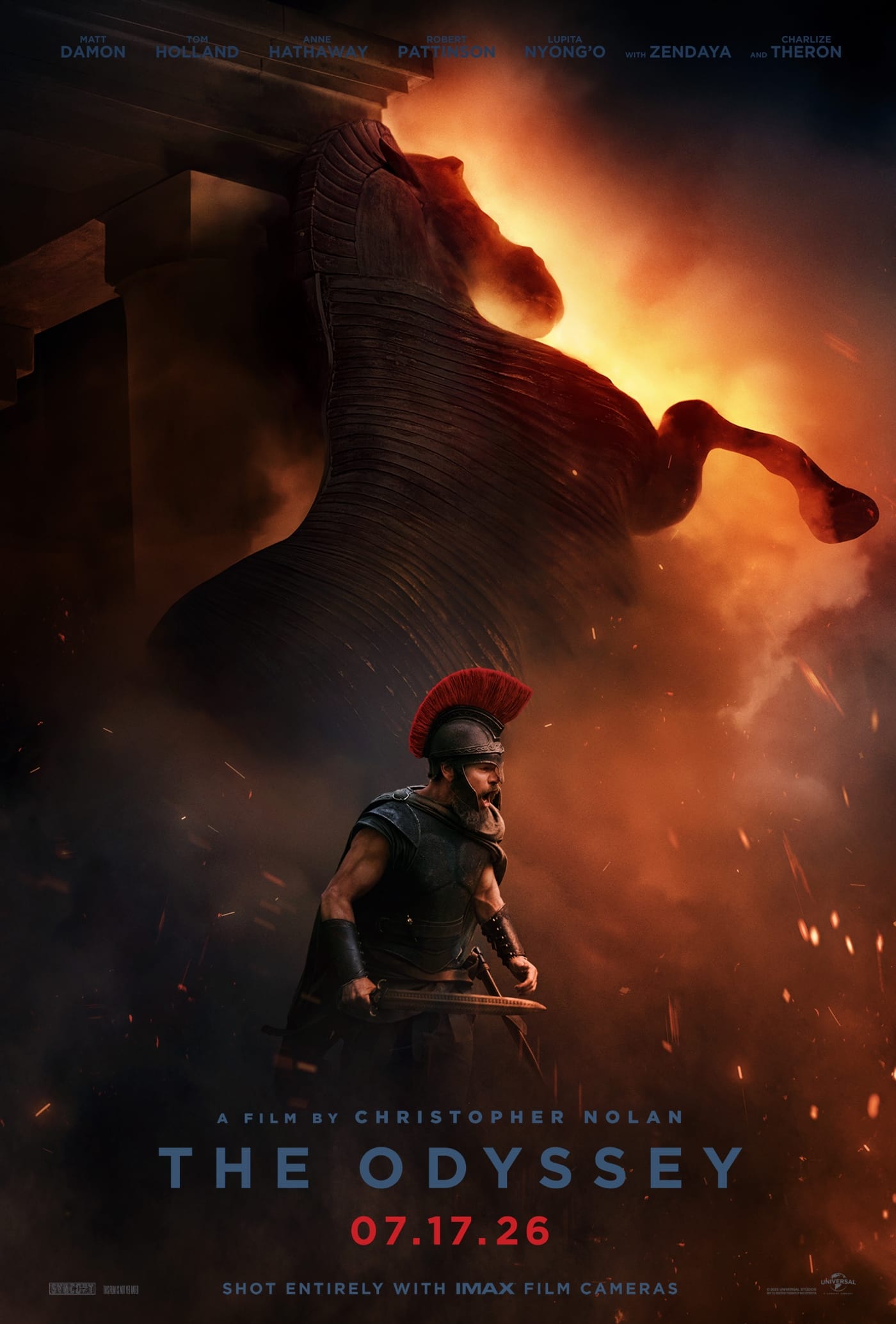
[NoHo Arts District, CA] – In this week’s movie and TV review blog, Mike Peros reviews Christopher Nolan’s ambitious adaptation of Homer’s epic, The Odyssey.
Christopher Nolan’s The Odyssey certainly received plenty of attention before its release. To name a few: concerns over fidelity to the source material; casting issues like Lupita Nyong’o as Helen (heck, even Matt Damon as Odysseus); the limited (as in “non”) use of Greek actors in this adaptation of the very Greek Homer’s epic poem. As a Greek (American-born), I must tell you…this was of no concern to me—I was only hoping Nolan would assemble a fine cast and deliver the goods for this ambitious epic. And by and large, he did. It’s a long film—but it does depict an epic journey, complications (and contemplations)—which would be hard to contain in under two hours, and Nolan’s riveting epic captures the viewer’s attention for nearly three.
If you remember The Odyssey, Homer’s Odysseus is a heroic, clever, albeit arrogant warrior king who’s got quite a journey to make before he gets home to his patient wife Penelope—and all the prospective suitors who are pressuring her to decide as to whom she’ll wed next since Odysseus has been away for nearly twenty years and could be dead for all she knows (though we know different). Though many of the events from Homer’s Odyssey remain, this is a different take on the tale. Nolan’s Odyssey is a brooding epic—mainly because for most of the running time, Odysseus is brooding, both guilt-and grief-stricken over his choices and actions—especially his actions in antagonizing the gods and suffering the loss of his men. Even though the events of Homer’s The Iliad predate the story, it’s very much on Odysseus’ mind—and the film’s depiction of Odysseus as being haunted by his role in conceiving the Trojan Horse and the brutal victory that transpired after the “gift” was accepted. And while the gods are ever present in the story, here they are represented by Athena (Zendaya), who is seen only by Odysseus—which has a powerful payoff toward the end.
For much of its length, the film juxtaposes Odysseus’ eventful and tragic journey home (depicted in flashback) with scenes of the steadfast (and not entirely content) Penelope waiting at home for his possible return, while enduring the boorish behavior of her house guests. (If you know your Homer and your Greek mythology—and even if you don’t—the film makes a big point of Zeus’ rule, namely that if you need to be a good host when guests arrive—since it may be a god in disguise—conversely, one should also be a good guest and not take advantage of their host’s hospitality. Breaking these rules could be – deadly. Or worse.) The film’s Odysseus is well aware of this rule, yet events and his own disposition conspire against him.
Odysseus’ journey is studded with several fine sequences. The scene with Polyphemus, the Cyclops, is probably embedded in anyone who has read the story, and the film’s interpretation doesn’t disappoint (with Bill Irwin as the glowering, gigantic figure). The film makes some changes—rest assured, Odysseus still antagonizes both the Cyclops and the gods, but…let’s just say this Cyclops isn’t as loquacious as the original. There are some harrowing scenes when Odysseus and his men come upon the Laetrogynians, who are depicted as armored storm troopers (rather than man-eating creatures—which might be good, since how many man-eaters can a story contain?). And the siege of Troy, doled out in bits and pieces, cumulatively has a powerful effect and adds a great deal to Nolan’s interpretation. (To that end, Eliot Page’s Sinon, a character not in Homer’s Odyssey, does an exceptional job.

Since this is a modern take on the ancient story, Penelope (Anne Hathaway) is even more enterprising and independent than she was in the original. (For his part, Odysseus’ son Telemachus is given more of an action hero role, especially since Tom Holland plays him). Robert Pattinson’s lead suitor is evil personified—but enjoyably so. Samantha Morton is a quirky, offbeat Circe—at least before she turns the men to swine. John Leguziamo is excellent as Odysseus’ devoted friend, Mentor. And Matt Damon himself is the perfect Odysseus for Nolan’s interpretation, projecting arrogance, integrity, insecurity, and regret, so that his Odysseus is more morally ambivalent than Homer’s. I do believe there are a few missteps. The beautiful and terrific Lupito Nyong’o isn’t given enough to do as both Helen and Clytemnestra—although, as Clytemnestra she is given a very good scene and makes the most of it. Charlize Theron is also on hand as Calypso, but here, she is depicted almost as a marginally sexier Dr. Joyce Brothers (“Tell me Odysseus, why are you so troubled?). And the final battle—incredible as it was in Homer’s story—is more protracted and even more implausible (Bourne anyone?). Caveats aside, Nolan’s The Odyssey is a significant achievement and one of the best films I’ve seen this year. But for the sake of the gods—please see it on the big screen.