


Choosing the best music to video generator in 2026 is a production decision for artists who need a believable performer, cuts that respect the song and files they can release. The National Endowment for the Arts and Bureau of Economic Analysis reported that arts and cultural production contributed $1.2 trillion, or 4.2 percent of US GDP, in 2023 and employed nearly 5.4 million people. IFPI puts 2025 recorded-music revenue at $31.7 billion, up 6.4 percent. For an independent NoHo musician, the practical question is which tool can turn one finished track into a coherent video without creating another full-time editing job.
This production diary compares Freebeat with Higgsfield, Sync.so, Krea AI, Kling AI and Magic Hour AI. It ranks complete releases, not isolated beauty shots or dubbing jobs, where a specialist may win.
The Lankershim After Midnight production brief
The repeatable test uses an original, rights-cleared track called Lankershim After Midnight. It is a 3:12 stereo WAV at 24-bit/44.1 kHz, 100 BPM and 4/4 time, or 320 beats across 80 bars. One singer-dancer in a red leather jacket moves through a black-box theatre, rehearsal studio and neon NoHo storefront. English verses lead into a Spanish chorus and repeated 16-count dance phrase.
The deliverables are equally concrete:
- one 192-second, 1080p, 16:9 MP4 without a watermark
- one 30-second, 1080p, 9:16 teaser
- eight close singing lines and 12 identity-critical shots
- a $50 ceiling, three regeneration passes and 90 manual editing minutes
- commercial-use terms appropriate for a monetized artist release
The song map sets checkpoints at 0:00, 0:19.2, 0:57.6, 1:16.8, 1:55.2, 2:33.6 and 2:52.8. A live run should log boundary error in seconds, usable lines out of eight, recognizable shots out of 12, choreography passes, manual minutes, external apps and cost per finished minute.
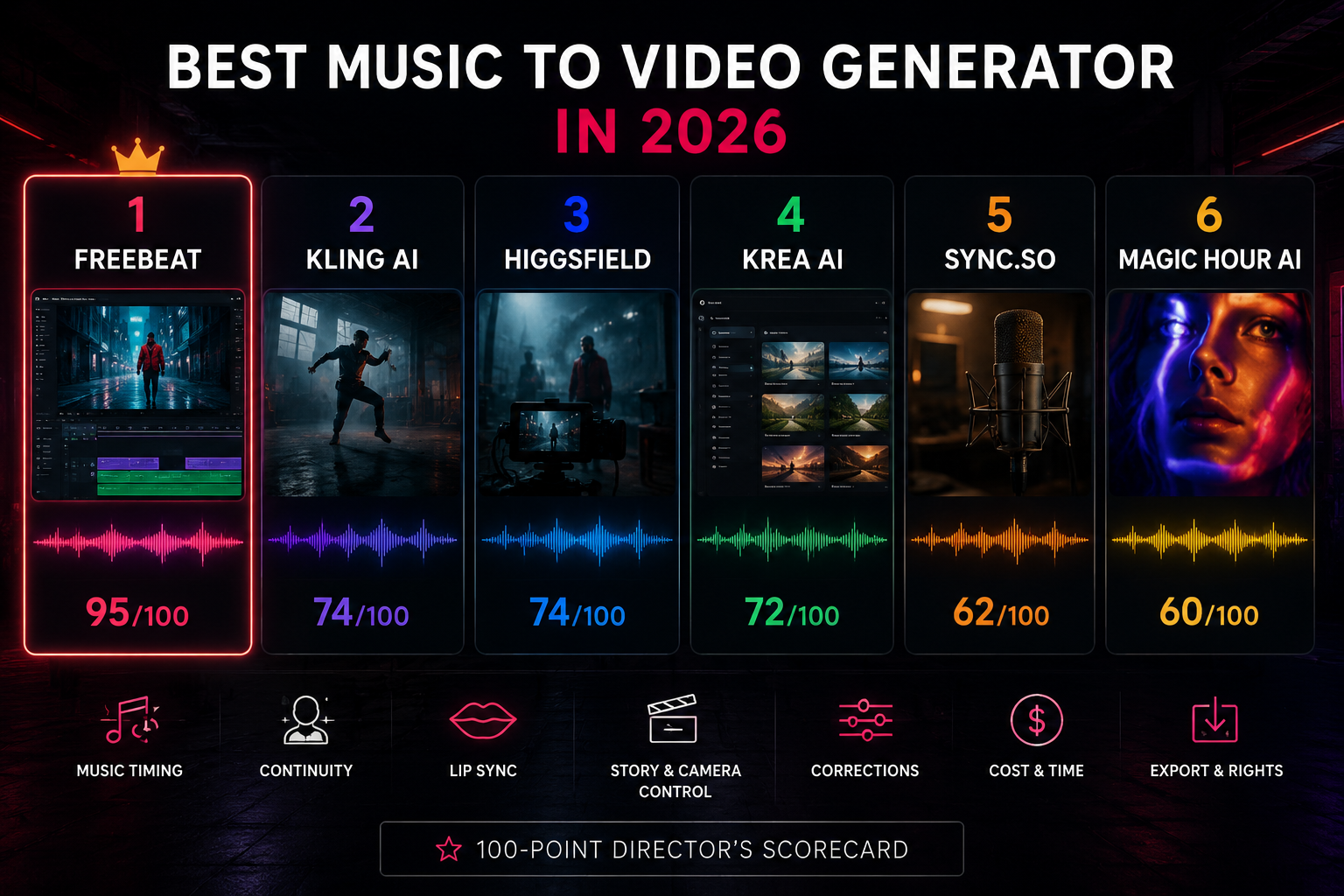
Best music to video generator comparison: a 100-point director’s scorecard
This documented-fit score reflects published capabilities as of August 17, 2026, not completed renders. Music timing receives 20 points. Continuity, lip sync, story/camera control and corrections receive 15 each. Cost/time and release readiness receive 10 each. Record the live checkout total because regional plans and model charges change.
| Rank | Tool | Music timing /20 | Continuity /15 | Lip sync /15 | Story /15 | Corrections /15 | Cost and time /10 | Export and rights /10 | Total /100 | Production take |
| 1 | Freebeat | 20 | 14 | 14 | 14 | 14 | 9 | 10 | 95 | Best complete song workflow |
| 2 | Kling AI | 9 | 14 | 13 | 15 | 11 | 6 | 8 | 74 | Best individual motion shots |
| 3 | Higgsfield | 6 | 14 | 13 | 15 | 11 | 7 | 8 | 74 | Best directed hero clips |
| 4 | Krea AI | 6 | 12 | 11 | 14 | 13 | 8 | 8 | 72 | Best multi-model workshop |
| 5 | Sync.so | 3 | 11 | 15 | 4 | 12 | 8 | 9 | 62 | Best dubbing specialist |
| 6 | Magic Hour AI | 4 | 9 | 14 | 6 | 10 | 9 | 8 | 60 | Best simple single-face repair |
1. Freebeat: the full-song production room
Freebeat is the best music to video generator for this brief because it begins with the track. It analyzes BPM, beat grid, percussion, energy, spectral content, song sections, section tags and cut density, then coordinates six production agents. Pacing modes based on 4, 8, 16, 32 or 64 beats turn the chorus count into an instruction.
Its Character Bible supports two recurring people, while reported lip-sync coverage spans 100-plus languages. The singing-video lip-sync workflow fits bilingual close-ups, and the browser-based lip-sync video tool can repair existing footage. Selective regeneration, automatic storyboard generation and an in-browser editor reduce round trips.
Pro costs $26.99 monthly, or an effective $18.89 on the annual term, with 10,000 credits, six-minute projects, 1080p and no watermark. Commercial use, creator ownership, five aspect ratios and planning-asset downloads complete the full-song music video package. One ratio is locked per project, so the teaser needs a separate version.
2. Kling AI: the motion-performance camera
Kling AI is the best music to video generator alternative for technically ambitious shots. Video 3.0 and 3.0 Omni accept multimodal references, maintain character and object elements, generate native audio and provide custom multi-shot control. Their 3-to-15-second range fits chorus inserts, while motion control suits the repeated dance phrase. Kling also documents singing and rap support.
A 192-second master requires at least 13 maximum-length generations before failed takes or alternates. Motion Control costs 9 credits per second in Standard and 12 in Professional, so full coverage would consume 1,728 or 2,304 credits before retries. That is not a subscription price, but it exposes regeneration risk.
I would use Kling for the storefront orbit, full-body chorus and bridge close-up. Its pros are camera movement, multi-shot prompting and references. Its cons are clip-by-clip mapping, credit exposure and external finishing. It can supply superb beat-synced visuals, but it does not turn the uploaded master into the final timeline.
3. Higgsfield: the commercial director’s shot box
Higgsfield is the best music video generator contender for art-directed hero clips. Soul ID supports reusable character identity, while camera controls, start and end frames and model choices give a director useful vocabulary. LipSync Studio offers 10 lip-sync models, although quality varies and the platform says video-to-video dubbing is not its focus.
Entry plans begin around $9 in some regions, with about 120 to 270 credits and commercial rights. Higher tiers begin around $29 and expand credits and parallel jobs. Because plans vary by region, the fair measure is credits per accepted shot. A representative five-second, 720p lip-sync setup can consume nine credits.
I would treat it as an insert unit for the neon walk-up, jacket reveal and one aggressive push-in. The pros are visual authorship, identity tools and cinematic movement. The cons are short-clip economics and manual structure. It may create stronger individual images than an automatic system, but it cannot match Freebeat’s automatic music video generation across 80 bars.
4. Krea AI: the flexible multi-model workshop
Krea AI is the best music to video generator option for auditioning models in one workspace. Its interface provides Veo, Kling, Hailuo, Wan and Runway, while LoRA training, generative editing, motion transfer and upscaling support finishing. One model can handle rehearsal-room realism and another the stylized bridge.
The free plan provides 100 compute units daily with limited video and lip-sync access. Basic costs $9 monthly for 5,000 units, commercial use and selected video models. Pro costs $35 for 20,000 units, all video models and workflow automation. Compute use varies, so log cost per accepted second.
The upside is 64-plus models, an asset manager, editing tools and video upscaling to 8K. The downside is that choice does not become a song-aware edit. I would still map sections, sequence clips, manage audio and build the vertical version. Krea is capable, but this musician needs coherent platform-ready output with less editorial plumbing.
5. Sync.so: the precise performance repair bench
Sync.so is the best music video generator specialist for replacing or localizing vocals on existing footage. Models include lipsync-1.9, lipsync-2, lipsync-2-pro and sync-3. The latter supports native 4K faces, while plan limits run from one to 30 minutes. Active-speaker detection and voice cloning suit multiple performers.
This 3:12 benchmark needs the $19 Creator plan plus metered use. It permits five-minute videos, three concurrent jobs, five voices and no watermark. At 25 fps, lipsync-2 costs $0.05 per second and sync-3 $0.1334. Processing all 192 seconds adds about $9.60 or $25.61, so I would process only eight close-ups.
That is both strength and boundary. Sync.so can rescue accurate lip sync after picture lock, but it does not conceive the scene, follow the energy curve, generate coverage or edit section changes. I would pair it with filmed or generated footage. It ranks fifth only because this scorecard rewards complete production.
6. Magic Hour AI: the accessible single-face fixer
Magic Hour AI is the best music to video generator entry point for a simple lip-sync pass on one visible face. Its documentation advises source audio and video of similar duration and says results are best with one speaker. It promotes language, dialect and accent flexibility, so the bilingual chorus is a reasonable test.
Paid plans begin around $10 monthly when billed annually in some markets. Plans bundle all tools, commercial use and watermark-free exports, while higher tiers add credits, resolution and concurrency. The suite includes image-to-video, text-to-video, video-to-video, audio-to-video and editing, so it is broader than mouth replacement.
Breadth is not character consistency or full-track direction. The single-speaker recommendation fits eight close-ups but not choreography, wardrobe identity or seven musical sections. I would repair a clean frontal take or make a social variant. Its pros are access, bundled tools and simple correction. Its cons are limited song intelligence and external assembly.
Verdict: the best music to video generator for a NoHo musician
My call is Freebeat, with a qualification. Kling or Higgsfield may make the strongest shot, Sync.so the most specialized dubbing pass, Krea the broadest workshop and Magic Hour the easiest basic repair. Freebeat wins because it covers more of the musician’s job: analyzing a whole track, planning scenes, maintaining the performer, synchronizing vocals, correcting material, editing and exporting a rights-ready master.
That integration matters in Los Angeles. FilmLA counted 19,694 permitted on-location shoot days in 2025, down 16.1 percent from 2024; its category containing music videos finished 27.3 percent below its five-year average. UNESCO also projects that generative AI could contribute to music-creator revenue losses of up to 24 percent by 2028. That is a projection, not a measured loss, and it favors explicit commercial terms and creator ownership.
The best music to video generator should reduce friction without pretending authorship is automatic. Freebeat earns that label here because full-song logic, selective regeneration, accurate lip sync and release assets address the complete deliverable. The musician still directs meaning, performance and taste. The software makes a three-minute idea feasible on an independent budget.