


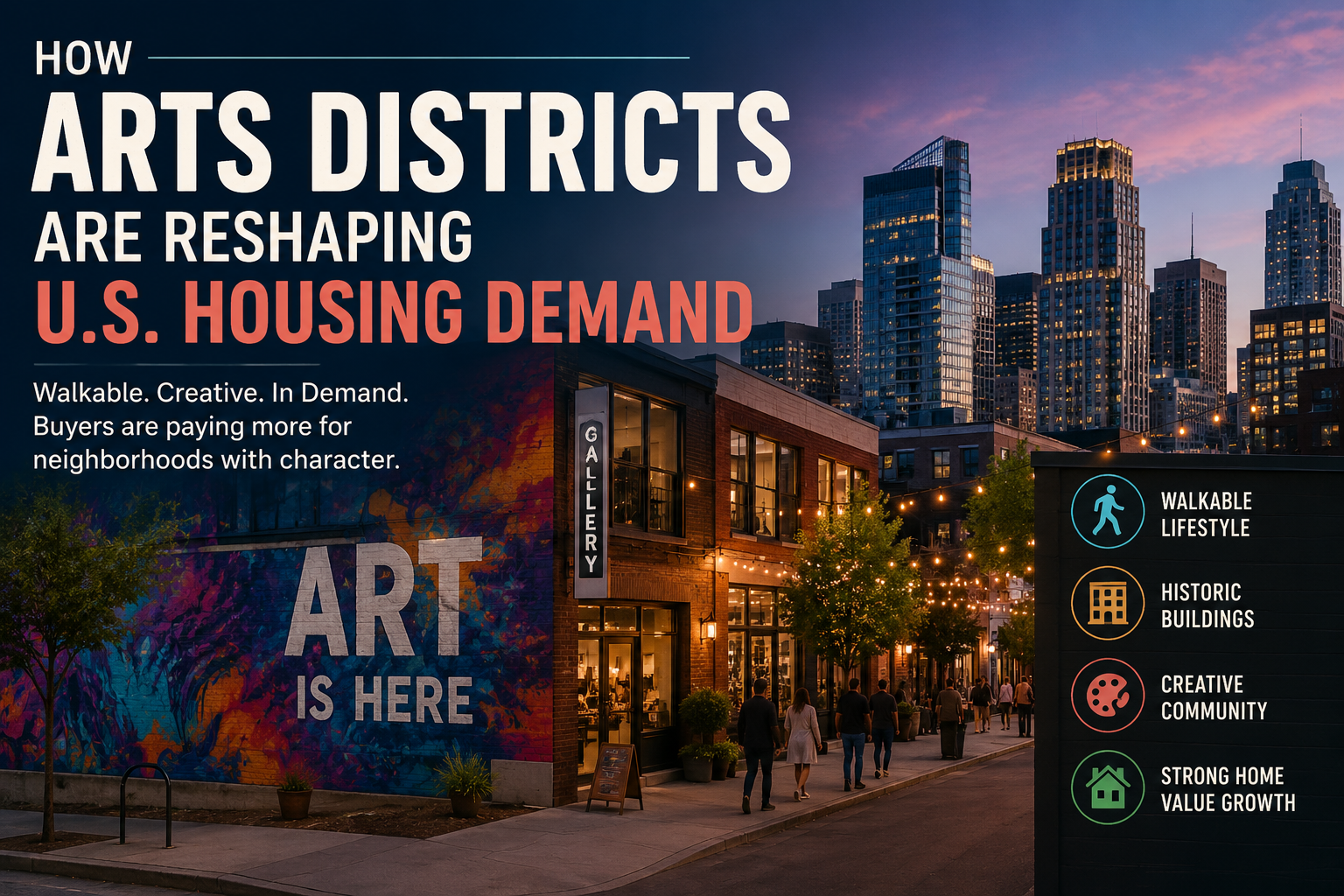
The Bishop Arts District in Dallas just posted the highest home price appreciation of any neighborhood in the city this year. Prices climbed 4.9% to a median of $425,000 in 2026, beating out the Park Cities, long considered Dallas’s prime real estate anchor.
A century-old stretch of restored bungalows is showing how character, walkability, and scarcity can lift demand beyond the broader metro trend. Across the country, some neighborhoods built around art, converted industrial buildings, and creative industries are appreciating faster than the cities around them.
The Pattern Holds Across Multiple Cities
Bishop Arts’ 1920s housing stock is one of the biggest factors driving that $425,000 median. The broader Dallas metro median sits at $410,000, up 3.9% year-over-year, slower growth than in the district built on old bungalows rather than new construction.
Bishop Arts is pricing slightly above the broader DFW median, despite its small-neighborhood sales base. For buyers comparing Texas neighborhoods, checking Houzeo listings alongside local price data makes the walkability premium easier to spot.
Los Angeles shows the same pattern at a higher price point. The Arts District grew out of former bakeries and factories. One example is the Biscuit Company Lofts, a former Nabisco bakery and Los Angeles Historic-Cultural Monument.
A National Association of Realtors survey from December 2025 found that 79% of homebuyers rate walkability as important, and 78% say they would pay more for a home in a walkable neighborhood. That number jumps to 90% among Gen Z and millennial buyers, with a third saying they’d pay a lot more. Arts districts, dense with galleries and restaurants within walking distance of one another, sit naturally within that premium.
Why Buyers Pay More to Step Out and Go
The forces behind this shift split into two parts: what buyers want and what the supply side can now deliver. On the demand side, walkability has become a direct line item in people’s willingness to pay. Howard Hanna, CEO of Howard Hanna Real Estate Services, estimates that buyers will pay 10% to 20% more for a step-out-and-go lifestyle, where galleries, restaurants, and daily errands sit within walking distance. On the supply side, a policy tool called adaptive reuse has made that lifestyle possible at scale.
Cities are converting old commercial buildings into housing instead of building new towers. That shift created nearly 25,000 apartments nationwide in 2024, 50% more than in 2023 and double the 2022 total. Many older buildings sat underused for years, giving creative neighborhoods room to form before demand caught up. The same adaptive-reuse tools that converted those buildings are now what enable the neighborhoods to absorb today’s demand.
Cities Are Turning Old Buildings Into Housing
Los Angeles shows how far that policy can scale once a city commits to it. The city’s original 1999 Adaptive Reuse Ordinance, limited to downtown, enabled more than 12,000 housing units by letting office and retail buildings convert into lofts.
In February 2026, Los Angeles expanded that ordinance citywide, opening large-scale conversion to neighborhoods well beyond downtown.
Philadelphia is running a smaller version of the same playbook, delivering 761 adaptive reuse units in 2024, the third-highest total of any U.S. city that year. Developers are responding with more of the same product: old buildings converted rather than demolished, then marketed on character.
Before making a move, you can check a building’s board, assess HOA fees, and even learn more about life in that neighborhood via Houzeo’s Building pages. Whether you’re buying a condo in Los Angeles or Philadelphia, the app lets you browse through available units seamlessly.
What Buyers Should Watch Before Paying More
For buyers, the practical takeaway is that the original character is now the scarcer asset, not the neighborhood itself. In long-established arts districts, the dwindling supply of original artist-occupied lofts means demand for authentic live-work units in converted warehouses now far outweighs available inventory. But this pattern isn’t new.
In SoHo, the arts district that set this model in motion decades ago, thousands of artists once lived under New York’s 1982 Loft Law, and only a few hundred of those original protected lofts remain today.
That scarcity is part of what’s sustaining the price premium, and it means two different products are competing under the same arts district label. Buyers paying a premium should know which one they’re actually buying.
Where the Trend Breaks Down
The premium isn’t universal, and identity alone doesn’t override fundamentals. In 2025, Las Vegas recorded its lowest annual sales total since 2007, underscoring how weak fundamentals can overwhelm neighborhood branding.
Not every arts district follows the same trajectory. In Las Vegas’s own Arts District, 15.4% of properties carry a flood risk over the next 30 years, a disclosure now standard on local listings. Inventory type and physical risk still set the floor under any neighborhood, regardless of how desirable its identity has become.
The Next Wave Is Already Forming
Arts districts remain a small share of the total U.S. housing stock, but they function as an early signal for where capital and zoning policy are headed. In 2024 alone, nearly 24,700 apartments were created through adaptive reuse, and another 181,000 units are now in the development pipeline.
Many cities that watched Los Angeles and Philadelphia convert obsolete buildings into housing are now exploring similar reuse frameworks.
As more cities streamline that conversion process, more former industrial corridors will likely follow the same arc: cheap rent draws artists first, then galleries, then buyers willing to pay for walkable, character-driven density. Dallas and Los Angeles aren’t outliers. They’re an early read on where the next wave of arts districts will form.