


[NoHo Arts District, CA] – This month’s LA Art blog artist Katherine Flynn talks about memory, abandoned objects, road trips and the ideas behind her exhibition The Shape of What Remains at bG Gallery.
For Katherine Flynn, making art is a way of paying attention to places, objects, memories, and the traces they leave behind. Her work is thoughtful, a little nostalgic, and honestly just pretty cool. In The Shape of What Remains, Flynn explores what happens after things have changed, been abandoned, weathered, or transformed. Through photographs, found materials, and sculptural installations, she invites viewers to consider the histories carried by both objects and people. In this conversation, she reflects on memory, the road, discarded things, and the unexpected ways meaning can emerge from what remains.

Q: The title The Shape of What Remains suggests both physical and emotional remnants. What does “what remains” mean to you in the context of this body of work?
A: “What remains” is about what time leaves behind, physically, emotionally, sometimes almost imperceptibly. I’m drawn to objects and places that have lived a life and been transformed by time and the elements. They carry evidence of where they’ve been even when their actual histories are unknown.
That’s very connected to my interest in liminal space, those in-between moments where places, people, and objects exist in transition. Something is no longer quite what it was, but it hasn’t entirely disappeared either. I think memory exists in a similar space. We carry fragments of experiences with us, but they shift and transform over time.
The discarded materials I work with embody that idea. They’ve been weathered, altered, and separated from their original purpose, but they still carry traces of what came before. What remains isn’t necessarily the original thing. It’s the shape it takes after time has passed.
Q: Abandoned vehicles are often seen as discarded objects. What drew you to view them instead as carriers of memory and history?
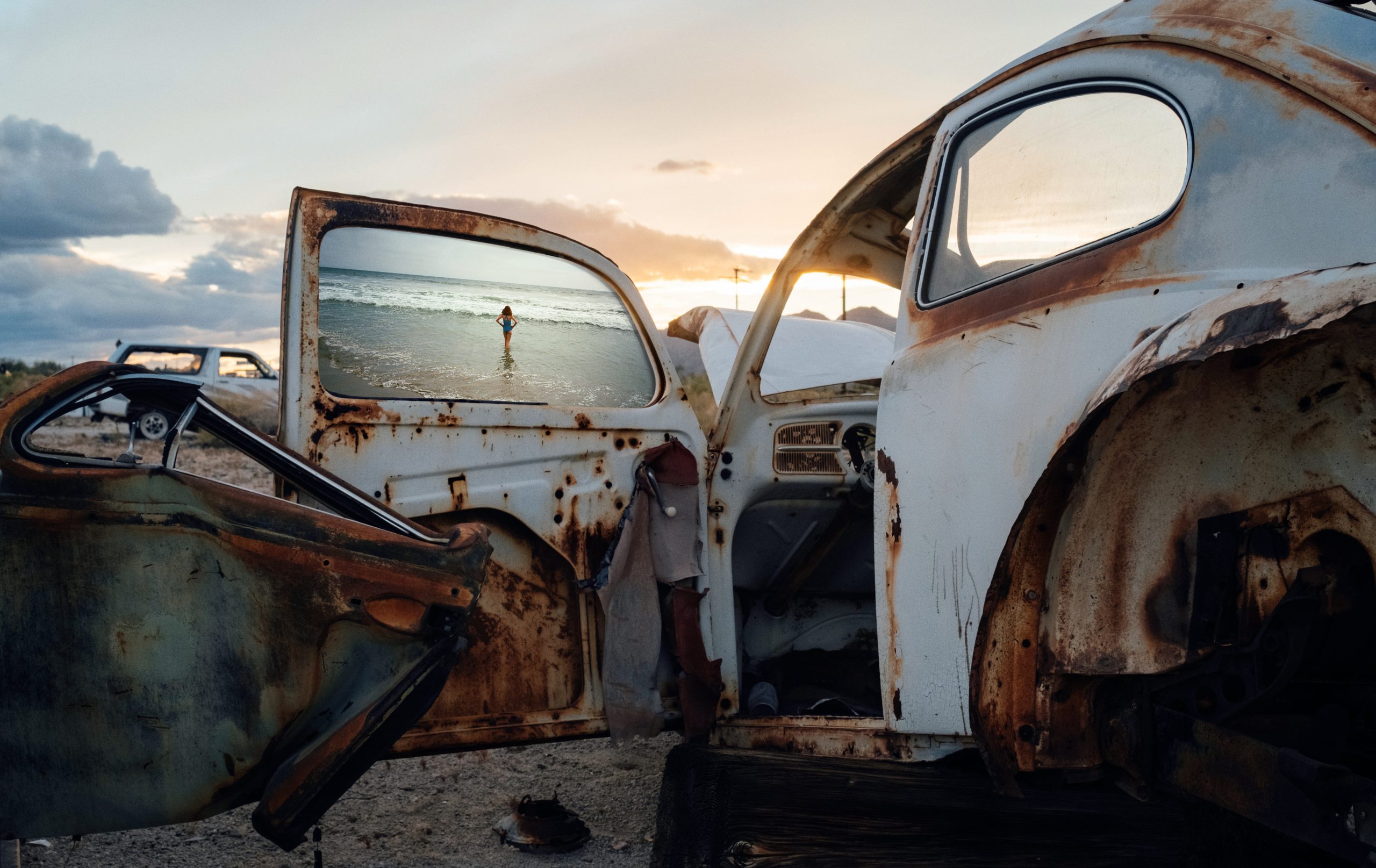
A: I’m drawn to the idea that these objects once held their own stories, countless moments and histories, before being abandoned and reshaped by the elements. The VW doors and mirrors I use have lived on the road, accumulating layers of history, time, and memory. They were once part of movement, part of adventures both ordinary and extraordinary.
Their slow, subtle transformation mirrors the fleeting nature of the moments I try to capture in my photography. Pairing these weathered objects with transient scenes creates a dialogue between past and present, permanence and impermanence, giving each image a deeper sense of history and change.
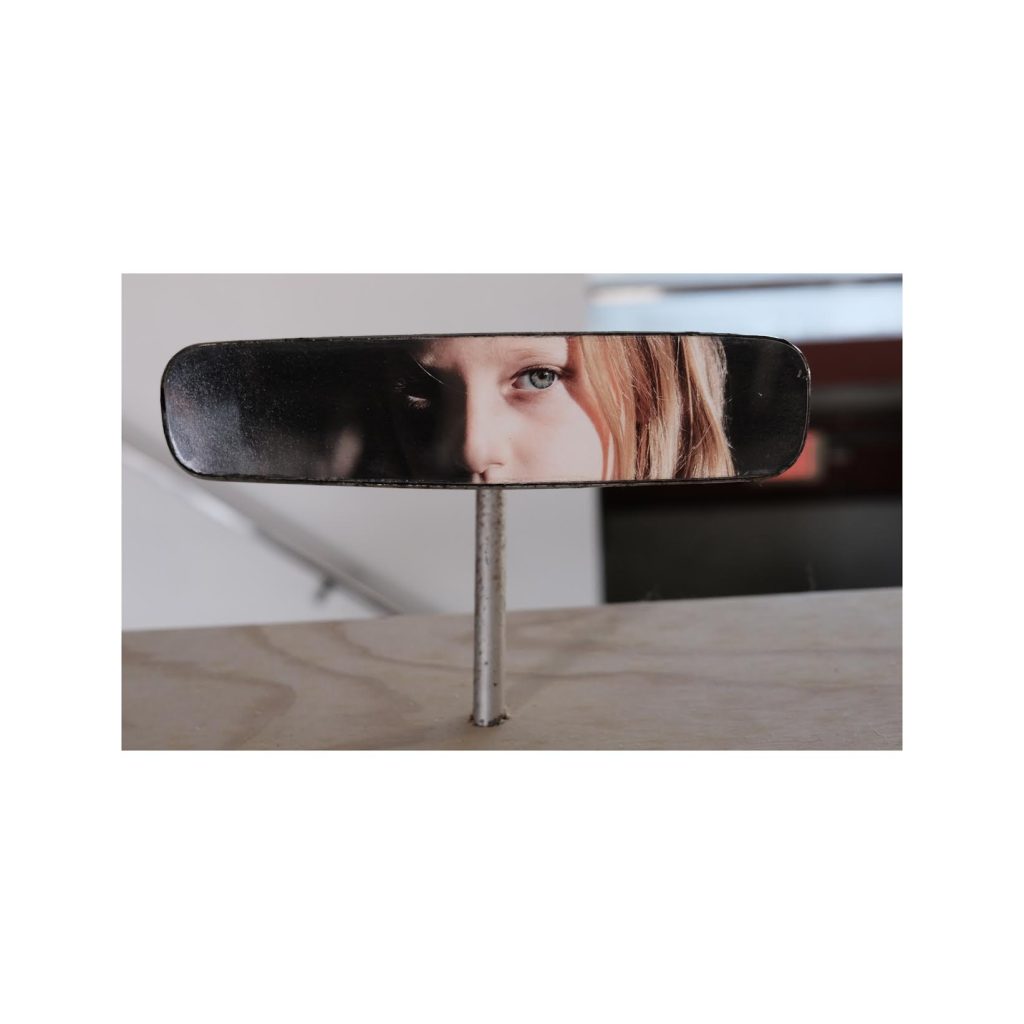
I think of repurposing them as a process of reanimation, turning waste into vehicles of meaning without erasing what came before. A mirror once used to navigate movement now reflects stillness, turning the act of looking into something layered and uncertain. That tension between passage, memory, and transformation is really at the center of the work.
Q: How did your photographic practice evolve into the immersive installation presented in this exhibition?
A: My photography has always been rooted in observation and discovery. I love the invisibility of being behind the camera, the spontaneity of it, and especially getting on the road without necessarily knowing where I’m going or what I’m going to find. Increasingly, that’s become both how I find what I photograph and how I find the discarded doors, mirrors, and objects that eventually become part of the work. I’m drawn to liminal spaces, those transitional states found both in the external world and within ourselves.
At the same time, my daughters and I had been transforming our desert junkyard in Landers into a kind of creative laboratory, building things from salvaged materials and found objects. That way of making became an extension of my photographic practice, an instinctive exploration of memory, impermanence, and transformation.
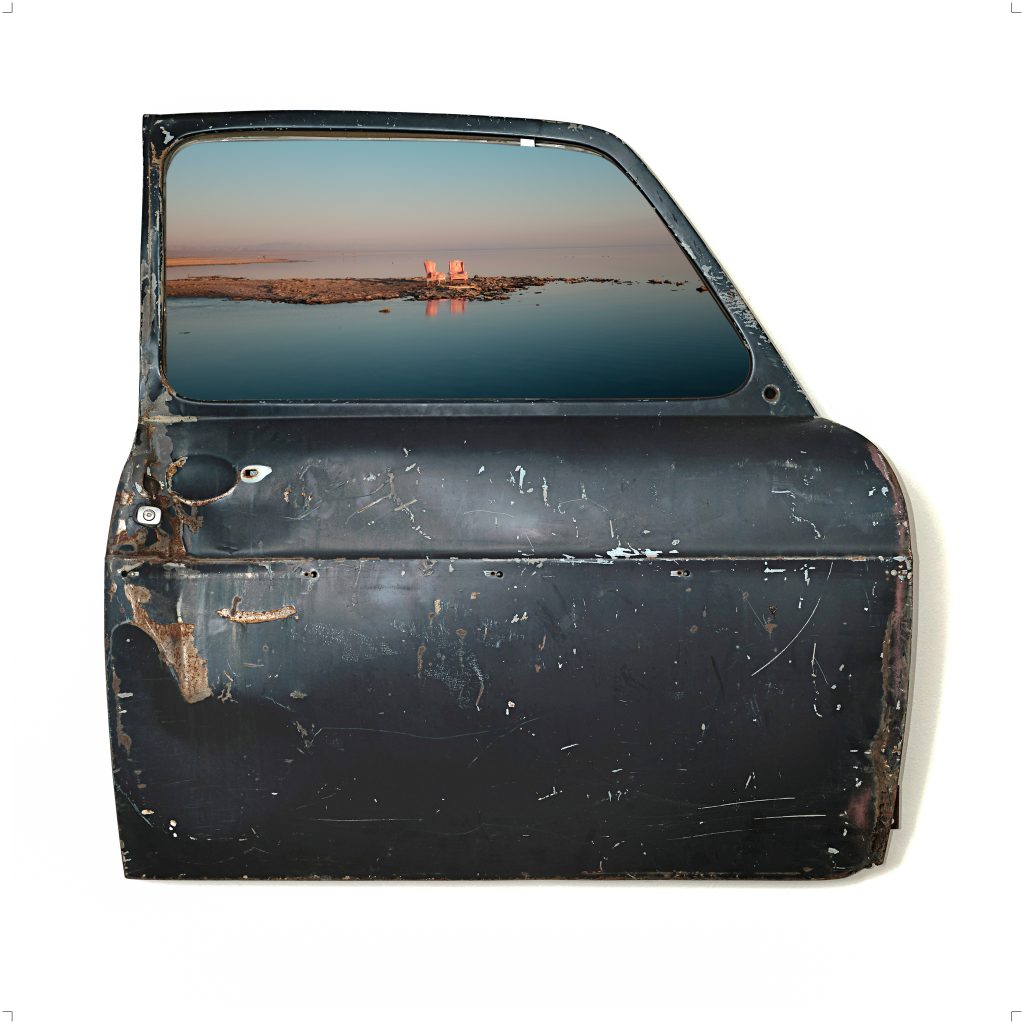
After my previous exhibit, I began questioning traditional methods of photographic display. I wanted the presentation itself to carry the same history and temporal quality as the images. I began using discarded VW doors, mirrors, and automotive fragments, selecting and customizing each photograph specifically for the object it inhabits.
Eventually, the object stopped simply being a frame. Its history, decay, and transformation became part of the meaning of the photograph. The work became both image and object. Moving further into sculpture and installation felt like a natural continuation of that process.
Q: Can you share a particular vehicle or site that profoundly influenced this series and why it stayed with you?
A: There are really two places that profoundly influenced the series. My daughters and I had been transforming our desert junkyard in Landers into a kind of creative laboratory, building things from salvaged materials and found objects. At one point, we even built a spaceship entirely out of discarded materials for a little movie my daughter and I made together. There was something about taking these abandoned things and allowing them to become something completely unexpected that stayed with me. That way of making became an extension of my photographic practice.
Years ago, I also happened upon a VW salvage yard and was immediately drawn to it. I thought it was incredibly beautiful, the colors, the light, the way the vehicles and parts were stacked and organized. I kept going back to photograph there long before I had any idea that the objects themselves would eventually become part of my work.
Jim, who owns the yard and has since become a great friend, helped me source many of the first doors and mirrors I used in the original experiment. What made that feel especially meaningful was his own deep affection for these vehicles. They weren’t simply discarded objects to him; they carried histories. I think he was genuinely moved to see pieces of them given a second, unexpected life. In a way, that yard became a bridge between the photographs I was taking and the physical language the work eventually took on.
Q: By inviting visitors to physically enter the automobile sculpture, you’re creating a participatory experience. What do you hope people feel or discover when they step inside?
A: The sculpture lived in my yard for a while, and I just kept adding to it, old letters, postcards, photographs, TripTiks, maps, things I’d found and collected over the years. Dozens of letters written between people I’ve never met eventually covered the inside walls. I loved not knowing the whole story, just these fragments of lives, road trips, love affairs, places someone was trying to get to. Things that had somehow survived even when the people and moments around them had moved on.
I wanted the inside of the car to feel familiar in the way being on the road feels to me, both universal and deeply personal. You’re surrounded by other people’s stories, but inevitably they begin to bring up memories of your own: places you’ve been, people you’ve known, things you’ve lost track of, or suddenly remember.
The sculpture itself is pieced together from parts of many different cars, each carrying its own unknown history. I think of it almost like a body, a vessel that gathers evidence of where it’s been. As we age and deteriorate, somehow those traces become louder. The scars and remnants start to tell more of the story, not less.
So when someone climbs inside, I hope there’s a kind of retrieval. You enter through fragments of other people’s histories and maybe find pieces of your own. The car becomes this strange container for all of it, different lives, different journeys, things lost and found again, all occupying the same space for a moment.
Q: Your work seems to exist at the intersection of landscape, personal history, and material culture. How do those themes interact in your creative process?
A: They’re almost impossible for me to separate. A lot of my photography happens alone on the road, where discovery takes precedence over destination. I love getting on the road knowing I may have four days and just driving until I need to turn back. What I’m drawn to in those moments I capture is often as much a reflection of my internal landscape as the physical one in front of me.
I might photograph something instinctively, emotionally, a landscape, an abandoned structure, an object, and only understand later why it stayed with me. The vulnerability in the work is often my own. The external landscape becomes a way of exploring the space between what we see and what we feel.
The materials carry another history into that process. A discarded door or mirror has already been somewhere. It has been used, weathered, abandoned, and transformed before I ever encounter it. When I bring the photograph and object together, those histories begin to overlap: the landscape, my own experience of it, the previous life of the object, and eventually whatever the viewer brings to it. I love exploring the interconnectedness of all our stories and experiences.
Q: Many people associate cars with freedom, identity, or transition. How do those cultural associations inform the narratives within your work?
A: Cars are inherently tied to passage. They carry us between places, but they also become containers for experiences, ordinary moments alongside transformative ones. So much of my photography happens on the road, where I’m often more interested in what exists between destinations than in the destination itself.
The automotive materials carry that history of movement into the work. A door once separated inside from outside; a mirror reflected what was behind while helping someone navigate what was ahead. They were functional objects built around movement.
Once removed from the vehicle, that function disappears, but the history of it remains. The mirrors, once used to navigate movement, now reflect stillness. The doors no longer take anyone anywhere, but they continue to hold traces of passage.
Pairing them with transient photographs creates a dialogue between movement and stillness, past and present, permanence and impermanence. In that sense, the objects haven’t really stopped traveling. They’ve become vehicles for a different kind of passage.
I like that none of those stories completely resolves the others.
Q: How do you balance documenting a real object with creating space for viewers to project their own memories and interpretations onto it?
A: I don’t really think of the things I photograph as fixed objects. I’m drawn to them because they’re already in some kind of liminal state, abandoned, deteriorating, repurposed, somewhere between what they were and what they might become. In a way, they’re rediscovering themselves too.
I’m interested in that space where the original story is still present, but no longer complete. You can see the evidence of a past life without knowing exactly what happened there. That ambiguity leaves room for someone else to enter the image and bring their own history to it. I don’t want to finish the story for them. I like that the object can hold its own history and someone else’s memory at the same time.
Q: After experiencing this exhibition, what question or idea do you hope visitors continue thinking about once they’ve left the gallery?
A: Maybe the idea that nothing is ever completely finished. We spend so much of our lives moving forward that we lose track of things, people, places, objects, versions of ourselves, and then something brings them back to us years later in a completely different form.
I’m interested in that retrieval: what remains after something has changed, and what can still be found in it. Maybe the things we think we’ve left behind aren’t really gone. They’re just waiting to be seen differently.
I’d love someone to leave thinking about the remnants of their own life, what they’ve carried with them without realizing it, what they’ve lost track of, and what might still be waiting to be rediscovered.
The Shape of What Remains is ultimately about the stories that linger. Through photographs, found objects, salvaged automotive parts, and immersive installations, Katherine Flynn explores what happens after things have changed, been abandoned, forgotten, or transformed. Rather than focusing on what’s been lost, the work asks us to consider what survives and how memory continues to shape the way we see the world.
We’re grateful to Katherine for sharing her thoughts and process with us. As you experience the exhibition, we invite you to bring your own memories, histories, and sense of curiosity into the work. Like the pieces themselves, those personal connections may reveal something unexpected about what remains.
Location
bG Gallery
2525 Michigan Avenue, Suite A2
Santa Monica, CA 90404
Exhibition Dates
September 16 – October 10, 2026
Gallery Hours
Tuesday – Saturday, 11:30 a.m. – 5:00 p.m. (and by appointment)
*All photos courtesy of the artist
https://santamonica.bgartdealings.com/show/bg-gallery-katherine-flynn-solo-exhibition