


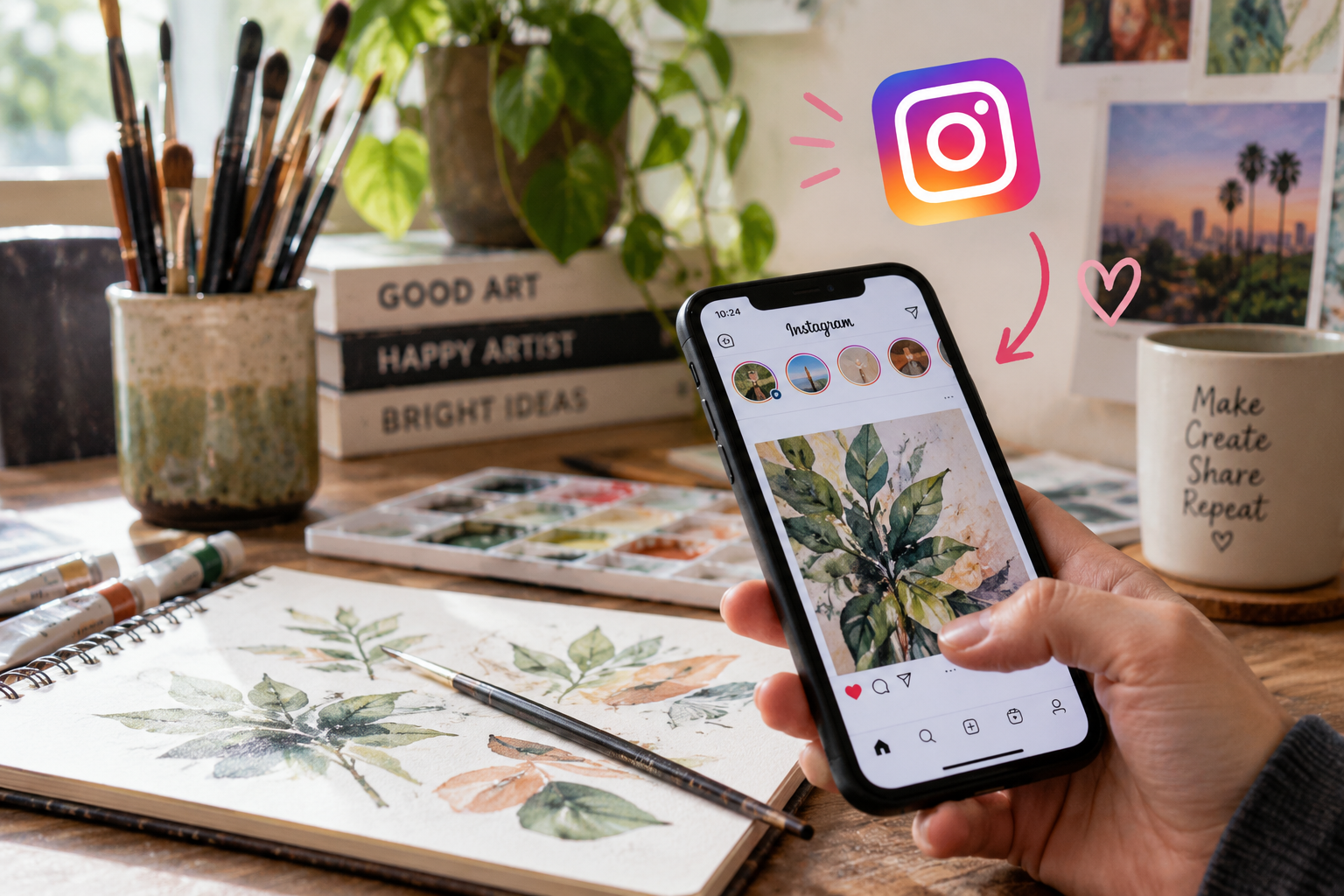
Scroll through Instagram, and you will find them. Artists with massive followings. Flawless posts. Perfect lighting. Clean edits. Captions that sound professional. Then you glance at your own profile. A few posts. A handful of likes. The comparison hits.
None of that matters to you. You are not selling anything. You are not chasing brand deals. You are not trying to be an influencer. You share your work because you love making it. That one difference changes everything about how you use the platform.
All eight strategies here point in the same direction. Hold onto your voice. Post what genuinely interests you. Let Instagram fit into your creative life, not consume it.
1. Share What You Truly Love
Start chasing what the algorithm wants, and you lose yourself. You start wondering which format brings more likes. Which subject performs better? Which style gets more comments? Before you realize it, you are making work that does not even feel like yours.
Share what actually excites you. Experiments. Sketches. Finished pieces. Studies. Works that might never be finished. Let your feed show where you have been and where you are heading.
Your account does not need a perfectly curated grid. It just needs to feel like you. Someone who shares because they love creating, not because they want to impress strangers.
2. Show How You Make Things
A finished piece only tells people what you created. Process shots and videos tell them how you got there. Sketches. Color swatches. Early versions. Short clips of your hand moving across the page. Those behind-the-scenes moments build a connection that a polished final image never can.
Mark Young picked up miniature painting during the pandemic. Self-taught. Never planned to explore traditional art forms. But learning the craft led him to places he never expected. What makes people care about his work is not just the finished pieces. It is the journey he shares along the way.
You are not manufacturing content. You are simply documenting what you already do. That small shift in perspective changes everything.
A few hobby artists experiment with services that bring more eyes to their profiles. Real people behind the engagement. These services do not use automated accounts. If that sounds interesting, you can explore Instagram followers through providers that prioritize authentic interaction. These services exist for personal enjoyment only. They are not for selling artwork, building a brand, or turning your hobby into a job.
3. Write Captions Like a Person, Not a Portfolio
Many artists treat captions like gallery labels. “Acrylic on canvas. 2026.” It tells people nothing about the work or the person who made it.
Try something different. Write about what inspired the piece. What you struggled with. Why you chose those specific colors. A strange idea behind the drawing. What you learned while making it. Something you still are not happy with.
A handful of honest sentences tell people more about you than a perfectly polished caption ever could. You do not have to get it right every time. Just write like yourself, and people will pick up on it.
4. Follow Artists You Would Talk To
The follow-for-follow game is exhausting. You end up with a feed full of accounts you do not care about and people who do not care about your work.
Instead, follow artists whose work genuinely interests you. Leave thoughtful comments rather than generic compliments. Respond when someone asks for opinions. Save work that inspires you. Discover artists outside your usual medium.
Instagram can function like a digital art club when you use it to exchange ideas rather than collect numbers. Social interaction has value even when there is no commercial objective.
5. Use Trends as Tools
Reels. Trending audio. Popular styles. Hashtags that appear and disappear. Trends keep popping up on Instagram all the time. Choose the ones that are really relevant to your business. Customize them according to your style. Ignore the ones that seem forced or irrelevant to your business.
Low likes on a post do not mean the art is bad. It only means that specific format did not connect the way you expected. That tells you something useful. It does not tell you anything about your skill as an artist.
6. Give Your Account Room to Grow Naturally
Every artist reaches that moment. You post regularly. You comment on other people’s work. You show up every day. Yet the response stays quiet. It starts to feel like you are speaking into a void.
Some personal users try services that give their accounts a little extra visibility. If you go that route, look for providers that use real people. Not automated systems. Delivery should happen gradually, not all at once. That looks more natural. Pricing should be clear with no hidden charges.
These services exist for personal and entertainment purposes. They help hobby artists gain a bit of visibility while they focus on making work they enjoy. They are not a replacement for creating good art or building genuine connections with other artists.
What to look for if you explore these options:
- Services that use real people, not bots
- No password required (only your public handle)
- Gradual delivery that looks natural
- Transparent pricing with no hidden fees
7. Do Not Let the Numbers Decide If You Are a “Real” Artist
Comparison is everywhere on Instagram. You see other artists with more followers. More likes. More comments. More apparent success. It is easy to question your own work.
You can make powerful work with 100 followers. Or 1,000 followers. Or no followers at all. The number does not change the art. Your followers’ and likes’ numbers just quantify activity on the platform; they don’t quantify your talent, your vision, or the value of what you’re creating.
Use your account as a record of your creative life rather than a constant performance review. The art matters more than the numbers.
8. Keep Creating Offline, Too
The healthiest Instagram presence supports your creative life. It does not replace it.
Keep sketchbooks. Visit galleries. Go to exhibitions. Take photographs without immediately posting them. Experiment with unfamiliar materials. Make things that will never appear online.
Deborah Thomas painted for years as a way to escape. Recently, she held her first solo exhibition. When she paints, she says she gets pulled into her own world. No Instagram post can replicate that feeling.
Spend time creating without checking notifications. That is where your voice comes from.
Signs Your Instagram Is Working for You
A healthy Instagram presence feels good, not draining. Here is how to tell if the platform is supporting your creative life.
| How You Feel on Instagram | What That Tells You | What to Change |
| Excited to share new work | Your creative drive is strong | Keep doing what you are doing |
| Happy when someone comments | Connection matters to you | Reply to everyone who takes the time |
| Inspired after looking at other artists | You feed off other people’s energy | Follow more artists in areas that interest you |
| Energized to make something new | The platform fuels you | Limit your time so it stays that way |
| Anxious about your numbers | You are measuring the wrong thing | Focus on the work, not the response |
| Hesitant to post something different | You care too much about reactions | Post it anyway. Reactions tell you nothing useful |
| Spending more time scrolling than creating | The app is winning | Put your phone down and pick up your tools |
Most artists recognize themselves somewhere on that list. You do not need to address everything right away. Just pay attention to what brings you energy and what drains it. Let that guide your next move.
Bottom Line
Your Instagram does not have to look like a polished portfolio. It does not have to follow every best practice out there. It just needs to show the work you love making and track how you grow over time.
The accounts that truly work are the ones that help you find other artists, give you space to share thoughts, and get you excited to pick up your tools again. Use the platform as a companion to your creative life. Do not let it become the engine driving it.