


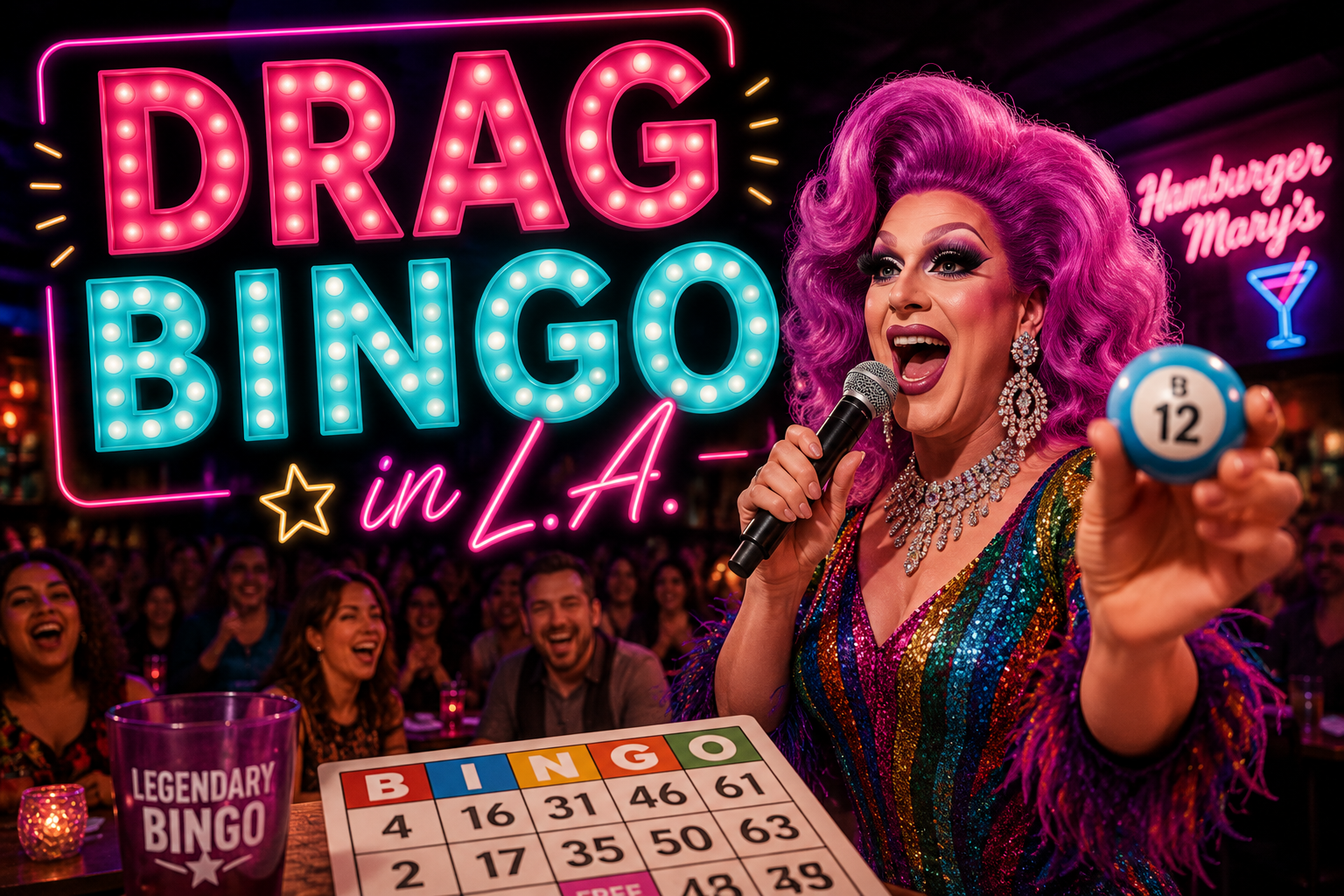
A drag queen at Hamburger Mary’s holds a microphone on a Tuesday night. She calls a number, works the crowd, and moves the tempo. The activity running underneath is bingo, but almost no one in the room would describe what they came for as a bingo game.
What has happened to bingo in Los Angeles over the last twenty-five years is a specific cultural evolution worth documenting. The activity has become something closer to legitimate live performance than the pre-war church-hall origins would suggest.
The elements that made bingo work in 1946 are still there. What has been added on top is a full layer of performance craft that turned the format into something new.
The LA Venues Where the Shift Actually Happened
Legendary Bingo is the specific event most responsible for the transformation. Jeff Bowman started it in April 1998 at Stonewall Gourmet Coffee in West Hollywood as a fundraising night for AIDS Project Los Angeles. The event moved to Hamburger Mary’s WeHo after Bowman spent months persuading the restaurant to try it.
Twenty-five years later, Legendary Bingo runs multiple nights per week at Hamburger Mary’s on Santa Monica Boulevard. Presale tickets sell out routinely. The event has been featured on more than twenty reality shows, including The Real Housewives of Beverly Hills and Millionaire Matchmaker.
The format has spread. Concern Now, HFC, and a rotation of local charities host their own drag bingo nights at Hamburger Mary’s and comparable venues across LA. Bingo Boy, RuPaul’s Drag Race alumni pop-ups, and dozens of independent comedy-hosted bingo events fill the same performance category in venues from Silver Lake to North Hollywood.
The economic model is worth noticing. Legendary Bingo alone has raised money for Project Angel Food, Best Friends Animal Rescue, AIDS Healthcare, the Leukemia and Lymphoma Society, the Gay Men’s Chorus, and the Los Angeles LGBT Center. The charity element is not decorative; it is structural to how the format sustained itself for twenty-five years.
What the Performance Actually Requires
A drag bingo night at Hamburger Mary’s runs on three specific elements that traditional bingo halls never had. The host is a genuine performer, not a caller reading numbers. The audience is an active co-performer, throwing sheets, cheering, booing, and reacting on cue.
The pacing is engineered rather than random. Each round runs to a specific rhythm the host controls, with tension built up before the winning number and released deliberately across the room. That structural craft is what distinguishes the format from the underlying game.
The performance element is what online bingo cannot replicate. Licensed bingo platforms preserve the game mechanics, the probability structure, and the chat-room social layer. What they cannot deliver is the drag queen with a microphone in a packed West Hollywood bar on a Tuesday night.
That gap does not make the online formats worse. It makes them different. Online bingo is a category of accessible mobile leisure that runs on genuinely different design goals from what Legendary Bingo is doing at Santa Monica Boulevard.
The Broader LA Live-Entertainment Ecosystem
The rise of drag bingo fits inside a wider pattern of participatory performance formats in Los Angeles. Immersive theatre, secret gigs, dinner-theatre revivals, and comedy-format hybrids all trace to the same trend. Audiences want to be inside the performance rather than passive spectators of it.
The cultural history of the format is worth reading in detail. Vice’s feature on the origins of Legendary Bingo traces founder Jeff Bowman’s early struggle to convince West Hollywood venues to try it. The piece also documents the eventual move to Hamburger Mary’s, the charity-driven weekly rhythm, and the room’s own traditions.
LA’s participatory performance ecosystem is larger than any single format. Sleep No More-style immersive theatre, Dinner Detective murder-mystery formats, Sofar Sounds secret concerts, and various pop-up comedy-hybrid nights all share DNA with what drag bingo built. Each of them relies on the audience being active rather than passive.
What the Format Provides That Traditional Theatre Doesn’t
The specific comparison between drag bingo as performance and traditional theatre is worth laying out plainly:
| Dimension | Traditional theatre | Drag bingo performance |
|---|---|---|
| Audience role | Silent, seated, receives the show | Active co-performer, reactive throughout |
| Outcome | Scripted and repeatable across performances | Random within a defined structure |
| Host relationship | Performer separated by proscenium arch | Performer moves through and around the room |
| Pacing | Set by the script and director | Set by the host reading the room in real time |
| Repeat attendance model | New play or new production required | Same format, new drag hosts and new energy |
| Revenue and social mission | Ticket sales fund the production | Ticket sales frequently fund a partner charity |
Neither format is inherently better than the other. They serve different specific goals for different audiences. Drag bingo is not a diluted form of theatre but a different kind of live performance operating under its own rules.
Where the Form Goes Next
The format’s trajectory looks stable. Legendary Bingo is now in its second quarter-century at Hamburger Mary’s. New drag bingo formats keep launching at LA venues from Silver Lake to Long Beach, and the underlying model has proved unusually durable.
Online platforms will continue to run in parallel rather than compete directly. The audiences overlap only partially. A physical drag bingo night sits far enough from what an online platform delivers that neither format really displaces the other.
What might change is the recognition. Drag bingo is still often treated as adjacent to real theatre rather than as a legitimate form in its own right. LA arts writing that took the format seriously as performance culture would help correct that gap.
The next time a drag queen at Hamburger Mary’s picks up a microphone, whatever the room came for is not really a bingo game. It is a specific piece of Los Angeles performance culture. Twenty-five years in the making.