


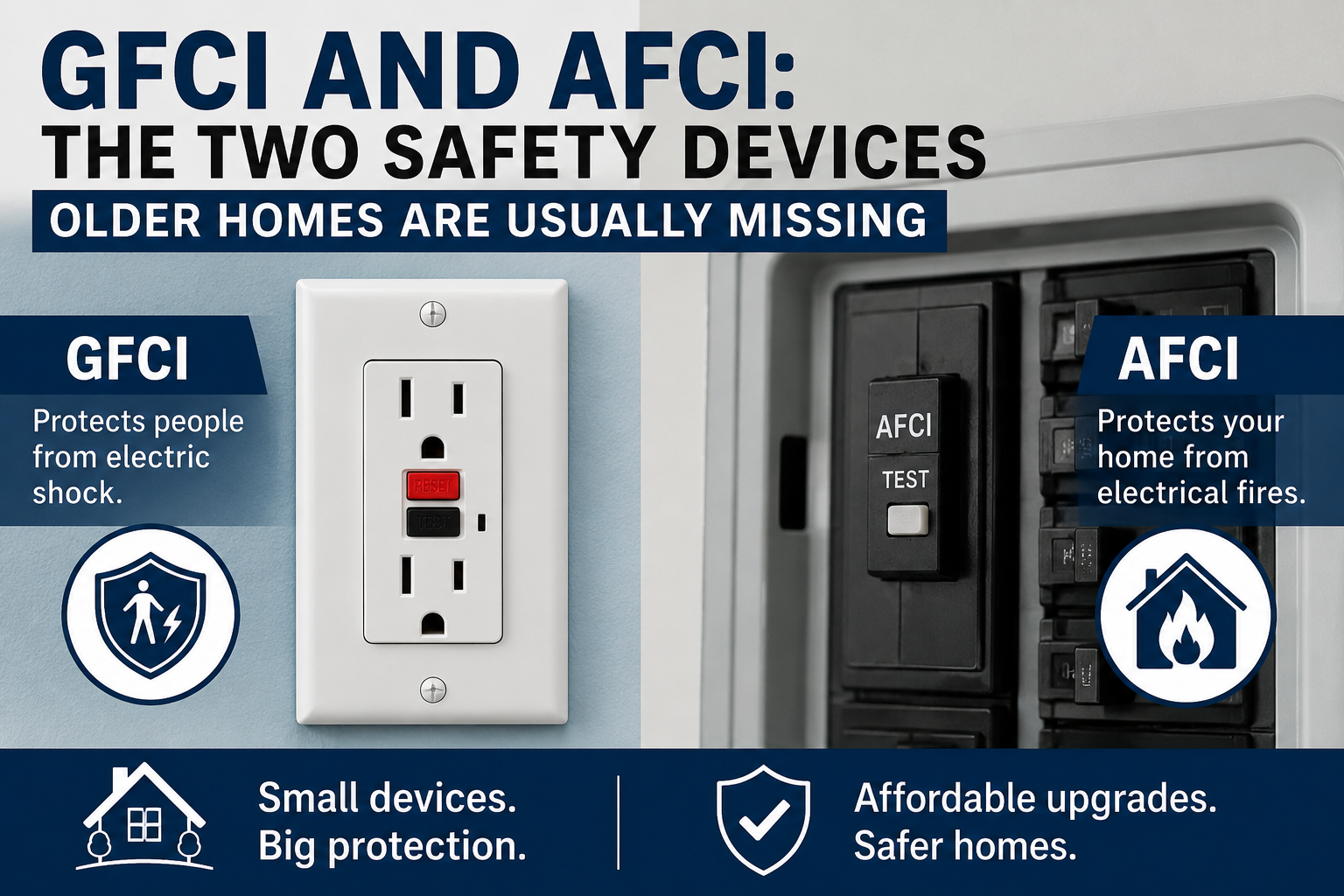
Most homeowners have seen the outlets with the little test and reset buttons and never thought much about them. Those are GFCI devices, and along with their less visible cousin, the AFCI, they are two of the most effective pieces of electrical safety equipment in a modern home. They are also two of the things most consistently missing from older houses in the Tulsa area. Here is what each one does, why it matters, and how to tell whether your home has the protection it should.
What a GFCI actually does
GFCI stands for ground fault circuit interrupter. It watches the flow of electricity in a circuit, and if it detects a difference between the current going out and the current coming back, which can mean electricity is escaping along an unintended path such as through a person, it cuts power within milliseconds. That speed is the difference between a startle and a serious injury. Current code requires GFCI protection in all the wet and outdoor spots in a house: bathrooms, kitchens, garages, basements, and exterior outlets. In homes that predate those requirements, the protection is often missing entirely.
What an AFCI does differently
AFCI stands for arc fault circuit interrupter, and it guards against a different hazard. An arc fault is a dangerous electrical discharge that can happen inside a wall when wiring is damaged, deteriorated, or poorly connected. Arc faults are a leading cause of residential electrical fires, and a standard breaker will not necessarily catch one, because the current involved may never exceed the breaker’s rating. An AFCI recognizes the electrical signature of the arc itself. Current code requires AFCI protection in bedrooms and most living areas, and older homes typically have none.
Why older homes miss both
The requirements for both devices have expanded steadily over the past several decades. Homes built or last rewired before the 1990s frequently lack GFCI protection where it is now required, and homes built before the 2000s usually have no AFCI protection at all. In established Tulsa-area neighborhoods where houses have not been updated since original construction, it is common to find bathrooms, kitchens, and garages without GFCI protection and bedrooms without AFCI protection. The homeowners rarely know until they ask.
How to tell what you have
GFCI outlets are easy to spot: they carry the test and reset buttons on the face of the outlet, usually in bathrooms, kitchens, garages, and near exterior outlets. If you do not see those buttons anywhere in those locations, your home likely lacks proper GFCI protection. AFCI protection lives at the panel in the form of special breakers, so it is harder to confirm without opening the panel, which is a job for a licensed electrician rather than a flashlight and a guess.
The good news about the fix
Compared with a rewire or a panel upgrade, adding GFCI and AFCI protection is straightforward and relatively affordable, which is what makes it one of the highest-value safety improvements available for an older home. A proper job assesses the whole house, installs GFCI outlets and breakers where they are required, adds AFCI breakers at the panel for the right circuits, and tests every device to confirm it works before the electrician leaves.
The work belongs with a licensed professional. Half Moon Plumbing and Electric has served the Tulsa area since 2007 under Oklahoma Electrical Contractor License #00140295, assessing what a home currently has, explaining plainly what is missing, and installing what is needed to bring it up to current safety standards. As a back-to-back Tulsa World “Best in the World” winner for plumbing and water treatment in 2024 and 2025, the company treats GFCI and AFCI protection as one of the most practical upgrades an older home can get.
The takeaway
If your home is more than a couple of decades old and you have never confirmed its GFCI and AFCI coverage, assume there are gaps. An assessment is inexpensive, the fix is affordable, and the protection guards against the two hazards, shock and electrical fire, that homeowners least want to learn about the hard way.