


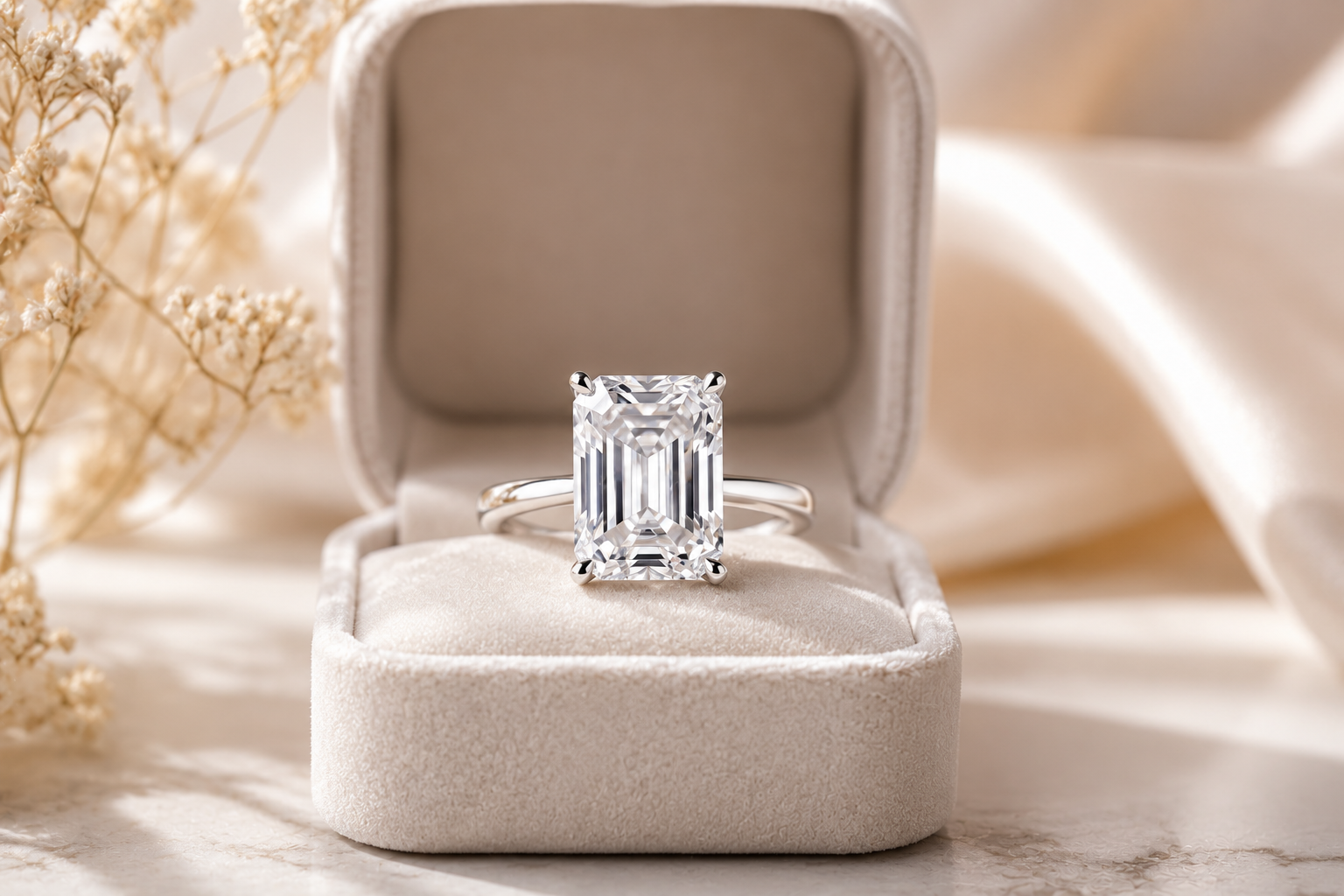
An engagement ring is the rare object that is both an industrial product and a piece of wearable sculpture. For most of the last century, the medium dictated the form. Diamonds were scarce and expensive, so the design problem was how to make a small stone look like more. That constraint has quietly collapsed. The arrival of large lab-grown diamonds has handed designers a material they have never had before, and it is changing what a ring can be.
This is a story about design more than money. When a four-carat center stone stops being a fantasy reserved for celebrities and becomes a real option for ordinary couples, the entire grammar of ring design has to be rewritten. The setting, the proportions, the metal, the silhouette on the hand all change. What follows is a look at that shift through the eyes of the people who actually draw these rings.
Why Is a Diamond’s Shape a Design Decision Before It Is a Buying Decision?
Jewelers talk about a diamond’s “cut” as if it were only a quality grade, but shape is the first compositional choice in any ring. A round brilliant reads as classical and symmetrical. An emerald cut reads as architectural, all clean lines and stepped planes. A pear or marquise introduces direction and movement. Before a single prong is placed, the shape has already decided the mood of the piece.
At smaller sizes, shape is a subtle note. At four carats, it becomes the entire composition. A 4-carat emerald cut is a slab of light roughly 10 by 8 millimeters that behaves like a window into the stone. A 4-carat oval stretches to nearly 14 millimeters long and pulls the eye down the finger. The same carat weight produces radically different objects, and a designer chooses among them the way a painter chooses a canvas orientation.
How do the major shapes change a ring’s character?
Round brilliants scatter light in a fiery, even pattern and forgive minor inclusions because the faceting hides them. Step cuts like emerald and asscher trade fire for clarity and calm, showing the diamond’s interior with honesty. Elongated shapes such as oval, pear, and marquise flatter the hand and cover more skin per carat. Cushions soften everything with rounded corners and a romantic, antique glow.
What Did Designers Actually Do When Big Stones Were Out of Reach?
For decades, the working assumption was that the center stone would be modest, so the artistry went into the architecture around it. Halos wrapped a ring of small diamonds around the center to inflate its apparent size. Pavé bands carpeted the shank in melee. Cathedral shoulders rose up to cradle the stone and lend it height and drama. These were brilliant solutions to a scarcity problem.
The result was a century of rings designed to make one carat look like two. That instinct is so deeply embedded that many buyers still reach for a halo automatically. But when the center stone is genuinely large, those same techniques start to fight the diamond instead of serving it. The design language built for scarcity does not translate cleanly to abundance.
How Are 4-Carat Lab-Grown Diamonds Changing What Designers Draw?
The most visible shift is toward restraint. When the diamond is already a statement, the setting’s job flips from amplification to support. Designers describe it as getting out of the stone’s way. Thin bands, minimal prongs, and open galleries let a four-carat diamond occupy the space it has earned. The ornament migrates from the setting back into the stone itself.
A four-carat lab-grown diamond in a near-colorless G to H grade with VS clarity now lands in roughly the $8,000 to $16,000 range for the stone, depending on shape, where a natural equivalent would run $60,000 to $130,000. That price collapse is what put the material in front of working designers and everyday buyers at the same time, and it is why the design conversation has moved so quickly.
Why does a large stone demand a quieter setting?
Visual weight is a finite budget. A four-carat diamond already spends most of it. Add a halo, heavy milgrain, and a wide pavé band, and the eye no longer knows where to rest. The composition becomes noisy. Designers working with large stones increasingly subtract rather than add, treating empty metal and negative space as deliberate elements rather than gaps to be filled.
Design Trends in 4-Carat Lab-Grown Diamond Rings
Several distinct movements have emerged directly from the availability of big lab-grown stones. Each one would have been impractical or absurdly expensive in the natural market, and each one treats the diamond as the protagonist rather than a costar.
The floating or “naked” diamond
This look pairs a very large center with a barely-there band and the most minimal possible setting, so the stone appears suspended above the finger. At four carats, the effect is striking because the size makes the minimalism look intentional and confident rather than cheap. The diamond seems to float, and the metal nearly disappears.
East-west orientation
Elongated shapes like oval and marquise are increasingly set sideways, running across the finger rather than along it. This rotation reads as modern and editorial, breaks the expected proposal-ring silhouette, and photographs beautifully. It is a design move that only makes sense when the stone is large enough to span the finger convincingly.
Toi et moi and multi-stone compositions
Two large stones set side by side, often in contrasting shapes, have surged in popularity. A four-carat total split between two two-carat stones, or an oval paired with a pear, creates a narrative ring with asymmetry and tension. Affordable large lab-grown stones make these two-stone designs financially possible for the first time.
Bezels and sculptural metalwork
A full or half bezel that hugs the stone’s outline has moved from a security feature to a design statement. At larger sizes the bezel becomes a bold metal frame, almost like a picture mount, and lends the ring a clean, contemporary, gallery-object quality that suits a four-carat stone’s presence.
The solitaire reborn as a confident choice
The plain solitaire was once the budget default, the ring you chose when you could not afford ornament. At four carats that meaning inverts. A single large stone on a thin band becomes the most self-assured statement a ring can make, because it asks for nothing but the diamond. Designers now treat the modern solitaire as the purest expression of the abundance era, where confidence replaces decoration and the proportions of band to stone are calibrated to the millimeter. A too-thick band reads as old-fashioned, while a slim, almost knife-edge shank lets the four-carat stone read as weightless and intentional.
How Big Is a 4-Carat Diamond, Shape by Shape?
Design intuition starts with real dimensions. The table below shows approximate face-up measurements for a four-carat stone in each major shape, the visual character it carries, and the setting direction designers tend to pair with it. These are working figures, and individual stones vary with cut proportions.
| Shape | Approx. Face-Up Size at 4ct | Design Character | Setting Direction Designers Favor |
| Round Brilliant | ~10.2–10.4mm diameter | Classical, symmetrical, maximum fire | Thin solitaire, six slim prongs |
| Oval | ~13–14mm x 9–10mm | Elongating, fluid, flattering on the hand | Low solitaire or east-west bezel |
| Emerald | ~10.0–11.0mm x 8.0–9.0mm | Architectural, calm, hall-of-mirrors clarity | Minimal solitaire, sharp clean prongs |
| Cushion | ~9.5–10.5mm | Soft, romantic, antique glow | Four-prong, optional thin pavé |
| Pear | ~14–16mm x 8–9mm | Directional, dramatic, maximum coverage | Five-prong with a V-tip, often east-west |
| Marquise | ~16–17mm x 8–8.5mm | Bold, vintage-modern, longest silhouette | Sculptural bezel or east-west solitaire |
Read down the character column and the artistic logic is clear. The shape is not a neutral container for carat weight. It sets the temperature of the entire piece, and at four carats that temperature fills the room.
How Does Metal Choice Become Part of the Composition?
Metal is the frame around the painting, and a large stone changes how that frame behaves. White metals like platinum and white gold read as neutral and let a near-colorless diamond appear icy and bright. Yellow gold introduces warmth and contrast, and at four carats it also performs a quiet trick: its warm tone masks slight color in the stone, so a lower color grade can look clean while the buyer saves on the diamond.
Two-tone settings, typically a yellow gold band with a white gold prong head, have grown alongside large lab-grown stones because the contrast makes the ring look custom and intentional. At four carats, the warm base plays against a bright center in a way that feels designed rather than defaulted. The metal stops being a structural afterthought and becomes a deliberate color decision.
Why are designers thinking about height, not just width?
A four-carat diamond is tall as well as wide. A high basket setting can make the ring impractical, catching on fabric and feeling unstable. Designers increasingly favor low-profile settings that bring the stone close to the finger, both for daily wearability and for a cleaner, more modern profile. The result is jewelry that looks sculptural from above and disciplined from the side.
What Does This Shift Mean for the Person Designing Their Own Ring?
The democratization of large diamonds has turned more buyers into co-designers. When a four-carat stone is attainable, couples engage with shape, orientation, and setting as creative choices rather than budget compromises. The conversation moves from “what can we afford” to “what do we want this object to say,” which is a fundamentally artistic question.
That freedom also raises the stakes on quality. At four carats, every flaw is magnified. Inclusions that vanish in a one-carat stone become visible, so designers push clarity recommendations up to VS1 and color to G or better for white settings. The art of the large ring is inseparable from the discipline of choosing a clean, well-cut stone, because the design will hide nothing. Buyers exploring options can study how cut, shape, and certification translate into finished pieces through curated collections of 4-carat lab-grown diamond rings with transparent, stone-level detail.
Are Large Lab-Grown Diamonds a Passing Trend or a Lasting Shift in Design?
Trends in jewelry usually move slowly because the material is permanent and the purchase is emotional. What makes the current moment different is that the change is driven by supply, not fashion. Lab-grown production has scaled to the point where large, high-quality stones are reliably available and affordable, and that is a structural change rather than a seasonal one.
Designers respond to what they can hold. For a hundred years, they could not hold a four-carat diamond on a normal budget, so they built an art of implication and inflation. Now they can, and a new art of restraint, scale, and sculptural confidence is taking its place. The halo will not disappear, and classical rounds in tidy solitaires will always have buyers, but the center of gravity has moved.
What will the next decade of ring design look like?
Expect more negative space, more unexpected orientations, more two-stone narratives, and more rings that treat the diamond as the entire artwork. Expect couples to commission rather than simply select. And expect the line between fine jewelry and small sculpture to keep blurring, because for the first time the material is generous enough to let the imagination lead.
The Bottom Line: Abundance Is the New Creative Constraint
Every art form is shaped by the limits of its medium. For engagement rings, the defining limit was always the price of carbon. Lab-grown diamonds have lifted that limit, and a four-carat stone now sits at the intersection of accessibility and drama where the most interesting design happens. The scarcity era produced clever rings that made a little look like a lot. The abundance era is producing confident rings that let a lot simply be itself.
That is the quiet revolution underneath the sparkle. The diamond stopped being the thing designers had to compensate for and became the thing they get to celebrate. For anyone who cares about how objects are made and why they look the way they do, the engagement ring has rarely been a more interesting canvas than it is right now.