


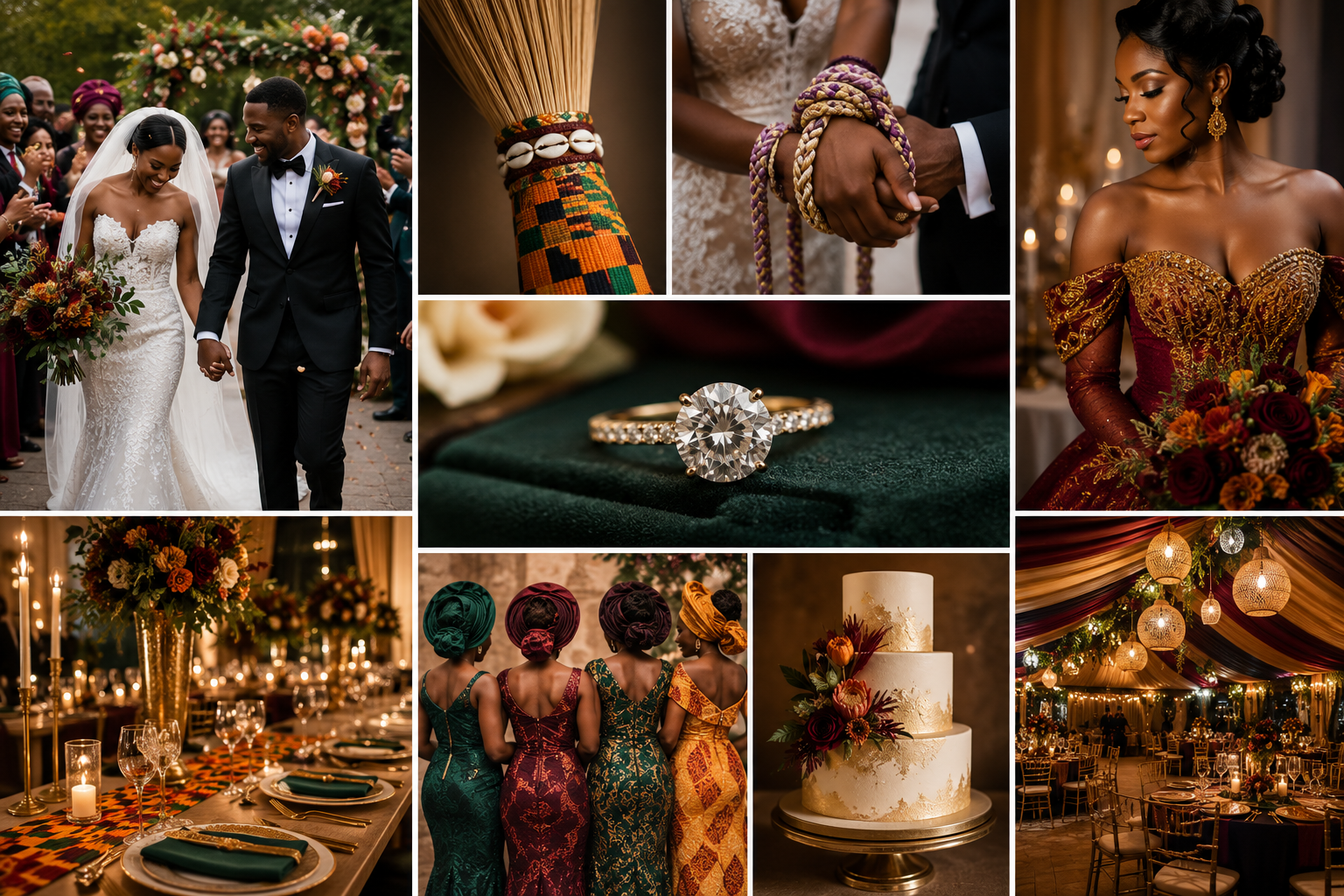
Fall 2026 will be the strongest season for African American weddings in fifteen years by industry-survey measures. Couples are spending more, planning longer in advance, and incorporating more cultural detail than in the average year. The trend list reflects what venues, planners, and dress designers are reporting as the most-requested elements.
Three forces drive the season. First, a generational return to heritage-forward planning, where couples reach into family and African ancestry for ceremonial elements. Second, a price-driven move toward lab-grown center stones for engagement rings, which lets couples reallocate budget to ceremony and reception details. Third, a fashion-driven return to color in bridal wear, where the traditional white gown is supplemented by Ankara prints, asoebi family sets, and post-ceremony colored dresses.
Heritage-Forward Ceremony Elements
Jumping the broom remains the most-requested ceremonial element, present in roughly 78% of African American weddings in 2026, and the broader category of hottest trends in weddings now consistently highlights these heritage-forward elements. The broom is increasingly custom-made, with handles wrapped in family textiles and bristles bound with cowrie shells, kente cloth, or ribbons in family colors. The decorated broom is then displayed in the couple’s home as a permanent keepsake.
The libation ceremony is the second most-requested element, with roughly 41% of couples including it in 2026. The officiant pours water or a chosen liquid while naming family ancestors, drawing the ceremony’s spiritual line back through specific named generations. The list of names is prepared by the couple in advance and often runs to several pages.
Tying the knot, where a cord, cowrie strand, or fabric strip is wound around the couple’s joined hands, has moved from a niche element to a more common one, present in about 26% of 2026 ceremonies. The corded material is often woven from family fabrics and kept after the ceremony.
Asoebi and Color in Bridal Wear
Color is the largest single change in 2026 bridal wear. The all-white ceremony gown remains the standard for the vows themselves, but post-ceremony dresses in rich colors are now expected. Reception dresses in royal blue, emerald, deep red, gold, and Ankara prints are the four most common categories. The reception change usually happens between the dinner service and the dance floor opening.
Asoebi, the West African tradition of family and bridal-party members wearing matching fabric, has expanded significantly in 2026. The wedding party orders matching fabric (typically Ankara or aso oke) and family members create their own outfits from the bolt, producing a coordinated visual effect across dozens or hundreds of guests. Some couples produce two asoebi sets, one for the wedding party and one for grandparents and elders.
The traditional white gown itself shows more detail in 2026. Beaded bodices, hand-cut lace appliqué, structured corsetry, and longer cathedral trains are appearing more often than in the minimalist 2010s and early 2020s. The trend overlaps with the wider return to maximalist bridal styling, but it specifically suits brides who want a ceremony gown that holds up to the visual weight of the cultural elements around it.
The Engagement Ring Inside the Larger Plan
Having unique engagement rings now plays a smaller share of the total wedding budget than it did ten years ago. African American couples in 2026 are increasingly choosing lab-grown center stones, which reduces the engagement ring cost by 70% to 80% compared to natural diamond equivalents. The savings are then redirected to ceremony and reception elements that produce more visible cultural meaning.
The engagement ring itself is also more personalized. Custom shanks, hidden halos, family birthstone accents, and engraved inner bands appear more often in 2026 designs than in standardized retail selections from prior years.
Reception Aesthetics for Fall 2026
Reception design has moved away from the all-white minimalist palette toward warmer, layered color schemes. Burgundy and gold, royal blue and ivory, emerald and burnt orange, and dusty pink with brass are the four most-requested combinations of 2026. Tablescapes incorporate textile elements (kente runners, mudcloth napkins, woven placemats) alongside the floral displays.
Floral choices have changed alongside the palette. Proteas, anthuriums, birds of paradise, and tropical greens have replaced the all-rose-and-peony scheme that dominated 2020s receptions. The tropical and African-origin botanicals connect the reception aesthetically to the ceremony’s heritage elements without requiring a literal pan-African theme.
The food itself reflects the trend. Soul food stations, jollof rice service, peanut stew, and crab boil service are appearing alongside or in place of traditional plated dinners. A 2026 wedding from a planner in Atlanta or Houston often features two food formats: a traditional plated course early in the evening and a late-night soul food or West African station that serves until the end of the reception. Coverage of 2026 bridal trends across designer collections shows the same maximalist, layered direction at the reception level.
Music and Program Choices
Music selections in 2026 follow a three-act structure. The ceremony itself often opens with live drumming or African vocal music, transitions to gospel or contemporary Christian music for the vows themselves, and closes with the wedding party’s “stroll” exit, typically to a step or fraternity song.
The reception music follows generational programming. The first hour is family-friendly Motown and classic R&B for the older guests. The middle hours move to 1990s and 2000s hip-hop and R&B for the wedding-party-and-friends demographic. The late evening shifts to contemporary Afrobeats, dancehall, and modern R&B as the older generation departs. The result is a deliberately segmented evening where each generation has its own dance floor moment.
DJs and emcees are now booked 18 to 24 months in advance for fall 2026 dates, longer than the 12-month lead time that was standard in 2022. The trend matches what coverage of recent wedding dress trends notes about how the booking timeline has tightened across major markets.
Budget Reallocation Patterns
The average African American wedding budget in 2026 is roughly $42,000, with regional variation between $28,000 (Midwest) and $68,000 (Mid-Atlantic). The biggest internal reallocation since 2020 is engagement ring spending down, reception detail spending up. A 2026 couple typically spends $4,500 on the engagement ring and $14,000 on reception design, where the 2020 equivalent was $6,800 on the ring and $9,500 on reception design.
The other major reallocation is photography and videography. Couples in 2026 are spending more on documentation than on flowers, reversing the pattern of the 2010s. The reason is generational: 2026 couples grew up sharing wedding moments on social media and want documentation that holds up to that standard.
A Practical Reading for Fall 2026 Planning
The single most useful fact for a couple planning a fall 2026 wedding is the lead time. Venues, photographers, and DJs in major markets are booked 18 to 24 months out. A couple planning a fall 2026 wedding should have the venue, photographer, and DJ confirmed by early 2025. The dress designer, planner, and floral team can follow in mid-to-late 2025. The engagement ring and cake have shorter lead times and can be finalized 3 to 6 months before the event.
A couple who have not started those bookings as of late 2025 should consider a spring 2027 wedding rather than forcing a fall 2026 date with the second or third choice for each role. Coverage of the American wedding economy and its recent contraction shows lead times across the rest of the country tightening on a similar curve.