


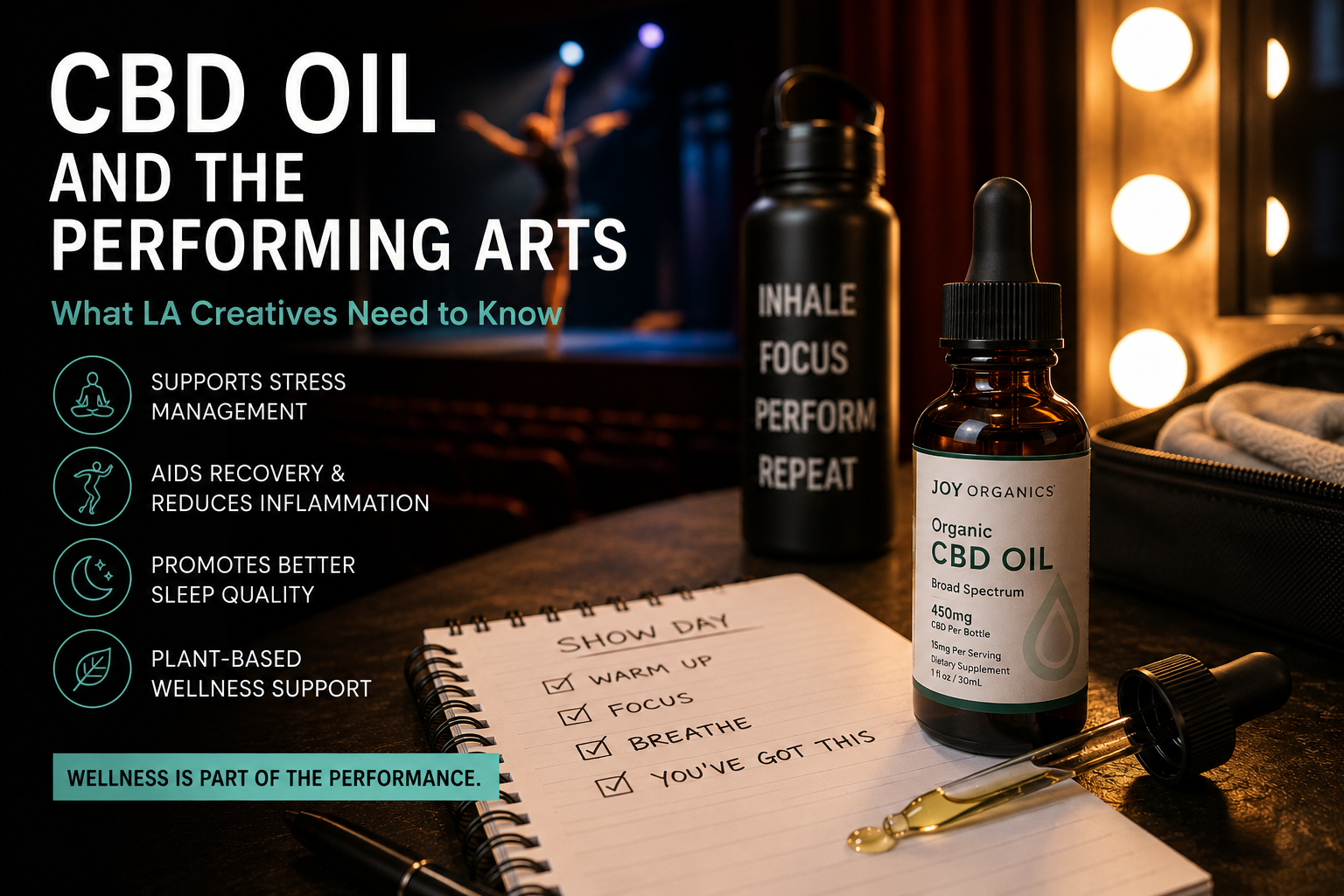
The life of a working performer in Los Angeles carries a particular kind of pressure. Auditions, callbacks, opening nights, late rehearsals, the financial uncertainty that runs underneath all of it. Stress is not an occasional visitor in the creative life. For many actors, dancers, and musicians, it is a constant companion.
In recent years, CBD oil tinctures have become part of the wellness conversation among LA’s creative community. Not as a cure for anything, but as one tool among several that performers reach for when managing the physical and mental demands of their work. If you have heard the term and wondered what it actually means in practice, this is a straightforward look at what CBD oil is, what the current research suggests, and what creatives should understand before trying it.
What CBD Oil Actually Is
CBD, or cannabidiol, is a compound derived from the hemp plant. It is non-psychoactive, meaning it does not produce a high. This distinguishes it from THC, the compound in cannabis responsible for intoxication. CBD is legal at the federal level when derived from hemp containing less than 0.3 percent THC, which is the standard for commercially available products in the United States.
CBD oil tinctures are liquid extracts taken sublingually, meaning a few drops held under the tongue for absorption directly into the bloodstream. This method is generally considered one of the faster-acting delivery formats, with effects typically felt within 15 to 45 minutes depending on the individual, the dosage, and whether they have eaten recently.
The compound works by interacting with the body’s endocannabinoid system, a regulatory network involved in managing stress responses, mood, sleep cycles, and inflammation. CBD does not flood this system or override it. It appears to modulate it, supporting the body’s own ability to maintain balance.
Why Performers Have Taken Notice
Performance anxiety is one of the most universal experiences in the arts. The physical symptoms are well documented: elevated heart rate, shallow breathing, muscle tension, racing thoughts, and a narrowed sense of focus that can either sharpen or derail a performance depending on how well it is managed.
Research published in The Permanente Journal found that CBD was associated with reduced anxiety scores in the majority of participants within the first month of use, alongside improvements in sleep quality. The mechanism appears to involve CBD’s influence on serotonin receptors, particularly the 5-HT1A receptor, which plays a central role in anxiety regulation. For performers dealing with pre-show nerves or the low-grade anxiety that builds during an intense production run, that research is worth understanding.
Beyond anxiety, physical recovery is a genuine concern for dancers and stage actors who put significant physical demands on their bodies eight shows a week. CBD’s potential anti-inflammatory properties have attracted interest from athletes and physical performers alike. While the research in this area is still developing, many in the physical performance world have incorporated CBD into their post-show recovery routines alongside more established approaches like ice, stretching, and rest.
Sleep is a third area that matters significantly to working performers. Late-night shows, early morning calls, and the mental stimulation of performance can make it difficult to wind down after the curtain falls. Poor sleep compounds every other stressor in a performer’s life. CBD tinctures, often taken as part of a nightly routine, have become one option people reach for when they need help making that transition from performance mode to genuine rest.
Understanding the Different Types of CBD
Not all CBD products are the same, and the differences matter when choosing something to incorporate into a wellness routine.
Full spectrum CBD contains all of the compounds naturally present in the hemp plant, including trace amounts of THC below the 0.3 percent federal threshold. Many researchers believe the various compounds work better together than in isolation, a phenomenon sometimes called the entourage effect.
Broad spectrum CBD retains most of the plant’s beneficial compounds but removes THC entirely. This is the format many performers prefer, particularly those who may be subject to drug testing or who simply want to avoid any THC exposure.
CBD isolate is pure cannabidiol with all other compounds removed. It is the most stripped-down format and lacks the supporting compounds that broad and full spectrum products retain.
USDA certified organic CBD tinctures, such as those in the Joy Organics tincture collection, carry an additional layer of verification. The USDA organic certification means the hemp was grown without synthetic pesticides or fertilizers and that the production process meets federal organic standards. For performers who are particular about what they put in their bodies, that certification provides meaningful assurance about the sourcing and quality of what they are taking.
What to Look for When Choosing a CBD Tincture
The CBD market expanded rapidly following the 2018 Farm Bill, and product quality varies considerably. A few markers help separate well-made products from those that are not worth the investment.
Third-party lab testing is the most important factor. Any credible CBD product should come with a certificate of analysis from an independent laboratory confirming the cannabinoid content, verifying THC levels, and testing for contaminants like heavy metals, pesticides, and residual solvents. If a product does not make its lab results readily accessible, that is a significant red flag.
Organic hemp sourcing matters for anyone who is particular about what they consume. Hemp is a bioaccumulator, meaning it absorbs compounds from the soil it grows in. Conventionally grown hemp can carry pesticide residues that transfer into the final product. USDA-certified organic sourcing removes that concern.
Carrier oil also plays a role in absorption and tolerability. Most quality tinctures use MCT oil derived from coconuts, which supports efficient absorption of CBD into the bloodstream. Some people have preferences or sensitivities around certain carrier oils, so it is worth reading the label.
The USDA-certified organic tinctures from Joy Organics address each of these considerations, offering broad-spectrum formulations with published lab results and organic certification across their tincture range. For LA creatives who want a clean, verifiable option, that combination of transparency and certification is what to look for in any tincture product.
How Performers Typically Use CBD Tinctures
There is no single right way to incorporate CBD tinctures into a wellness routine. Dosing varies by individual, and most practitioners recommend starting with a low dose and adjusting gradually based on how the body responds. The general principle is that less is often enough, and more is not always better.
Some performers take a small dose of CBD tincture in the hour or two before a performance, using it as part of a broader pre-show preparation that might also include breathwork, movement warm-ups, and mental focus practices. Others use it after shows as part of a wind-down routine, combined with stretching and limiting screen time, to help the nervous system deactivate after the stimulation of live performance.
Consistency tends to matter more than any single dose. Many people who report meaningful results from CBD tinctures use them regularly over several weeks rather than occasionally on high-stress days. The endocannabinoid system appears to respond better to consistent input than to sporadic use.
What CBD Cannot Do
It is worth being straightforward about the limitations. CBD is not a treatment for anxiety disorders, chronic pain, or any specific medical condition. The FDA has approved one CBD-based medication, Epidiolex, for certain forms of epilepsy, but that is a pharmaceutical product at clinical doses, not a wellness tincture.
For performers dealing with diagnosed anxiety, significant mental health challenges, or serious physical injuries, CBD is not a substitute for professional care. It works best as a complementary tool within a broader approach to wellness, alongside adequate sleep, consistent physical care, and appropriate professional support when needed.
The research base is still developing. The studies that exist are promising, but the field is relatively young and rigorous large-scale clinical trials are still catching up with the widespread consumer interest. Anyone incorporating CBD should approach it with realistic expectations and a willingness to pay attention to how their own body responds.
The Broader Wellness Shift in LA’s Creative Community
The interest in CBD tinctures among performers reflects a broader shift in how the creative community in Los Angeles approaches wellness. A generation ago, the culture around managing performance stress leaned heavily on things that ultimately took a toll. What has changed is that many working artists now take seriously the idea that sustainable performance requires sustainable self-care.
CBD tinctures fit into that framework as one option among many: clean, non-intoxicating, and increasingly well-understood. For LA creatives who want to understand what the conversation is actually about and whether it is worth exploring for themselves, the most important step is the same one that applies to any wellness decision. Do the research, prioritize product quality, and pay attention to your own experience.
The NoHo community has never been short on people pushing themselves hard in service of their work. Having good tools for managing those demands is part of the craft of making a career in the arts last.