


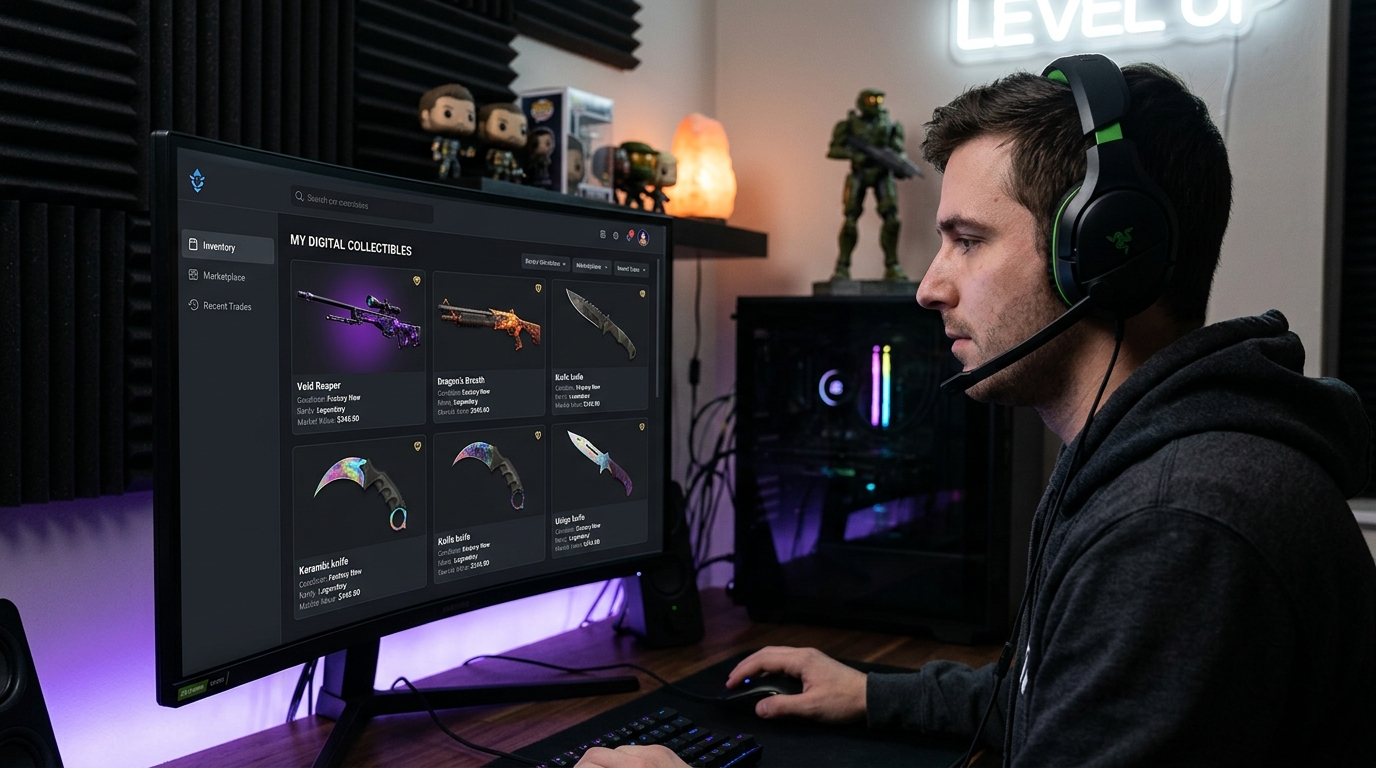
Ten years ago, the idea that a virtual knife skin in a video game could sell for tens of thousands of dollars would have sounded like satire. Today it is routine. The CS2 skin economy alone runs into hundreds of millions of dollars annually, and the communities built around CS2 case opening sites like Clash.gg have developed their own culture, vocabulary, and sense of value that rivals anything happening in traditional collecting circles. Something real has shifted in how people, particularly younger people, think about ownership, status, and what makes a digital item worth caring about.
Understanding that shift requires stepping back from the individual items and looking at the broader cultural logic driving it.
From Cosmetics to Culture
The history of gaming skins follows a familiar pattern in pop culture: something starts as a peripheral feature, captures a community’s imagination, and gradually becomes central to the identity of the whole scene.
In the early days of multiplayer gaming, cosmetics were purely decorative. You might unlock a different color scheme for your character or a variant weapon appearance as a reward for completing a campaign. These items had no economy around them. They existed inside the game and stayed there.
Everything changed when games began treating cosmetic items as tradeable assets. Steam’s marketplace, introduced in 2012, was a turning point. Suddenly the skin you unlocked or found in a crate was not just a cosmetic reward, it was property. It had a price. Other players wanted it. You could sell it, trade it, or hold it and watch its value move over time.
CS:GO, and now CS2, became the most visible arena for this transformation. The game’s weapon skins range from common, low-value drops to extraordinarily rare variants that command prices equivalent to a used car. The rarity tiers, the condition grades, the float values that determine exactly how worn a skin appears, these attributes created a complexity of categorization that mirrors the grading systems in physical card collecting or numismatics.
Why People Collect Digital Items
The psychology of collecting is well understood in the physical world. People collect because scarcity creates value, because belonging to a community of fellow enthusiasts provides identity, because the hunt itself is rewarding, and because curated ownership signals something about the person doing the collecting.
All of those same drives apply to digital collecting. What has changed is the medium and the speed.
Physical collectibles are slow. Graded trading cards take weeks to process. Vintage items require authentication that can take months. The market moves, but it moves at a human pace. Digital skins move in real time. A skin’s value can spike overnight because a prominent streamer was seen using it, or collapse because the game released a new variant that captured the community’s attention. The market is alive in a way physical markets simply are not.
That speed creates a different relationship with the items. Collectors in the physical world often hold for years or decades. Skin collectors might hold for days, weeks, or indefinitely, watching market movements the way someone else might track equities. The collector and the trader are often the same person.
What the two worlds share is the social layer. Displaying a physical collection to guests, wearing a rare piece of jewelry, driving a sought-after car, these are all signals. In gaming, equipping a rare skin serves the same function. Every opponent who sees your weapon in a CS2 match is receiving information about who you are and what you have. That social signaling is not trivial. It is one of the primary engines driving the entire skin economy.
The Case Opening Ritual
Within the broader skin culture, case opening occupies a specific and fascinating place. It is not just a transaction, it is an experience. The ritual of purchasing a case, acquiring a key, and watching the roll animation determine what skin appears has structural similarities to other forms of collectible unboxing that have driven billions of views on YouTube and TikTok.
The trading card parallel is obvious but worth stating clearly. The reason packs of trading cards outsell individual cards at certain price points is not purely economic. People pay for the experience of the reveal. The possibility of the rare pull. The moment of discovery. Case opening in CS2 operates on precisely the same logic, but delivered through a platform that can be accessed instantly, shared in real time, and experienced alongside a community of other players.
Platforms like Clash.gg have built entire ecosystems around this ritual. With over 400 cases to choose from, including custom cases created by the community itself, the variety goes well beyond what the base game offers. Case battles add a competitive dimension, pitting players against each other to see who opens the higher-value drops from identical cases. The social, competitive, and collectible elements are layered together into something that functions more like a hobby ecosystem than a simple feature.
That depth of ecosystem is what separates a passing feature from a genuine subculture.
Digital Ownership and the Generational Divide
There is a persistent skepticism from older generations about the value of digital items. The argument usually takes the form of a question: but you don’t really own it, do you? The item exists on a server. The company could change the terms. It is not physical.
This skepticism misses something important about how the generation that grew up digital understands ownership. For someone who has spent significant portions of their life inside games, digital spaces are not a lesser version of reality. They are another context in which real things happen, real relationships are formed, and real value is created and exchanged.
The legitimacy of an item’s value is not determined by its physical existence. It is determined by whether a community agrees that it has value, whether it is scarce, and whether it can be authentically transferred from one person to another. CS2 skins meet all three criteria. A StatTrak Karambit in Factory New condition is rare, is genuinely owned and transferable by the person holding it, and has a market of willing buyers who agree on approximately what it is worth. That is not a simulation of value. That is value.
The NFT boom and subsequent correction taught the market some hard lessons about the difference between manufactured scarcity and genuine community-backed scarcity. Gaming skins predate the NFT wave and have proven more durable because their value is anchored in something real: a game with millions of active players, a competitive scene with genuine prestige, and years of accumulated community lore around specific items and their histories.
Skins as Identity and Self-Expression
Beyond the economics, there is a dimension of digital collecting that is harder to quantify but arguably more important to the people involved: identity.
The skins a player uses communicate something. A player who runs a consistent aesthetic across their inventory is signaling taste and intentionality. Someone using a rare discontinued skin is signaling history with the game and the community. A player whose loadout reflects a particular color scheme or theme is treating their inventory as a form of personal expression not unlike how someone might curate their wardrobe or the art on their walls.
This expressive function of digital items is something designers and platform builders are increasingly taking seriously. The best skin ecosystems are not just marketplaces. They are creative contexts in which players participate in the ongoing visual culture of the game. Community-created cases on platforms like Clash.gg extend that participation further, giving players the ability to curate and contribute to the item culture rather than just consume it.
Where the Digital Collectibles Space Is Going
The skin economy is not a niche. It is one of the most active and financially significant corners of gaming, and its influence is expanding.
Other games are watching what CS2 built and building their own economies. The concept of player-owned cosmetics with real market value is becoming an expectation rather than a novelty for certain audiences. Brands outside of gaming have noticed, with collaborations between game properties and fashion labels, streetwear brands, and artists producing digital items that blur the line between gaming collectible and cultural artifact.
The platforms that facilitate this economy are also evolving. The best ones are building communities, not just transaction layers. They are investing in the social rituals around collecting, the competitive experiences, and the tools that let players engage with the item culture more creatively. That is where the most durable value gets created, not in any single item, but in the depth of the ecosystem around it.
Digital ownership is not the future. For a significant and growing part of the gaming population, it is already the present, and it is producing a pop culture of its own that is worth paying serious attention to.