


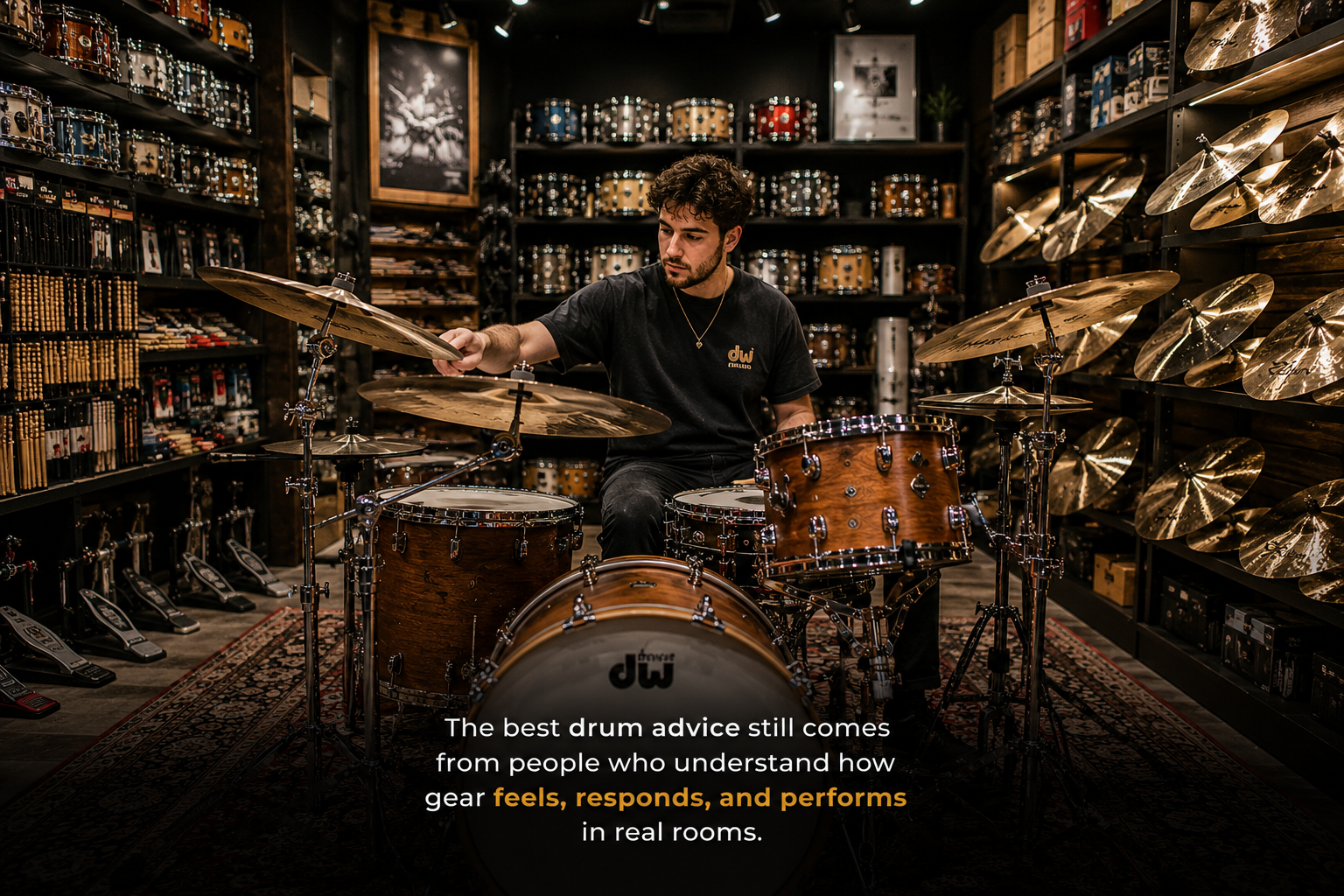
A drummer can hear bad advice almost as quickly as a bad cymbal.
It shows up in the way someone talks about gear as if every kit is interchangeable, every ride cymbal is just a size and a price point, every snare drum can be judged by its shell material alone.
It shows up in the assumption that the loudest setup is the strongest setup, or that the most expensive pedal will fix a weak foot, or that a drummer’s problem is always solved by buying more.
Drummers know better.
The instrument is too physical for that. It lives in touch, tuning, room response, rebound, muscle memory, and the tiny negotiations between a player’s body and the sound in front of them.
Online shopping has changed how musicians buy gear, and mostly for the better.
A drummer in a small town can now hear boutique cymbals, compare snare drums, research hardware, and order parts that would once have required a long drive or a lucky local shop. Access has expanded. Choice has exploded.
But more choice has not made expertise less valuable. It has made expertise more necessary.
Drumming is not a product category; it’s a language
A guitar player can talk about tone in familiar terms: warm, bright, clean, overdriven, compressed, glassy, thick. Drummers have their own vocabulary, but it is often harder to translate online.
What does “dry” really mean when one cymbal’s dryness sounds focused and another sounds dead? What does “fat” mean when a snare still needs enough articulation to cut through a mix? What does “dark” mean in a small rehearsal room versus a recorded jazz session? What makes a kick drum feel big without turning muddy?
These questions are not academic. They shape how a drummer performs. A cymbal that blooms too slowly can make a groove feel late. A ride that overpowers the room can force the whole band to change dynamics. A snare that sounds exciting in isolation can become harsh under microphones. A pedal that feels fast to one player can feel unstable to another.
Human expertise matters because drumming is full of context. The right answer depends on the player, the room, the music, the budget, the band, the skill level, and the kind of sound the drummer is trying to build.
An algorithm can recommend what other people bought. A knowledgeable drum specialist can ask why you are buying it in the first place.
The drum shop as cultural space
For decades, drum shops have been more than retail spaces. They have been informal schools, rehearsal rooms without songs, museums without velvet ropes, and gathering places where players learn by listening.
A young drummer walks in for sticks and leaves having heard someone tune a snare properly for the first time.
A touring player drops by between shows and teaches half the room a lesson in cymbal touch without meaning to.
Someone tries a ride cymbal in the corner, and three strangers suddenly have opinions about wash, bell, stick definition, and whether it would work for a trio gig.
That is not nostalgia. That is how musical knowledge moves.
NoHo Arts District understands this kind of creative ecology well. Arts neighborhoods are built on proximity: performers, teachers, rehearsal spaces, studios, workshops, and small businesses all feeding each other. The same principle applies to a great drum shop. It is not only a place where instruments are sold. It is a place where taste gets sharpened.
Online retail can carry inventory. Human expertise carries culture.
Why drummers still need guidance
The internet gives players information, but information alone is not the same as judgment.
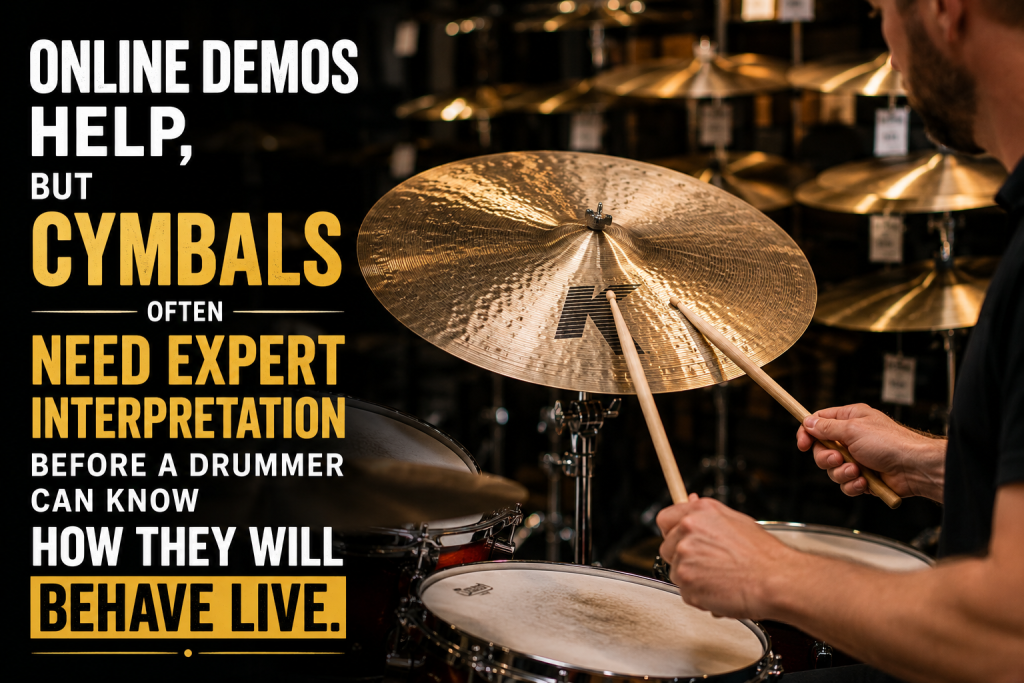
A drummer can watch twenty cymbal demos and still choose the wrong one. Not because the demos are bad, but because the drummer may not yet know what to listen for. The wash might sound beautiful through headphones but become uncontrollable in a small church. The bell might cut nicely in a video but feel awkward in real playing. The crash might record well but sit poorly with the rest of the player’s cymbal setup.
This is where a knowledgeable retailer becomes more like a translator.
A good drum expert can help a player understand questions like:
- Are you buying for live work, recording, practice, or all three?
- Do you play with a heavy hand or a lighter touch?
- Does your band need more projection or more control?
- Is your room bright, dead, small, reflective, or heavily treated?
- Are you replacing a sound you dislike or expanding your palette?
- Do you need gear that inspires you, gear that solves a problem, or both?
Most drummers have made at least one purchase that looked right on paper and felt wrong in the room. Human guidance helps reduce those mistakes.
Drum Center of Portsmouth and the specialist model
Drum Center of Portsmouth is a good example of why specialist knowledge still matters in the online era.
Founded by Shane Kinney in 2009, the shop grew from Kinney’s own background as a drummer, retail professional, drum technician, and active member of the New England music community. The store has developed into one of the most recognized drum-focused retailers in the world, with a large physical showroom and a strong online presence.
That history matters because the Drum Center of Portsmouth does not approach drums as a side department. It approaches them as the entire conversation.
The electronic drum set from Drum Center of Portsmouth is not a collection of expensive objects. It is a musical system. The kick has to relate to the bass player.
The snare has to speak in the mix. The toms need a useful tuning range. The cymbals have to sit around the kit without fighting each other.
Hardware must support the body, not punish it. The whole thing should make a drummer want to play longer and better.
That kind of thinking is difficult to automate.
The Myth of “Best Gear”
One reason expert guidance remains essential is that drumming has very few universal bests.
The best ride cymbal for a jazz trio may be wrong for a loud indie rock band. The best snare for a studio backbeat may be too controlled for a live gospel setting.
The best kick pedal for speed may not suit a drummer who wants weight and resistance under the foot. The best electronic kit for an apartment may not satisfy someone preparing for acoustic gigs.
The word “best” only becomes useful when paired with a situation.
- Best for what room?
- for what player?
- for what genre?
- for what budget?
- for recording or live use?
- for feel or projection?
- for reliability or character?
A good drum specialist does not flatten those questions. They bring them forward.
That is what separates expert retail from ordinary online shopping. The goal is not to push a drummer toward the most expensive option. The goal is to help them understand which piece of gear solves their actual musical problem.
Why sound demos help, but do not replace expertise
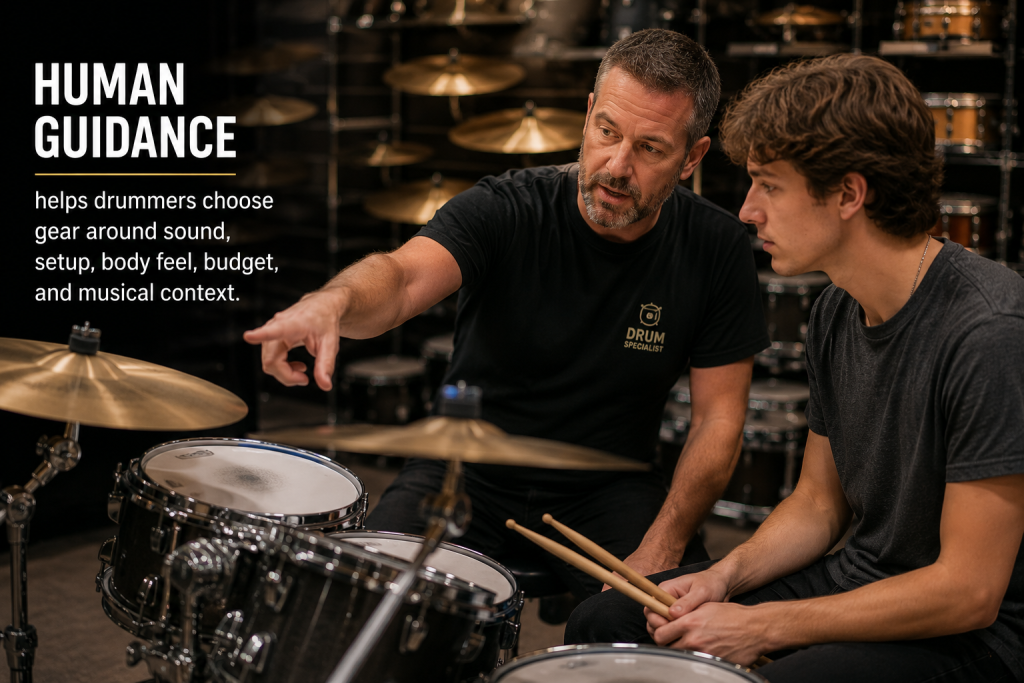
Online sound demos have become one of the most useful tools in drum retail. For cymbals especially, they are essential. Hearing the exact cymbal before buying is far better than relying on model descriptions alone.
But demos still require interpretation.
A cymbal demo is shaped by the room, the microphones, the player, the sticks, the mix, the headphones or speakers used by the listener, and the way the cymbal is being played. A sensitive drummer can extract useful information from that, but not every buyer knows how to separate the instrument from the production.
That is where expert commentary matters.
Someone who has played thousands of cymbals can say, “This one opens up quickly,” or “This ride has more spread than the recording suggests,” or “This crash is darker than typical for the line,” or “This one will sit better in a lower-volume room.”
Those details are gold. They are the difference between hearing a sound and understanding how that sound behaves.
The art of matching gear to the player
The best drum experts are not just gear people. They are listeners.
They listen to what a drummer says, but they also hear what the drummer may not know how to say yet.
A beginner may say they want a “professional” kit when what they really need is something reliable, tunable, and forgiving.
An intermediate player may say they need a new snare when the bigger issue is heads and tuning. A touring drummer may ask for power when what they need is consistency under microphones.
Expertise is not about showing off knowledge. It is about narrowing the field so the player can make a better musical decision.
This is especially important because drummers often develop through phases. The kit that helped someone learn at home may not work for their first band.
The cymbals that sounded exciting at age seventeen may feel crude at twenty-five. The hardware that seemed fine for practice may fail under gigging conditions. A drummer’s ear matures, and the setup has to mature with it.
A strong specialist retailer helps players grow into better choices rather than simply selling them the next object.
Why this matters for musicians
For working drummers, gear is not decorative. It is part of the job.
The wrong hardware can make load-in harder. The wrong cymbals can irritate a front-of-house engineer. The wrong snare can make a set feel stiff. A poorly chosen electronic kit can limit rehearsal quality. A fragile pedal can fail at the worst possible time.
Players who work regularly do not only need exciting gear. They need dependable gear that behaves predictably from room to room.
That is where expert-led drum retail becomes practical, not romantic.
A knowledgeable shop can guide a drummer toward choices that serve the gig. The advice may not always be glamorous. Sometimes the answer is better cases, a more stable hi-hat stand, quieter cymbals, proper heads, a different beater, or a snare that tunes well across multiple rooms.
The best experts know when not to oversell.
The beginner needs expertise most
Advanced drummers often know how to ask better questions. Beginners do not, which is why they may need human guidance even more.
A new drummer can easily get buried under options: shell sizes, cymbal packs, electronic kits, throne height, stick sizes, practice pads, pedals, heads, dampening, hardware packs, tuning keys, metronomes.
The wrong first setup can make the instrument feel harder than it needs to be.
A good expert can simplify the starting point. They can explain what matters now and what can wait. They can help a beginner avoid the trap of buying too cheaply and replacing everything quickly, or overspending on gear they do not yet understand.
That first positive experience matters. If the setup feels good, the drummer practices. If the drummer practices, they improve. If they improve, they stay with the instrument.
Good guidance keeps people playing.
Online shopping Is better when it feels human
The future of music retail is not a choice between online convenience and human expertise. The best version combines both.
Online shopping gives drummers access. Specialist knowledge gives that access meaning.
A drummer should be able to compare gear from home, hear demos, ask questions, get honest recommendations, and buy from people who understand the stakes of the purchase. That is not old-fashioned. That is the standard serious musicians deserve.
Drum Center of Portsmouth represents that model well because it brings the credibility of a dedicated drum shop into the online space. Its value is not only that it sells drums. Its value is that it understands drummers.
Final Takeaway
Great drummers do not become great because they bought the right cymbal or snare. They become great through time, listening, practice, touch, discipline, and musical curiosity.
But the right gear can support that growth. The wrong gear can get in the way.
That is why human expertise still matters. Drummers need more than search filters and customer reviews. They need guidance from people who understand sound, setup, feel, rooms, performance, and the strange personal chemistry between a player and an instrument.
Online shopping may have changed where the buying happens. It has not changed what good drummers need: honest ears, informed advice, and gear chosen in service of the music.