


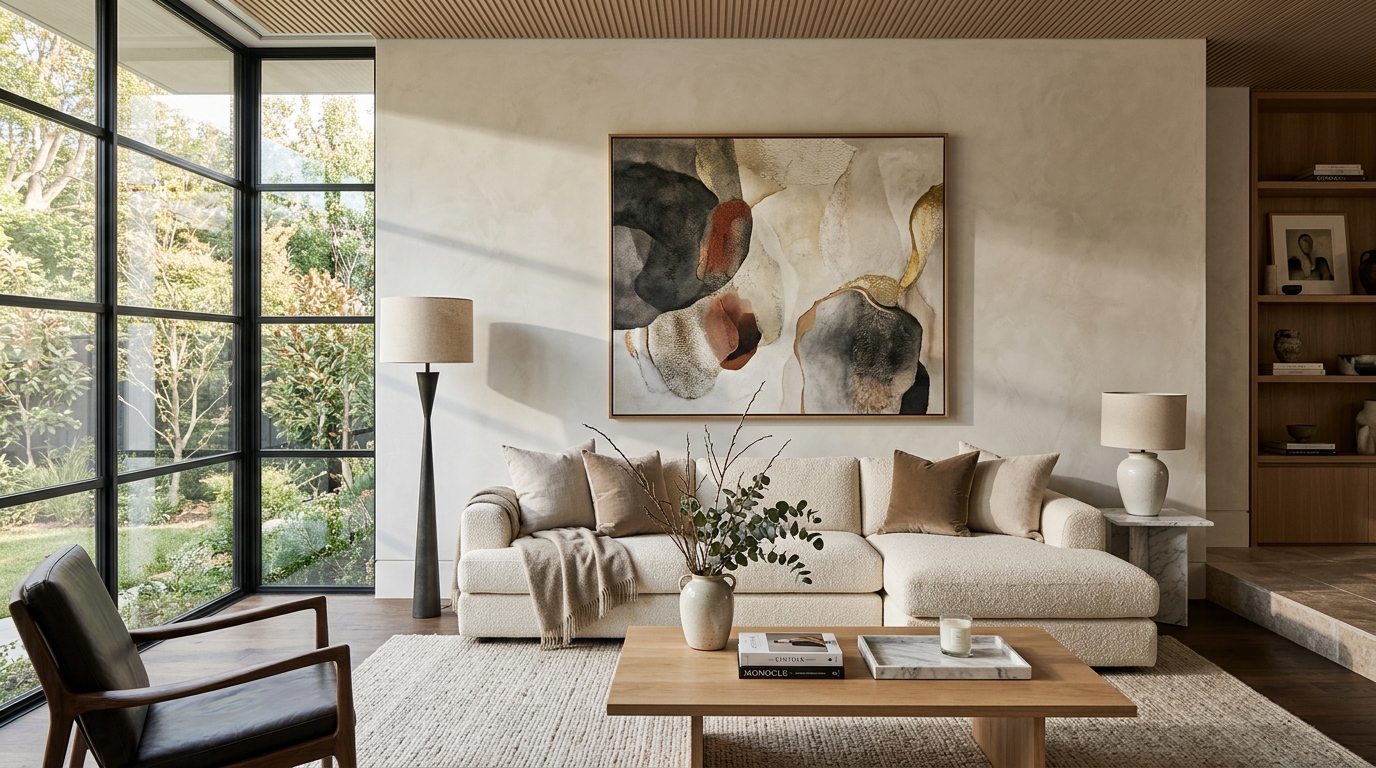
Large wall art has a way of speaking before anything else in a room gets its turn. The human eye looks for hierarchy, and size is the fastest cue it can find. A substantial piece on the wall gives the space a clear center of gravity, which is often what makes a home feel intentional rather than merely assembled. Even in rooms filled with good furniture, the absence of a strong visual anchor can leave the atmosphere oddly weightless.
Scale also affects how we read the architecture itself. A large artwork can make low ceilings feel taller by pulling attention upward, or make a long wall feel less like an empty runway. It can soften hard angles, add warmth to modern lines, and provide a focal point that keeps the room from feeling like a collection of separate purchases. In that sense, the work is not just decoration, but a device that edits the room into a coherent whole.
There is also a psychological comfort in getting scale right. When art is too small for the wall it occupies, the room can feel tentative, as if it is waiting for a decision. When a piece is appropriately bold, the space often feels calmer because the primary visual question has been answered. This is especially true in living rooms and dining areas where people gather and naturally scan the room. A well-scaled piece communicates that the home has a point of view.
Setting the Focal Point Without Overcrowding
The best large wall art behaves like a lead actor, not a loud extra. It creates a focal point, yet it should still leave room for supporting elements like lighting, textiles, and furniture to do their work. A common misstep is treating big art like an oversized poster and cramming it into a wall already busy with shelves, sconces, or competing frames. The result can feel cluttered, not dramatic, because the eye does not know where to rest.
A more effective approach starts with subtraction. Identify the wall that can tolerate the most visual emphasis, often the one behind a sofa, above a credenza, or opposite the entry where visitors instinctively look. Then let the artwork claim that territory with breathing room around it, rather than surrounding it with smaller pieces that dilute its authority. If you want layered interest, consider texture in the room instead of additional wall objects, such as a sculptural lamp, a woven throw, or a rug with subtle pattern.
Large wall art can also calm spaces that already have architectural drama. In a room with tall windows, exposed beams, or strong millwork, a big piece can serve as a counterweight that prevents the architecture from dominating the mood. The trick is to choose a work that echoes one or two qualities in the room, such as a repeated color, a similar line, or a shared material tone. That relationship makes the focal point feel integrated rather than imposed.
Choosing Subject Matter That Reads From Across the Room
Big art should be legible at the distance from which it will be seen most often. That does not mean it must be simplistic, but it should have a clear structure that holds together from across the room and still rewards attention up close. Landscapes, abstracts with strong composition, large-format photography, and graphic forms tend to perform well because they stay coherent at multiple viewing ranges. Works with intricate detail can succeed, yet they need a dominant gesture or silhouette that reads quickly. You want something that looks intentional even in peripheral vision. Otherwise, the wall can feel oddly undecided.
Subject matter also sets the emotional temperature of the room. A sweeping landscape can bring ease to a busy household, while a high-contrast abstract can add edge to a neutral interior that risks feeling too polite. Portraiture can be powerful, but it is intense at a large scale because a face becomes a social presence in the room. In dining areas, that presence can feel theatrical, while in bedrooms, it can feel overly watchful. Photography often reads cleanly, yet it can turn chilly if the palette is steely or the content is stark. Match the image to how you live daily.
Once you know the mood you want, the next hurdle is sourcing: finding something large enough to hold a wall, yet curated enough to avoid endless scrolling. Marketplaces with strong filters can help here, especially when you are weighing subject matter against size, material, and finish. Chicago-based iCanvas, for example, offers ready-to-hang pieces by independent artists as well as licensed works from estates and cultural institutions, with options across canvas, fine art paper, acrylic glass, wood, and metal. For a quick sense of what works at scale, its large wall art offerings provide a useful cross-section of styles and formats. The point is not to outsource taste, but to shorten the distance between an idea you like and a piece that will hold a wall with confidence.
Color, Contrast, and the Quiet Power of Negative Space
Color is often treated as the main event, but contrast is what makes large wall art feel crisp. A piece can be entirely neutral and still deliver impact if it has strong light-to-dark relationships, clear line, or visible texture. Conversely, a colorful work can feel flat if the palette is busy but the composition lacks structure. In a home, where lighting shifts throughout the day, contrast helps the art hold its presence from morning glare to evening lamplight.
Negative space is equally important, both inside the artwork and around it. Art that includes open areas or restrained composition can make a room feel more expansive, especially in smaller homes or apartments where visual calm is valuable. Minimalist works often succeed at large scale because they give the eye room to breathe and allow furniture silhouettes to stay readable. Even figurative pieces benefit from spacing that prevents the subject from feeling cramped.
It also helps to think of the artwork as a color manager. Large pieces can unify a palette by pulling a secondary color from a rug into the vertical plane, or by introducing a new accent that you can echo in pillows, ceramics, or books. The goal is not perfect matching, which can look overly staged, but a subtle conversation between surfaces. When color and negative space work together, the impact feels sophisticated rather than shouty.
Placement and Proportion: The Measurements That Matter
Most placement mistakes come down to one problem: art floating too high. In living spaces, the center of the artwork should generally align with eye level for a standing adult, adjusted for the realities of furniture below it. When a piece sits over a sofa or console, it should relate to that object, not hover above it like a separate idea. A useful guideline is to keep the bottom edge of the frame or canvas closer to the furniture than you think, so the grouping feels anchored.
Proportion is the second issue, and it has less to do with the wall’s size than with the furniture’s width. Over a sofa, the artwork often looks best when it spans a significant portion of the sofa’s length, rather than appearing as a small centered stamp. That does not always mean one gigantic piece, but it does mean committing to a visual mass that can hold the wall. If you do use one large work, it should feel like a deliberate counterbalance to the sofa’s presence.
Lighting completes the placement story. Natural light can be flattering, but it can also cause glare on glossy surfaces, so the finish and position should anticipate where windows fall. If you use picture lights or adjustable spots, aim for a soft wash rather than a harsh beam, which can flatten texture. Proper placement and thoughtful lighting turn large wall art from an object into an experience that changes as the day progresses.
Material and Finish: Canvas, Paper, Acrylic, Metal, and Wood
The surface you choose is not just a technical detail; it changes the mood of the room. Canvas often reads warm and familiar, partly because its texture softens images and reduces glare under common household lighting. Fine art paper can look crisp and refined, particularly when matted and framed, which adds an architectural edge. Acrylic glass tends to heighten color and contrast, giving modern spaces a polished, gallery-like sheen.
Metal prints have their own personality, often leaning contemporary because of their sleekness and the way highlights move across the surface. In rooms with a lot of matte finishes, metal can add a welcome element of reflectivity, though it requires thoughtful placement to avoid glare. Wood prints can bring organic warmth, especially in homes with natural materials like oak floors, stone counters, or linen upholstery. They can also soften minimalist interiors that risk feeling too sterile.
The material should also match the room’s use. A high-traffic hallway may benefit from a durable surface that can be wiped down, while a bedroom might suit a quieter, more tactile finish that feels restful. Humidity and temperature can matter too, especially in bathrooms or kitchens, where certain materials hold up better than others. When finish aligns with function, the work feels like it belongs, not like it was chosen in isolation.
The Statement Piece as Storytelling and Personal Identity
A home is one of the few places where people can shape an environment around their own taste without needing consensus from a committee. Large wall art makes that freedom visible because it carries personal preference at an architectural scale. It can signal a fascination with travel, a loyalty to modernism, a love of photography, or a sense of humor that guests immediately understand. In a world of algorithmic sameness, a decisive piece can read as a quiet act of individuality.
Storytelling does not require literal narrative. A large abstract can reflect a homeowner’s appetite for risk, while a serene landscape can express a desire for calm. Even typographic or graphic pieces can function as a kind of manifesto, though restraint helps those works age well. The most successful statement pieces tend to leave room for interpretation, which keeps them interesting long after the novelty fades.
Finally, large wall art can help a home evolve over time. Because it creates a strong visual anchor, it can support changes in furniture and accessories without the room losing its identity. Move a chair, swap a rug, repaint a wall, and the art can remain the reference point that keeps the space coherent. In that way, the statement piece is not just a dramatic flourish, but an investment in the home’s long-term visual stability.