


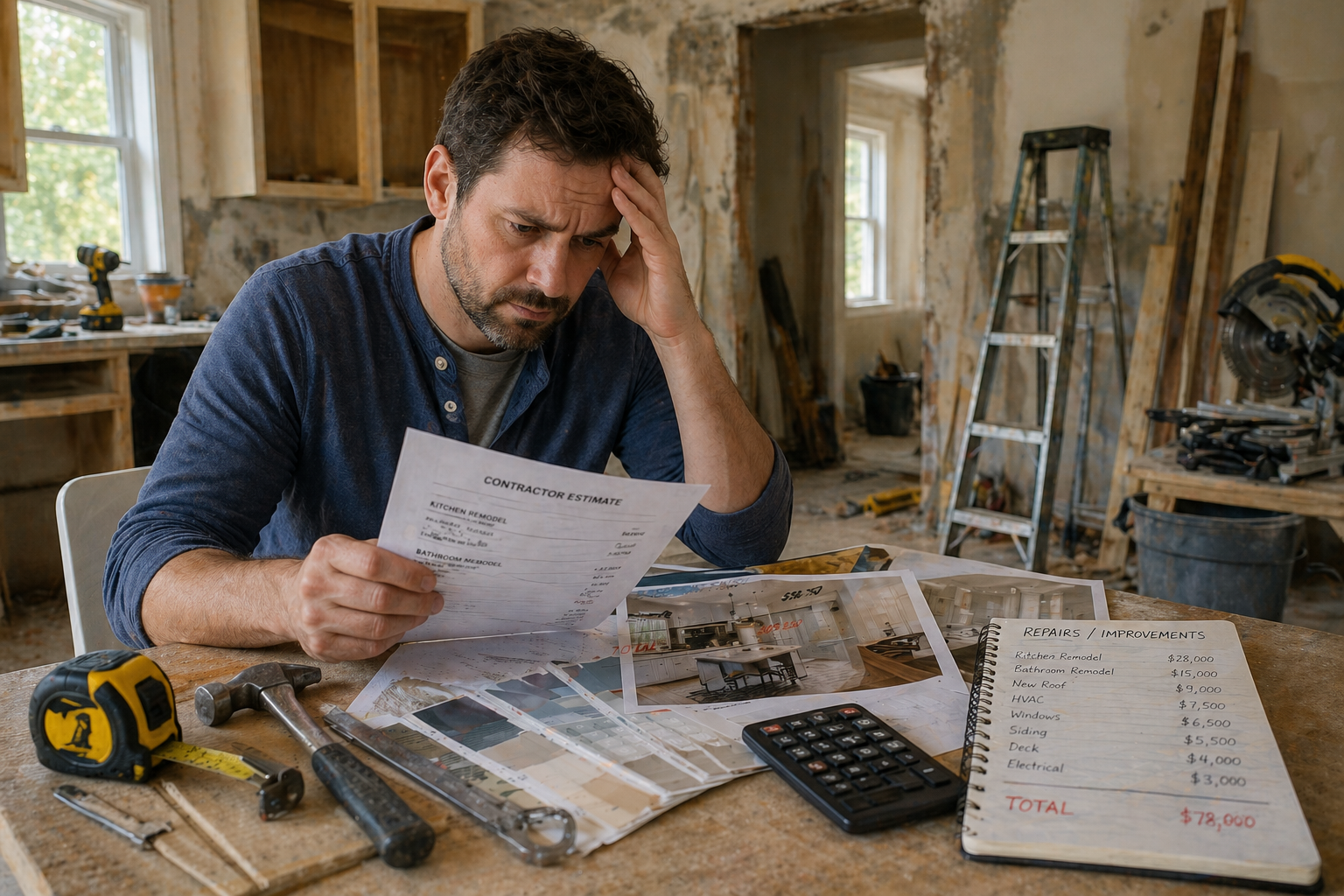
There’s a persistent myth in real estate that repairs and improvements automatically pay for themselves at sale time. They don’t. Some repairs return 80 to 90 percent of their cost. Others return less than 30 percent. And a third category, including some of the most expensive ones, return effectively nothing measurable in the appraised value.
This matters because sellers preparing to list often spend tens of thousands of dollars trying to maximize their sale price, only to find that buyers don’t value the work the way they expected. The money is gone, the home didn’t sell faster, and the price didn’t move much either.
Knowing which repairs don’t pay off helps you avoid wasted spending and make smarter decisions about whether to fix problems or price around them. Here’s where the math most often goes wrong.
Major Kitchen and Bathroom Overhauls
Kitchen and bathroom remodels are the classic “invest in your home for resale” advice, but the data tells a more complicated story. According to industry remodeling cost-versus-value reports, full kitchen overhauls typically return 50 to 60 percent of their cost at sale. Major bathroom additions often return even less.
The disconnect happens because buyers don’t pay extra for someone else’s taste. Your $80,000 kitchen with the marble island, custom cabinets, and high-end appliances might add $40,000 to $50,000 to the appraised value if it matches the home’s overall price tier and the local market’s expectations. If it’s nicer than the neighborhood supports, the return drops further.
Mid-range updates work better than full overhauls. Replacing dated cabinet fronts, swapping out countertops, updating faucets and lighting; these targeted improvements often return 70 to 80 percent of their cost and don’t run the risk of overcapitalizing for the neighborhood.
The worst kitchen mistake is going more upscale than the home’s price point can support. Spending $60,000 on a kitchen in a $300,000 home doesn’t yield a $360,000 home. It yields a $310,000 home with a really nice kitchen, and you’ve lost $50,000 in the process.
Bathroom additions follow a similar pattern. Adding a bathroom to a one-bath home increases value substantially. Going from three bathrooms to four does very little. Going from four to five is essentially a wash, no matter how much you spent on tile.
Invisible Repairs That Don’t Move the Needle
Some of the most expensive home repairs add nothing visible to the property. Buyers can’t see them, appraisers can’t quantify them, and the math works against the seller every time.
Whole-house rewiring is the classic example. An older home with knob-and-tube wiring or aluminum branch circuits may need a $15,000 to $25,000 electrical update. The work is genuinely necessary, addresses real safety issues, and may be required for the home to be insurable. But it doesn’t add anywhere near $25,000 in market value. Buyers expect modern electrical to be there. They don’t pay extra for it.
Sewer line replacement is another. A failing main sewer line can cost $8,000 to $20,000 to replace, depending on length and access. Necessary work. But the buyer who looks at your home expects working plumbing, doesn’t care that you replaced the line two years ago, and won’t pay you back for it.
Foundation repair falls in the same category. Significant foundation work can cost $10,000 to $40,000 and is essential when needed. The repair stops the problem from getting worse, but it doesn’t make the home worth more than a comparable home that never had the issue. In fact, the disclosure of past foundation work can actually scare off some buyers entirely.
Asbestos remediation, lead paint encapsulation, and mold removal all follow the same pattern. The work is necessary, sometimes legally required, but adds little visible value at sale. These repairs make sense when you’re staying in the home. They make less sense as pre-sale investments unless they’re blocking a sale entirely (like a roof needed for insurance underwriting or HVAC required for a buyer’s lender).
Personal Style Choices That Limit Buyers
Strong personal style works against you at sale time. Some renovation choices that look great to the homeowner actively reduce the buyer pool, which means longer time on market and lower offers.
Bold paint colors are the easy example. Deep burgundy walls, accent colors in every room, painted ceilings, two-tone walls; all of these require buyers to imagine repainting before they can see themselves in the home. Most won’t bother. They’ll move on to the next listing.
Wallpaper, especially heavily patterned or textured wallpaper, is even worse. Removing wallpaper is a notoriously time-consuming project that can damage drywall. Buyers see wallpaper and add removal costs to their offer, often more than the actual cost of removal.
Custom built-ins limit buyer flexibility. A library wall of built-in shelves looks impressive but reduces how the buyer can use the space. Same with custom murphy beds, built-in entertainment centers, or specialty rooms like wine cellars, home theaters with stadium seating, or dedicated craft rooms. They appeal to specific buyers and turn off everyone else.
Imported tile, exotic flooring, and high-end specialty finishes are similar. Beautiful work, but buyers compare your home to others and don’t pay premiums for materials they wouldn’t have chosen themselves. Pool tables, hot tubs, and other amenities built into specific rooms tend to be removed within a few years of sale, so the buyer pays nothing extra for them and may even discount for removal.
Room Conversions and Layout Changes
Converting rooms from their intended purpose almost always reduces value. The most common version is converting a garage into living space, including finished family rooms, in-law suites, and home offices. The square footage adds nominally to the home, but the loss of garage space typically reduces buyer interest more than the added space gains it.
Removing bedrooms is another expensive mistake. Combining two small bedrooms into one large primary suite seems like an upgrade. From a value perspective, it usually isn’t. A four-bedroom home is worth more than a three-bedroom home with a fancy primary suite, all else equal. You’ve turned a desirable feature (bedroom count) into a less desirable one (oversized primary).
Converting a bedroom into a closet, home office, or workout room follows the same pattern. The conversion typically reduces the home’s official bedroom count, which directly reduces appraised value. Buyers searching online filter by bedroom count, so a three-bedroom listing simply doesn’t appear when buyers search for four-bedroom homes.
Sunroom and three-season room additions are problematic for different reasons. They add square footage but usually as unconditioned space, which often isn’t included in the home’s official square footage for appraisal purposes. The cost of construction is significant, but the value adjustment is small.
Open-concept conversions can go either way. Removing walls between the kitchen and living room often does add value, especially in older homes. But removing structural walls without proper engineering, or removing a dining room entirely, can backfire if the layout no longer matches buyer expectations for the home’s price tier.
The Repair-Versus-Sell Calculation
Many sellers face a more fundamental question than which repairs to make: whether the repairs make sense at all. When the total cost of bringing a home to market-ready condition approaches 30 to 40 percent of the home’s likely sale price, the math often favors selling as-is rather than investing more.
This applies most often to inherited properties, homes with deferred maintenance from long-term owners, and properties damaged by storms, fires, or extended vacancy. The repair list runs into the tens of thousands. The renovations require months of work and contractor coordination. And after all of that, the home sells for slightly more than it would have without the work, sometimes barely covering the cost of the project itself.
In the South, working with cash home buyers in Alabama and similar regional buyers gives sellers an alternative to the renovation-then-list path. The cash offer comes in below retail, but it eliminates repair costs, agent commissions, months of carrying costs, and the risk that contractors uncover bigger problems mid-project. For homes where the math is questionable, that simpler equation often nets out comparable to a traditional sale once all the costs of doing it the long way are honestly counted.
The honest test is to compare three numbers: the as-is cash offer, the projected sale price after repairs minus all costs (repairs, commission, holding, contractor overruns), and the time-and-stress cost of doing the work yourself. The renovation route often looks worse than expected once those numbers are filled in without optimism baked in.
The Bottom Line
The repairs that pay off at sale are usually the boring ones, including fresh paint in neutral colors, replaced flooring where it’s worn out, cleaned-up curb appeal, working appliances, and minor fixes that signal a well-maintained home. The repairs that don’t pay off are usually the ambitious ones, the personal-taste ones, and the necessary-but-invisible ones that buyers expect to be in working order anyway.
Before spending significant money on pre-sale improvements, run the numbers honestly. Get an agent’s opinion on what work will actually move the price, not just make the home “nicer.” And remember that the cheapest renovation is the one you don’t need to do because the buyer is fine with the home as it is, or because you’ve found a sale path that doesn’t require it in the first place.