


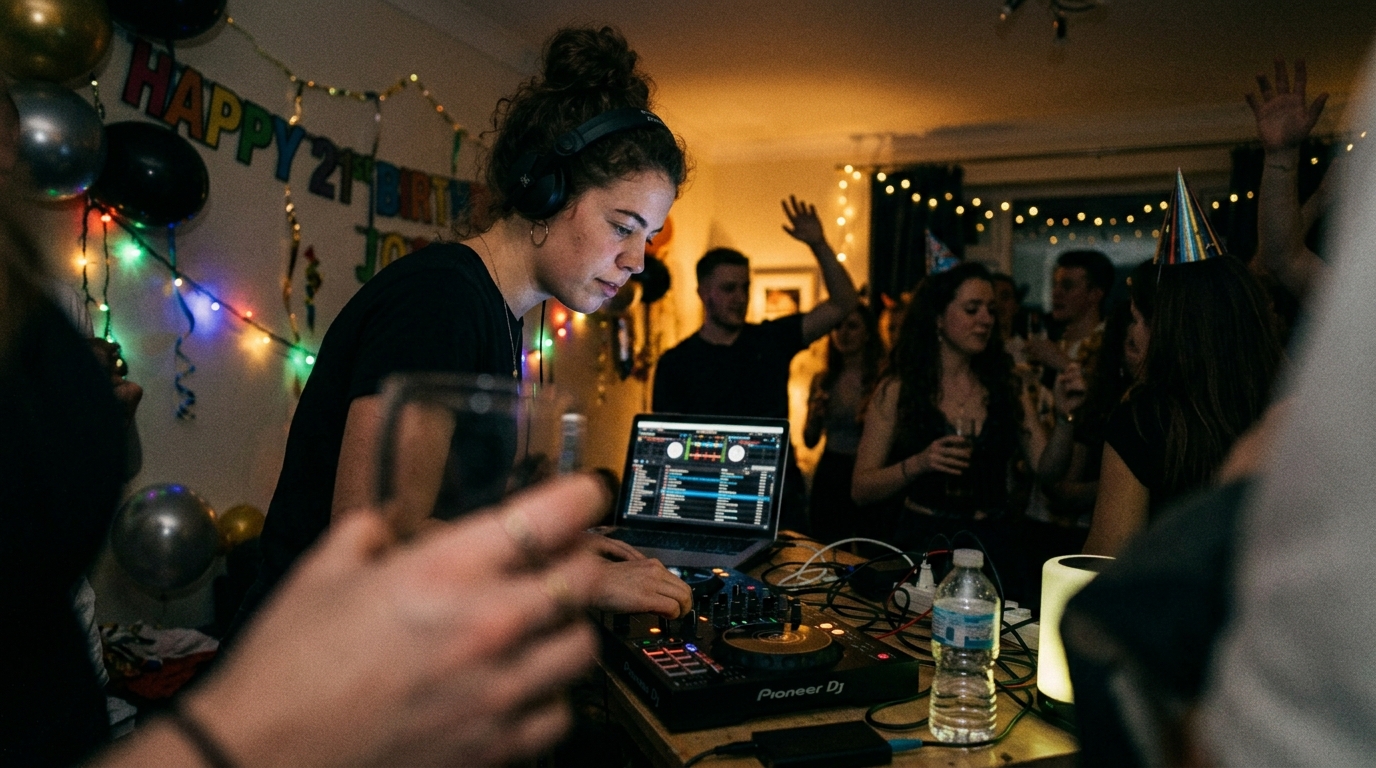
A great birthday DJ set rarely feels “performed at” the crowd. It feels like the night is unfolding naturally—one track leading to the next, energy rising and falling in the right places, different generations all getting their moments. That doesn’t happen by accident. It happens because experienced DJs are constantly reading the room, making micro-decisions every few minutes, and steering the vibe without anyone noticing the steering wheel.
So what does “reading the room” actually mean at a birthday event—and how can you set your DJ up for success?
The Birthday Crowd Is Different (and That’s the Point)
Birthday events are often more complex than club nights or weddings. The guest list can include:
- school friends who want throwbacks,
- work colleagues who prefer background-friendly hits early on,
- family members spanning decades of musical taste,
- and a guest of honour whose preferences matter most—until they don’t, because the dancefloor is telling another story.
A DJ isn’t just selecting songs people like. They’re managing a mixed social environment where comfort, nostalgia, alcohol timing, and group dynamics all influence what will land.
Before the First Track: The DJ Is Already Reading
The “brief” is useful—but the subtext matters more
Most DJs will ask for a few basics: age range, favourite genres, any do-not-play tracks, key moments (cake, speeches, surprise entrances). But the best insights are often indirect:
- Is this a “big dancefloor” birthday or a chatty cocktail-style gathering that may peak later?
- Are there strong friend groups that will move as a unit?
- Is the guest of honour a confident centre-of-attention type, or do they need a gentle ramp-up?
A skilled DJ listens for those cues because they dictate pacing. A high-energy opener at 7:30 can be perfect for a 21st… and completely wrong for a 50th where guests are still arriving, hugging, and finding their drinks.
Arrival-time observation is real-time research
The first 20–30 minutes are reconnaissance. DJs watch:
- How people greet each other (big loud reunions vs. reserved catch-ups)
- Where guests cluster (bar area, tables, near the dancefloor)
- Who’s “leading” (one confident group can set the tone)
- Body language (tapping feet, head nods, phones out filming—these are signals)
This helps them choose a first “anchor” style: something accessible that won’t scare people off the floor, but also won’t drain momentum.
Setting Up for Success: Matching DJ Style to Party Style
A lot of “reading the room” starts with choosing a DJ whose default instincts fit your crowd. Some DJs naturally lean toward open-format and crowd-pleasers; others are excellent at niche genres, deep cuts, or club-style mixing. If you’re comparing options, it helps to look at examples of the kinds of birthday parties they typically play and the musical lanes they’re comfortable switching between. If you want a quick way to understand what’s available in that space, you can see party DJs for birthday celebrations and get a feel for different styles and setups—then brief your DJ accordingly.
That alignment matters because the best “on-the-fly” decisions come from a DJ who already speaks your crowd’s language.
The Dancefloor Is a Feedback Loop, Not a Yes/No Vote
DJs don’t watch the loudest people—they watch the “middle”
It’s easy to be fooled by a few enthusiastic dancers. A DJ who reads the room well tracks the middle of the room—the people who might dance if given the right nudge. When that group starts moving, you’re not just entertaining the committed dancers; you’re converting the hesitant ones, and the floor grows.
They test ideas in small doses
Think of the next few songs as controlled experiments. DJs will often:
- drop a familiar chorus to see if hands go up,
- try a slightly different tempo for one track,
- or pivot eras (00s → 90s) to gauge which nostalgia hits harder.
They’re watching how quickly people return after a track ends, whether couples start moving, and whether groups form circles (a sign of confidence) or drift back to tables (a sign the energy isn’t sticking).
Tempo, Energy, and “The Moment” (Not Just the Playlist)
BPM is a tool, not a rule
At birthdays, the goal isn’t maximum BPM—it’s maximum participation. Many successful sets build energy in waves:
- warm, sing-along-friendly tracks early (people can dance without feeling judged),
- a stronger run once the room is settled,
- a short breather for drinks and chats,
- then a second peak later.
A DJ might hold back the biggest “anthem” because playing it too early can create a false peak. Once you’ve hit the night’s biggest singalong, it’s harder to raise the ceiling again.
Micro-timing matters: cake, speeches, surprise guests
The best DJs treat key moments like scene changes. If cake is coming out, they may shift to something bright and familiar, keep volume comfortable for photos, then rebuild after. If there’s a surprise performance or a video montage, they’ll avoid dropping a floor-filler right before it—because stopping a packed dancefloor can feel like slamming the brakes.
Handling Requests Without Losing Control
Requests are data. They reveal what people wish the party was, which isn’t always what the party needs right now.
A strong DJ will mentally sort requests into three buckets:
- Immediate plays (fits the current vibe perfectly)
- Later plays (good song, wrong moment)
- Polite declines (will clear the floor or clash with the host’s boundaries)
And they’ll often “blend” the request into the narrative—using a track that bridges from the current style into the requested one, so the shift feels intentional, not jarring.
Room Layout, Sound, and Lighting: The Invisible Hand
Reading the room isn’t only about music. It’s also about environment.
A dancefloor can be “shy”
If the dance area is in a separate room, poorly lit, or far from the bar, people hesitate. Good DJs adapt with:
- slightly lower initial volume (easier to step in),
- brighter, more familiar tracks early,
- and lighting that makes the dancefloor feel inviting rather than exposed.
Volume is emotional
Too loud early can kill conversation and make older guests leave the room. Too quiet late can flatten the peak. DJs continuously adjust—sometimes by small increments that no one consciously notices, but everyone feels.
Practical Ways to Help Your DJ Read Your Room
If you’re hosting, you can make “reading the room” easier without micromanaging:
- Share three “must-play” songs and three “absolutely not” songs, plus one or two genres you want to avoid.
- Mention the guest groups: “There’ll be a big 90s R&B crew” or “My family loves Motown.”
- Flag any sensitive lines (explicit lyrics, messy breakup songs, anything you don’t want associated with the guest of honour).
- Tell them what a win looks like: nonstop dancing, a balanced mix, or a late-night club feel.
Because when a DJ understands the social goal, the musical decisions get sharper.
The Takeaway: Great DJs Lead by Listening
Reading the room is equal parts observation, psychology, and craft. It’s knowing when to push, when to hold, and when to let the crowd feel like they’re in control—while quietly guiding them to the best version of the night.
And when it’s done well, you don’t remember the transitions or the tactics. You just remember that your birthday party felt like it had a heartbeat—and everybody caught it.