


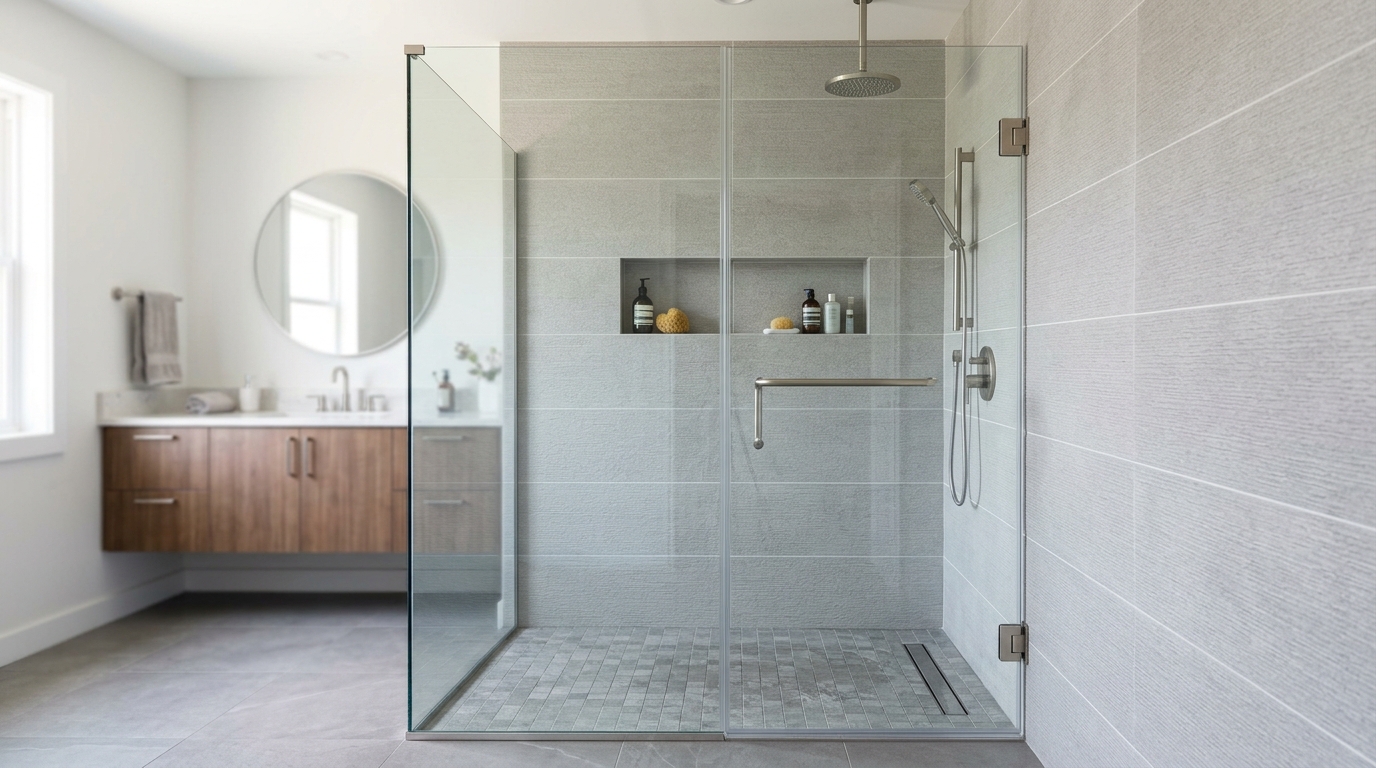
A well-designed bathroom is really a composition: tile sets the backdrop, fixtures provide the focal points, and lighting pulls everything forward. Yet one element can quietly undo all that work—an overly busy shower enclosure. Metal frames, thick tracks, and chunky headers tend to cut up sightlines, creating visual “speed bumps” right where your most expensive materials often live.
Frameless glass, when specified thoughtfully, does the opposite. It reduces visual noise, lets your finishes read as a continuous surface, and makes the shower feel like part of the room rather than a separate box. If you’ve invested in statement tile, premium plumbing, or boutique hardware finishes, this is one of the most effective ways to let them shine.
Why “less enclosure” makes the whole bathroom feel more designed
Clear sightlines let tile do its job
Tile is inherently graphic: grout joints create rhythm, patterns guide the eye, and natural stone has movement that only reads from a distance. Frames interrupt that. A vertical metal stile can bisect a feature wall; a top header can visually “cap” tall tile and make ceilings feel lower. Frameless glass keeps the geometry you planned intact—especially important with:
- full-height tile installations
- bookmatched stone slabs
- continuous large-format tile with minimal grout lines
- patterned encaustic or mosaic accent walls
In design terms, frameless enclosures protect the “visual field.” Your eye can travel across surfaces without getting snagged on hardware.
Light behaves better with frameless glass
Bathrooms live and die by light—natural, ambient, and task. Thick framing casts shadows and creates reflective clutter. Frameless glass allows light to bounce deeper into the shower and across adjacent walls, which can make a bathroom feel brighter even without changing the fixtures.
If you’ve chosen tile with texture (zellige, fluted ceramic, split-face stone), you’ll notice the difference immediately: raking light becomes a feature instead of something the frame fights against.
The fixtures become the focal point—not the enclosure
Finishes read cleaner and more intentional
Most shower hardware today is treated like jewelry: matte black, brushed nickel, champagne bronze, polished chrome, or mixed finishes. The problem with framed systems is that you’re adding yet another metal finish—often limited to what the enclosure manufacturer offers. That extra finish can feel accidental.
Frameless systems, on the other hand, typically rely on minimal hinges, clamps, and a handle. That means the fixture finish (valves, showerhead, rail, body sprays) can remain the star, and you can often coordinate the small bits of enclosure hardware more precisely.
Your plumbing layout looks more “architectural”
Ever seen a beautifully planned rainhead and handheld setup, then a big aluminum frame slices through it visually? With frameless glass, the plumbing reads as an intentional arrangement on a clean plane. This matters if you’ve done:
- a centered valve and symmetrical controls
- an off-axis layout to avoid studs or niches
- a statement rainhead or ceiling-mounted arm
When the glass is nearly invisible, the composition looks deliberate—more like a spa than a standard builder shower.
Choosing glass and door details that truly highlight your materials
Start with the right configuration
Not every bathroom should have the same door style. A pivot door can feel crisp and substantial; a hinged door can work beautifully in tighter footprints; a fixed panel can create that “wet room” vibe with fewer moving parts.
The key is to choose a layout that complements your tile lines and keeps hardware out of important sightlines. If you’re exploring options, it helps to look at real-world examples of shower doors designed for custom bathrooms to understand how different configurations affect what you actually see—tile, fixtures, and all the details in between.
Don’t overlook glass clarity (it changes everything)
People often assume “clear is clear,” but glass choices subtly affect how tile color and stone movement read.
- Low-iron glass: reduces the green edge tint you’ll see in standard clear glass, especially noticeable with white, cream, or light gray tile.
- Standard clear glass: perfectly fine in many settings, but the edge tint can slightly cool warm palettes.
- Frosted or patterned glass: great for privacy, but it softens tile detail—use it when you want the shower to recede, not when tile is the feature.
If your shower includes a hero surface (handmade tile, marble slab, a dramatic niche), low-iron glass is often the difference between “nice” and “gallery-like.”
Practical design tips that prevent common frameless missteps
Align the enclosure with grout lines and feature edges
A frameless door is basically a crisp, vertical plane. If it lands awkwardly—cutting through a niche, slicing a centerline, or ending just shy of a grout joint—it can look like an afterthought.
Before ordering glass, confirm where the fixed panel ends relative to:
- niches and shelves
- accent bands or mosaics
- the centerline of a valve or rainhead
- outside corners and returns
This is one of those “measure twice” moments where a small adjustment makes the entire wall feel intentional.
Plan for water management early (not after tile is installed)
Frameless doesn’t mean “watertight at any cost.” It means clean detailing, which relies on smart planning:
- A properly pitched shower floor (and curb top, if you have one) is non-negotiable.
- A slightly longer fixed panel can reduce overspray without adding visual bulk.
- Strategic placement of the showerhead—aimed away from the door seam—often solves more than extra seals do.
If you’re going curbless, pay extra attention to floor slope and drain placement. A linear drain at the back wall, for instance, can help keep the “glass line” clean and minimize water migration.
Keep hardware minimal, but not flimsy
Good frameless enclosures feel solid because the glass is thicker and the hardware is engineered for weight and repeated use. That sturdiness matters when you’re trying to create a premium impression. A door that swings smoothly and closes cleanly reinforces the quality of the tilework and fixtures around it.
Here’s a quick checklist worth sharing with your installer (one of the few times a list is actually useful):
- Confirm glass thickness appropriate for the span and door size
- Match hardware finish to your plumbing (or choose a deliberate contrast)
- Ensure blocking is in place behind tile where hinges will mount
- Verify swing clearance so the door doesn’t fight vanities, toilets, or towels
Maintenance and longevity: keeping the “invisible” look
Frameless glass looks best when it stays clear. The good news: maintaining it is more routine than difficult. A quick squeegee after showers and a non-abrasive cleaner go a long way. In hard-water areas, consider protective coatings and make sure ventilation is doing its job—humidity is what turns a bright, refined shower into a dull one over time.
The bigger takeaway is this: frameless glass is not just a styling move. It’s a way of honoring the materials you already paid for—tile patterns, stone veining, carefully chosen fixtures—by removing visual barriers and letting the bathroom read as one cohesive design. If the goal is a space that feels intentional, calm, and quietly high-end, “less enclosure” is often the smartest upgrade you can make.