


There’s a running joke among actors in Los Angeles: the most expensive part of your career isn’t acting classes. It’s the photos you need before anyone will let you into the room.
It’s not entirely a joke. If you’ve been in LA for more than a year, you’ve probably spent somewhere between $400 and $1,200 on headshots. Maybe more. And if you’re honest with yourself, you’ve probably done it more than once, because your look changed, your agent wanted something different, or the last batch just didn’t land the way you hoped.
The headshot economy in Los Angeles is a business unto itself. And for the actors funding it, the math has never quite added up.
What Headshots Actually Cost in LA (The Full Picture)
Most actors know the sticker price. A decent headshot photographer in Los Angeles charges between $300 and $800 for a standard session. That typically includes 2 to 3 looks, an hour or two of shooting, and a set number of retouched finals (usually 2 to 4 images).
But that’s not the real cost. Here’s what most people miss.
Hair and makeup: Unless you’re doing your own (and most casting directors can tell when you did), budget $150 to $300 for a professional makeup artist. Some photographers include this. Many don’t.
Wardrobe: You probably already own what you need, but if your agent wants a specific look, a quick shopping trip can add $50 to $200. Not a huge expense, but it adds up across multiple sessions.
Retouching upgrades: The base package might include light retouching, but if you want additional edited images beyond the initial set, expect $25 to $75 per photo.
Reprints and digital formatting: Some photographers still charge for specific file formats, higher resolution exports, or prints for physical submissions. This is becoming less common, but it hasn’t disappeared entirely.
Time: A headshot session, including travel, parking (in LA, never free), the actual shoot, and a potential change of location, eats 3 to 5 hours of your day. If you’re missing a shift or turning down a booking to do this, that’s income lost.
Add it all up and a single headshot session in Los Angeles realistically costs $500 to $1,200 when you factor in everything. For an actor who needs to update shots annually (or more often), that’s a significant recurring expense in a career that already runs on financial uncertainty.

The Uncomfortable Question Nobody Asks Their Photographer
Here’s the thing nobody mentions in the headshot conversation: a large percentage of actor headshots don’t actually accomplish what they’re supposed to.
The purpose of a headshot is simple. It should make a casting director want to see you in the room. It should look like you on your best day. And it should feel current, not like a glamour shot from three years and a different haircut ago.
But the traditional headshot process has a structural problem. You’re asked to look natural and relaxed in what is, by definition, an unnatural and pressured situation. You’re performing “being yourself” while a photographer you met 20 minutes ago directs you through expressions. The lighting is great. The backdrop is professional. But the energy? It’s often forced.
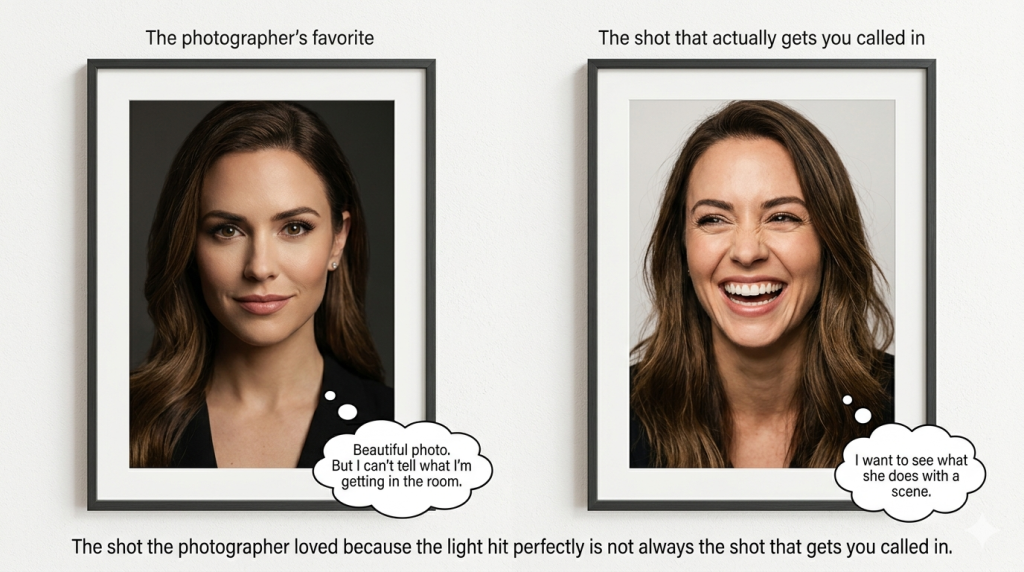
I’ve talked to casting directors who say they can spot a “photographer’s favorite” versus an actor’s authentic energy instantly. The shot the photographer loved because the light hit perfectly isn’t always the shot that gets you called in. There’s a disconnect between what looks technically impressive in a portfolio and what reads as genuine in a casting inbox.
This doesn’t mean all headshot photographers are doing it wrong. Many are exceptional at putting actors at ease and capturing something real. But the format itself introduces friction that works against authenticity. And you’re paying premium prices for that friction.
What’s Actually Changing (And What Isn’t)
The conversation around AI-generated headshots has been building for the past two years, and actors have strong opinions on both sides. That’s fair. This is a career where your face is your instrument, and anything that touches your professional image deserves scrutiny.
But the technology has moved faster than most people’s assumptions about it.
Current AI headshot generator tools don’t paste your face onto someone else’s body or create a fictional version of you. The better ones analyze multiple reference photos of your actual face, learn your specific features, and generate portraits with professional lighting, backgrounds, and composition. The output looks like you walked into a well-lit studio on a day when everything clicked.
For actors specifically, tools built for performer and actor portrait generation can produce a range of looks, from theatrical to commercial to casual, without requiring a single appointment, a makeup artist, or a parking garage in West Hollywood.
Is this where it gets interesting? For a lot of working actors, yes.
The appeal isn’t just about saving money (though saving $400 to $900 per session certainly matters when you’re between bookings). It’s about speed and volume. An actor who needs to update their look for a new role type, test different styling approaches, or simply refresh outdated shots can generate options in hours rather than weeks. The barrier to keeping your materials current drops dramatically.

The Objections Worth Taking Seriously
I want to be honest about the pushback, because some of it is valid.
“Casting directors will know it’s AI.” This was true eighteen months ago. With the current generation of quality tools, it’s increasingly difficult to distinguish AI-generated portraits from traditional photography. That said, not all tools are equal. Cheap or poorly built generators still produce that plastic, uncanny look. If you’re evaluating your options, spending time comparing the stronger tools available matters more than just picking the first one you find.
“My agent won’t accept AI headshots.” Some agents are indeed skeptical, and that’s worth a direct conversation. But an increasing number of agents care about one thing: does the photo get you seen? If it looks professional, accurate, and current, the method of production is becoming less relevant.
“It feels like cheating.” This is the emotional objection, and I understand it. Acting is a craft, and there’s something meaningful about the ritual of a headshot session. But consider this: the goal of a headshot isn’t to prove you can sit for a photographer. It’s to open doors. If a $30 AI-generated image gets you the same audition as a $600 studio session, the question isn’t whether it’s “real enough.” The question is whether you’d rather spend that $570 on acting classes, self-tapes, or rent.
A Practical Framework for LA Actors
If you’re an actor in Los Angeles weighing your options, here’s a realistic way to think about it.
For your primary theatrical headshot: If you can afford a great photographer and you have one you trust, there’s still real value in that relationship. A photographer who knows your type, understands your casting range, and can direct you effectively is worth the investment.
For everything else: Commercial looks, updated shots between major sessions, testing new styling, or simply having backup options ready when your agent calls with a last-minute submission? This is where AI tools earn their keep. The cost is low enough to experiment freely, and the turnaround is fast enough to stay current without scheduling your life around a photo shoot.
For actors on a tight budget: If the choice is between a $700 photographer session you can’t really afford and updating your headshots at all, the math is clear. A strong AI-generated headshot that accurately represents you today is infinitely better than a beautiful studio shot from two years ago that doesn’t look like you anymore.

What This Really Comes Down To
The headshot economy in Los Angeles has operated on scarcity for decades. Limited photographer availability, high session costs, and slow turnaround times created a system where actors paid premium prices because there was no alternative.
Now there is.
That doesn’t mean traditional photography is dead. It means the monopoly is over. Actors have more options, lower costs, and faster turnaround than at any point in the history of the industry. The ones who benefit most will be the ones who stop treating headshots as a ritual and start treating them as a tool: something that should be updated often, tested regularly, and never allowed to hold your career hostage because you can’t afford the session.
Your face is your business. How much you pay to photograph it should be your choice.