


Every generation eventually stops running from its parents’ taste and starts raiding it. But what’s happening with the 1970s feels different, less like a nostalgia cycle and more like a slow-moving cultural reckoning. Across music, visual art, fashion, and interior design, a decade once dismissed as a cautionary tale of excess and bad upholstery has become the dominant reference point for some of the most serious creative work being made right now.
The shift is structural, not sentimental, and the latest releases from the major furniture brands make it clearly legible. A Henge bed with a burnished metal headboard, the bulky shapes of a Poltrona Frau chair, Poliform’s room-divider bed conceived to float at the center of the space rather than pushed flush against a wall, Ligne Roset reissuing its entire seventies archive: these are not isolated choices from isolated companies. Read together, they point insistently in the same direction.
The Acknowledgment That Took Forty Years: Music’s ’70s Reckoning
The sonic vocabulary of the decade spent years circulating as borrowing before it became citation. When Bruno Mars and Anderson .Paak released an album openly described as a love letter to seventies soul, complete with Bootsy Collins serving as its narrator, the reference stopped being subtext. Streaming didn’t kill that lineage; if anything it surfaced it, because when listeners can access everything simultaneously, recordings built around actual weight and room acoustics tend to outlast the ones optimized for earbuds. That’s not coincidence: it’s physics.
The ’70s Comeback Is Almost Anti-Instagram: Art Against the Scroll
The clearest signal from the visual art world came in November 2023, when Agnes Martin’s Grey Stone II sold at Sotheby’s New York for $18.7 million: more than double its high estimate. Martin spent much of the seventies working from a compound she built herself in New Mexico, producing gridded canvases that required sustained attention to be understood. The fact that work of that nature is now setting records isn’t incidental. Collectors are actively moving toward art that resists easy reproduction and demands physical presence, which is almost a clinical description of the Arte Povera movement that ran parallel to Martin’s practice in Italy during the same decade. Both were arguing, from different continents, that material and process were the content.
Fashion’s Seventies Obsession Feels Smarter This Time
Fashion reached the seventies before interiors because clothes can test cultural weather faster than sofas. Alessandro Michele’s Gucci turned corduroy, louche tailoring, tinted lenses, pussy-bow blouses, and gender ambiguity into a commercial language without making them look like costume. Saint Laurent keeps returning to the long, lean silhouette of the Left Bank; Chloé’s bohemian revival proved that softness can still carry discipline. The point is not flares. The point is permission: brown can be glamorous, volume can be sensual, and a body does not need hard minimalism to look intelligent. That lesson has now moved indoors.
Imperfect Materials and How Interiors Got Interesting Again
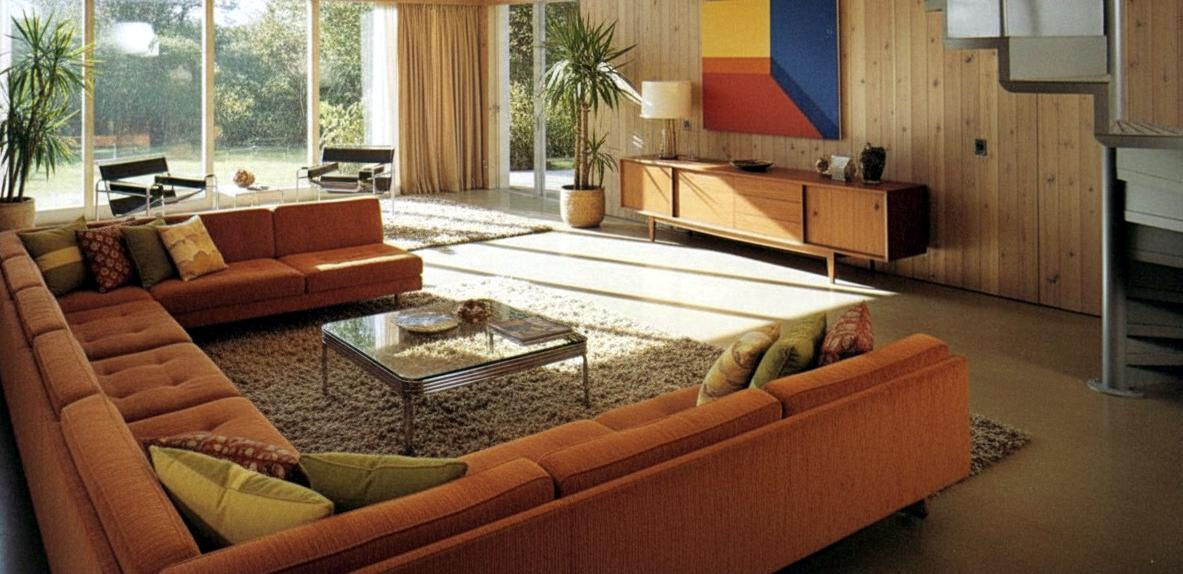
Living spaces are following the same instinct: warmth, depth, generous proportions, and surfaces that show their making. The seventies were not polite about furniture. They gave us conversation pits, low seating, modular sofas, smoky glass, chrome, burl wood, travertine, and rooms arranged around behavior rather than symmetry. Acerbis and Fritz Hansen understood this tension unusually early. After years of staged white interiors optimized for resale photography, that feels almost subversive. Travertine is the obvious emblem, because its pores and variations make uniformity impossible. But the stronger argument belongs to patina. Burnished metal, veined stone, thick leather, velvet, lacquer, and imperfect wood register use and light differently over time.
The ’70s Never Needed to Be Retro
The seventies never produced one exportable style the way mid-century modernism did. What it produced was a disposition: a belief that objects should carry physical authority, that rooms should feel inhabited rather than presented, and that materials were allowed to be themselves. That disposition went underground for decades and is now surfacing everywhere, in the bass frequencies of contemporary R&B, in the auction records of minimalist grid painters, and in the stones being pulled from Tuscan quarries for dining tables in Miami and London. The decade made its argument fifty years ago. It’s only now being fully answered.